How the Ringtone Went From Cultural Obsession to Universal Social Taboo in Twenty Years
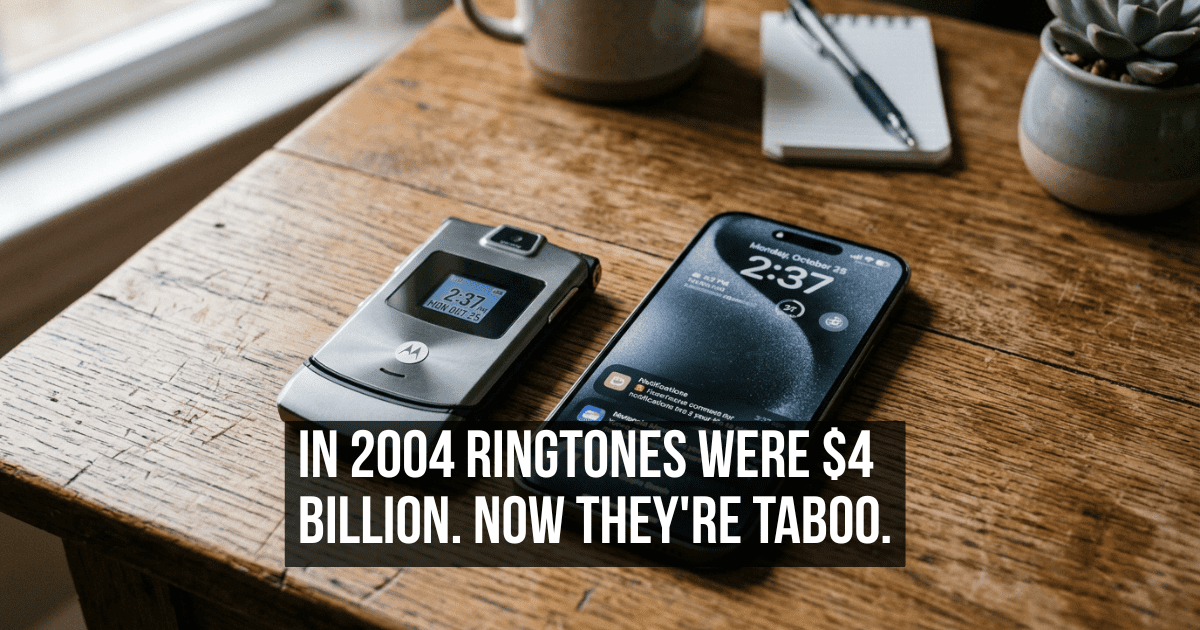
In 2004, the global ringtone market was worth approximately $4 billion. That figure exceeded the entire market for digital music downloads in the same year. People paid up to $5 to make their phone play the opening bars of a song when called, and an entire generation chose ringtones with the deliberateness of a wardrobe decision — the Crazy Frog’s “Axel F” sold an estimated 12 million copies as a ringtone globally in 2005, making it one of the best-selling singles in European chart history.
Twenty years later, almost everyone keeps their phone on silent in public. The ringtone still exists as a feature. Audible ringing in most social or professional contexts now reads as a minor social infraction — the acoustic equivalent of failing to hold a door. The cultural distance between those two moments is instructive.
What the Ringtone Was
The ringtone era of the early 2000s is often remembered as a peculiar commercial fad. It was also a genuine form of sonic self-expression in an environment with very few alternatives. Mobile phones of the early 2000s offered limited personalization — a choice of case, perhaps a screen background, and the ringtone. In an era before apps, before social media profiles, before smartphone cameras had made visual self-presentation a daily activity, the sound your phone made when someone called you was one of the more legible public statements about who you were. People took the choice seriously because the stakes of self-presentation, in a world with fewer channels, were concentrated where the channels existed.
The ringtone industry understood this and organized its business model accordingly — including, infamously, a system of subscription traps that charged users weekly fees for ringtone access they had not clearly agreed to and often did not realize they were paying for. The financial exploitation was real. So was the genuine cultural engagement.
The Mechanism of Reversal
The shift to silence happened through the same mechanism by which most social norms change: not through collective decision but through the gradual accumulation of individual behavior until the baseline expectation shifted.
Smartphones reorganized the relationship between users and their phones. By the early 2010s, the phone was no longer primarily a device you received calls on — it was a device you managed continuously, checking messages, email, social feeds, and notifications throughout the day. The call became the exception rather than the norm. The ringtone, designed to announce an incoming call, became an interruption of ambient concentration rather than a useful signal — both for the person being called and for everyone within earshot.
Once enough people moved to vibrate or silent, the audible ringtone began to stand out. Once it stood out, it became conspicuous. Once it was conspicuous, it became socially pressured — the sound of someone who hadn’t yet updated their default settings, or who didn’t notice, or who simply didn’t care about the disruption they were causing. None of these associations were flattering. The norm tipped.
What Disappeared With the Sound
The cultural amnesia around ringtones is almost complete. An entire commercial category that generated billions annually, that produced chart-topping hits, that occupied genuine cultural attention, has become nearly invisible in twenty years. The industry that sustained it — the ringtone providers, the operators who ran the subscription services, the artists who licensed their tracks for mobile use — does not exist in its previous form.
More quietly, what disappeared with it was a form of daily sonic personality. The silent phone is functionally identical to every other silent phone. It makes no statement in public. The ringtone was one of the few acoustic personalizations available in everyday life — a brief, involuntary broadcast of taste and identity to the people in proximity at the moment of a call. That broadcast is now suppressed almost universally.
The Speed of the Shift
The ringtone story is worth holding onto as a case study in norm reversal, because the speed of the change is so compressed. In 2004, audible self-expression through your phone was a commercial category worth four billion dollars and a social norm understood as personal expression. In 2024, the same behavior reads, in most contexts, as mildly antisocial. The technology didn’t disappear. The social meaning of using it did. Twenty years is not a long time for a cultural norm to fully invert. It is long enough to make the previous state seem almost unimaginable.



Leave a Reply