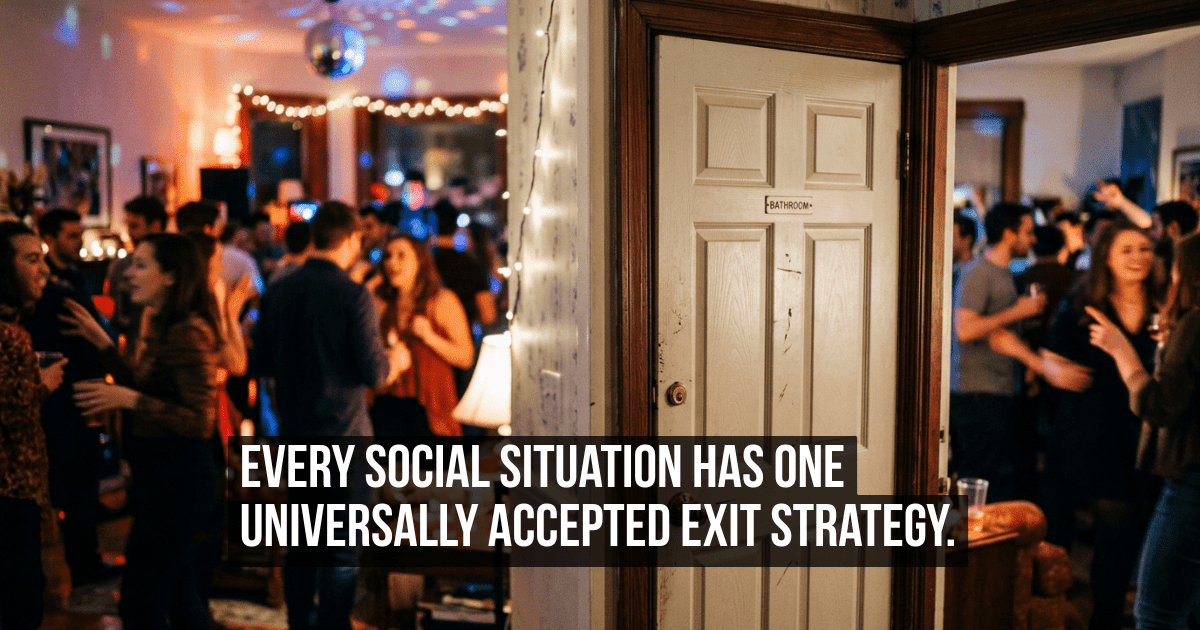
The Bathroom Break Is the Only Socially Acceptable Exit From Any Situation
The meeting has been running for fifty minutes and there is no visible end. Or the family gathering has reached the conversational stretch that requires more of you than you currently have. Or the dinner is going fine but you’ve been performing fine for two hours and you need thirty seconds that don’t require anything from you at all. You excuse yourself. You go to the bathroom. You did not particularly need to go to the bathroom.
Nobody questions it. Nobody ever questions it. That’s the entire architecture.
The Only Exit That Requires No Explanation
Every social situation comes with an implicit contract: you arrived, and now you stay until the situation ends by consensus. Leaving early requires negotiation — an excuse, a reason, a performance of reluctance. Checking your phone requires at least a visible pretext. Stepping outside for air is readable as a mood signal. The bathroom is the single exception: a departure that is universally legible as biological necessity, universally accepted, and universally private.
Nobody follows you. Nobody times you, within reason. Nobody asks what you did in there.
Social psychologists who study what they call “strategic withdrawal” — the deliberate use of exits and pauses to manage social energy — note that the bathroom break is the most efficient tool available to most people in most contexts. It requires no explanation, generates no social debt, and can be deployed across virtually every social situation that exists.
What the Break Is Actually Doing
Research on self-regulation and social performance finds that sustained social engagement depletes specific cognitive and emotional resources. Being “on” — attending, responding, managing your presentation, monitoring the room — is effortful work, even when the people involved are ones you genuinely like. A 2010 study from the University of Michigan found that brief periods of solitude during socially demanding periods reliably restored the capacity for subsequent social engagement.
The bathroom provides guaranteed solitude at zero social cost. Two minutes alone, away from the performance, is often enough to reset the register. You go in depleted; you come out with slightly more than you had. The math is straightforward and the privacy is absolute.
The phone has made this more efficient. The brief scroll — or the three minutes of doing nothing in particular with a lit screen — serves the same function as the parked car: a moment of self-directed time in a context that otherwise belongs to other people.
The Break That Different Events Allow
The social code around bathroom timing varies subtly by context. At a long business meeting, five minutes is unremarkable. At a formal dinner, excusing yourself during the main course requires better timing than between courses. At a wedding reception, a fifteen-minute disappearance raises no questions — weddings are designed for brief departures.
The break’s duration and timing are themselves social signals, read differently depending on the architecture of the occasion. The unspoken expertise people develop around this — not too long, not visibly early, not during a moment of emotional peak — is never taught and rarely named, but it is, in most socially fluent people, genuinely refined.
The Ritual Nobody Names
People who are introverted by disposition, or who find sustained social performance more taxing than others do, tend to develop a more deliberate relationship with the bathroom break. They deploy it with a precision that looks instinctive but is, over time, finely calibrated: not too frequent to be noticed, long enough to actually recover, timed to the lull in the conversation that won’t be missed.
Everyone uses it. Almost no one names what they’re using it for.
The bathroom break is the most democratic social technology available — free, universal, requiring no justification, available in virtually every situation where humans gather. You’ve used it hundreds of times and called it something else. That’s fine. It works either way.
Something went wrong. Please refresh the page and/or try again.
Help us improve your journey
We use cookies to personalize your experience and understand how you use our site. By clicking 'Yes, I'm in!', you help us show you content you'll actually love. If you prefer to keep things simple, you can stick to the essentials. You can change your mind anytime!
Necessary
Always active
The technical storage or access is strictly necessary for the legitimate purpose of enabling the use of a specific service explicitly requested by the subscriber or user, or for the sole purpose of carrying out the transmission of a communication over an electronic communications network.
Preferences
The technical storage or access is necessary for the legitimate purpose of storing preferences that are not requested by the subscriber or user.
Analytics
The technical storage or access that is used exclusively for statistical purposes.The technical storage or access that is used exclusively for anonymous statistical purposes. Without a subpoena, voluntary compliance on the part of your Internet Service Provider, or additional records from a third party, information stored or retrieved for this purpose alone cannot usually be used to identify you.
Advertising
The technical storage or access is required to create user profiles to send advertising, or to track the user on a website or across several websites for similar marketing purposes.




Leave a Reply