Why You Check Your Phone Immediately After Putting It Down Three Seconds Ago
The Loop You Cannot Break
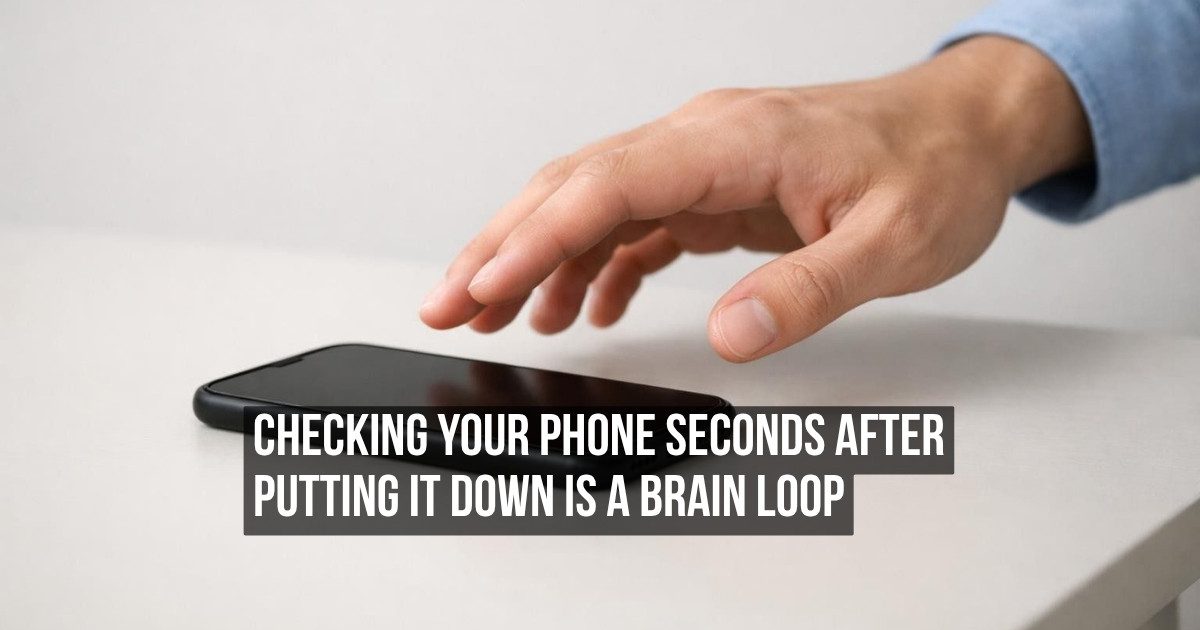
You put your phone down. Screen off. Placed deliberately on the table, face down, as a small act of discipline. Three seconds pass. Maybe five. Your hand is already reaching for it again. You unlock it, stare at the home screen, find nothing new, lock it, put it down. Eight seconds later, you do it again.
You are not expecting anything. No message, no notification, no update of any importance. And yet the hand moves. You watch it happen with the detached horror of someone who has realized they are not entirely in control of their own limbs.
A Habit Without a Trigger
Most habits follow a cue-routine-reward loop, as described by Charles Duhigg and supported by decades of behavioral research. You feel hungry, you eat, you feel satisfied. The phone check breaks this model. There is no cue. No hunger signal, no notification sound, no external prompt. The hand moves because the absence of stimulation has itself become the trigger.
Neuroscientist Adam Gazzaley at the University of California San Francisco calls this “boredom intolerance” — the decreasing ability to sit with an unstimulated mind. Your brain has been trained to expect constant input. The moment input stops — the moment between putting the phone down and picking it up again — your brain registers the void not as rest but as deprivation. The check is not seeking something specific. It is fleeing something nonspecific: the sensation of nothing happening.
The Three-Second Window
The speed is the revealing part. If you waited thirty seconds, you could catch yourself. You could notice the impulse, evaluate it, decide whether to act. But three seconds is below the threshold of conscious intervention. The behavior completes before your prefrontal cortex — the part responsible for deliberate decision-making — has time to weigh in.
This is how habitual motor patterns work. You are not deciding to check your phone. You are executing a motor sequence that has been reinforced thousands of times until it runs automatically, like reaching for the light switch when you enter a dark room. The gesture is post-decisional. By the time you are aware of it, it has already happened.
Research by psychologist Larry Rosen at California State University found that the average person checks their phone approximately 96 times per day — once every ten minutes during waking hours. The overwhelming majority of these checks are initiated without any external prompt. You are not responding to your phone. You are responding to the absence of it.
What You Are Actually Checking For
The screen reveals nothing new. But the act of checking provides something that nothing new cannot: a micro-dose of resolution. The uncertainty of “has anything happened?” is replaced by the certainty of “no, nothing has happened,” and that tiny shift — from unknown to known — produces a faint neurological reward. Your brain does not care that the answer is boring. It cares that the question has been answered.
You are not addicted to content. You are addicted to the act of resolving micro-uncertainty. The phone is simply the fastest, most accessible tool for doing it.
The Ghost in Your Hand
The next time you put your phone down, count. See how many seconds pass before your hand starts moving. The number will tell you something your self-image would rather not hear: the space between you and your device is no longer measured in intention. It is measured in reflexes.
You are not checking your phone. Your phone has trained your hand to check for it.
Something went wrong. Please refresh the page and/or try again.
Help us improve your journey
We use cookies to personalize your experience and understand how you use our site. By clicking 'Yes, I'm in!', you help us show you content you'll actually love. If you prefer to keep things simple, you can stick to the essentials. You can change your mind anytime!
Necessary
Always active
The technical storage or access is strictly necessary for the legitimate purpose of enabling the use of a specific service explicitly requested by the subscriber or user, or for the sole purpose of carrying out the transmission of a communication over an electronic communications network.
Preferences
The technical storage or access is necessary for the legitimate purpose of storing preferences that are not requested by the subscriber or user.
Analytics
The technical storage or access that is used exclusively for statistical purposes.The technical storage or access that is used exclusively for anonymous statistical purposes. Without a subpoena, voluntary compliance on the part of your Internet Service Provider, or additional records from a third party, information stored or retrieved for this purpose alone cannot usually be used to identify you.
Advertising
The technical storage or access is required to create user profiles to send advertising, or to track the user on a website or across several websites for similar marketing purposes.




Leave a Reply