Why Carrying Your Phone in Your Hand All Day Changed Your Posture, Gait, and Peripheral Vision
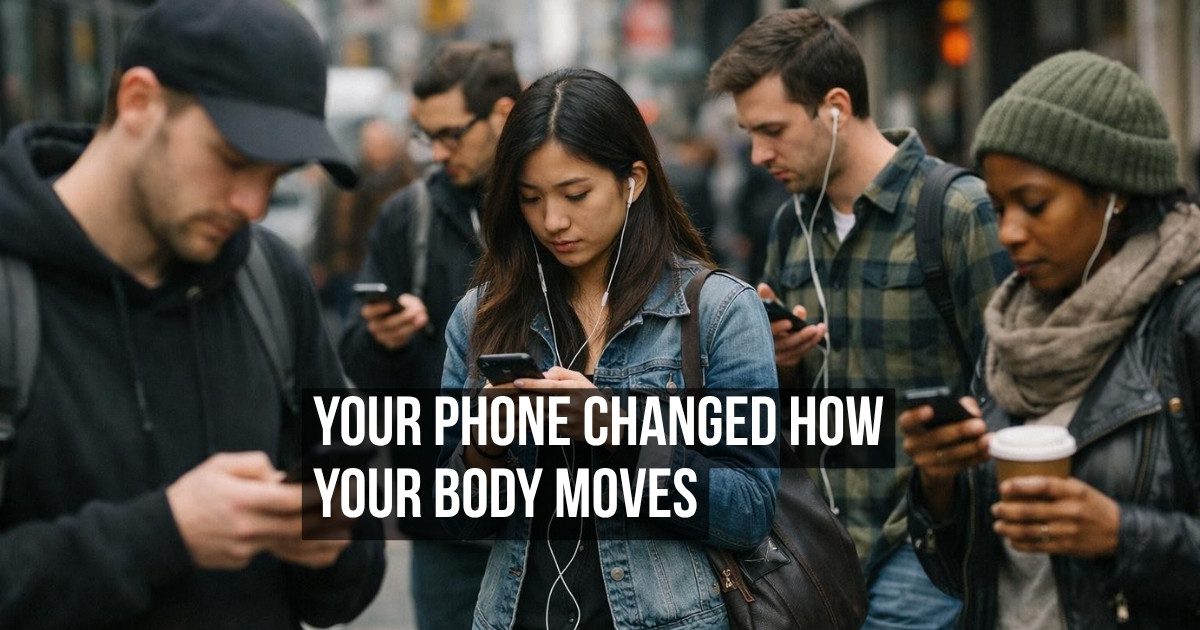
Watch people walk down any busy street and count how many carry a phone in their hand — not raised to the ear, not actively in use, just held. In their palm, at their side, screen facing inward. A 2019 observational study by researchers at the University of British Columbia counted pedestrian behaviour at urban intersections and found that approximately 40 percent of walkers carried a phone in hand at any given moment, with less than half of those actively looking at the screen. The phone wasn’t being used. It was being held. And that holding — sustained, habitual, asymmetric — has consequences that extend from the wrist to the spine to the visual field.
The Grip That Reshapes the Hand
A modern smartphone weighs between 170 and 240 grams. Holding it in a pincer grip — fingers curled underneath, thumb resting on the screen or side — requires sustained low-level activation of the flexor muscles in the forearm and the intrinsic muscles of the hand. The load is trivial for a few minutes. Over hours of daily carry, it produces chronic low-grade tension that physiotherapists now recognise as a distinct pattern of musculoskeletal strain.
Occupational therapists at the Hospital for Special Surgery in New York have documented an increase in patients presenting with De Quervain’s tenosynovitis — inflammation of the tendons on the thumb side of the wrist — correlated with smartphone holding and scrolling. The condition, historically associated with repetitive industrial tasks, has acquired the informal name “texting thumb,” though the holding posture, not texting itself, is increasingly implicated as the primary mechanical stressor.
Asymmetric Loading and Postural Drift
When you carry an object in one hand, your body compensates. The shoulder on the loaded side drops slightly. The opposite shoulder elevates to maintain head-level balance. The torso rotates fractionally toward the loaded side. These micro-adjustments are invisible to the naked eye but measurable with motion capture technology, and they compound over time.
A 2021 study published in the Journal of Biomechanics used inertial measurement units attached to participants’ torsos and found that carrying a phone in the right hand produced a consistent leftward lateral lean of approximately 1.5 degrees during walking. The lean was too small to notice subjectively but large enough to alter spinal loading patterns over the course of a full walking day. Participants who habitually carried their phone in the same hand reported higher rates of unilateral neck and shoulder discomfort than those who alternated or used pockets.
Gait Disruption
Human walking relies on contralateral arm swing — the right arm swings forward when the left leg steps forward, and vice versa. This counter-rotation stabilises the torso and reduces the metabolic cost of locomotion. Holding a phone in one hand suppresses the arm swing on that side, because the brain prioritises protecting the held object over executing the natural pendular motion.
Research at the University of Delaware measured gait dynamics in participants walking with and without a handheld phone and found that phone-in-hand walking reduced arm swing amplitude by approximately 60 percent on the holding side. The suppressed swing was partially compensated by increased trunk rotation, which increased metabolic cost by a small but measurable margin. In practical terms: walking with a phone in your hand is less efficient, less stable, and slightly more tiring than walking with your hands free, even though the phone weighs less than a large apple.
The Visual Field Contraction
Even when not looking at the phone, carrying it in hand alters visual behaviour. Eye-tracking studies conducted by researchers at the University of Tokyo found that pedestrians holding a phone — even without looking at the screen — displayed a narrower horizontal gaze pattern than those with empty hands. The phone’s presence in the peripheral visual field created a low-level attentional anchor: the eyes periodically flicked toward the hand to confirm the phone’s status, reducing the time available for scanning the wider environment.
When the phone is actively in use — reading a message, checking a map, scrolling a feed — the visual field contracts dramatically. Studies on “smartphone blindness” or “inattentional blindness” have shown that phone-engaged pedestrians fail to notice obstacles, changes in traffic signal status, and even other people directly in their path at rates significantly higher than undistracted walkers. A 2018 experiment at Western Washington University found that 75 percent of phone-engaged pedestrians walking past a unicycling clown failed to notice the clown. The phone doesn’t just redirect gaze. It compresses awareness.
The Phantom Vibration and the Ready State
Why carry the phone in hand at all, if not actively using it? Part of the answer is anticipatory readiness. Holding the phone ensures that any incoming notification can be seen and responded to within seconds. The cost of pocketing the phone is a two-to-three-second retrieval delay — trivial in absolute terms, but psychologically significant for users conditioned by years of immediate-response feedback loops.
A related phenomenon: phantom vibration syndrome. Studies published in Computers in Human Behavior report that between 70 and 90 percent of smartphone users have experienced the sensation of the phone vibrating when it didn’t, particularly when the phone is in a pocket or bag. Holding the phone in hand eliminates this uncertainty — you know instantly whether the buzz was real. The grip is not a neutral carrying decision. It is an anxiety-management behaviour: the hand maintains contact with the phone to maintain contact with the social stream it represents.
The phone in your hand is not being carried. It is being managed — its weight absorbed by your wrist, its asymmetry registered by your spine, its presence narrowing your visual field, its readiness keeping your arm from swinging naturally. No single effect is dramatic. All of them are continuous, daily, and cumulative. You adapted to the phone. Your body adapted around the phone. And neither adaptation was a decision you made. It was a posture you drifted into, one held phone at a time.
Something went wrong. Please refresh the page and/or try again.
Help us improve your journey
We use cookies to personalize your experience and understand how you use our site. By clicking 'Yes, I'm in!', you help us show you content you'll actually love. If you prefer to keep things simple, you can stick to the essentials. You can change your mind anytime!
Necessary
Always active
The technical storage or access is strictly necessary for the legitimate purpose of enabling the use of a specific service explicitly requested by the subscriber or user, or for the sole purpose of carrying out the transmission of a communication over an electronic communications network.
Preferences
The technical storage or access is necessary for the legitimate purpose of storing preferences that are not requested by the subscriber or user.
Analytics
The technical storage or access that is used exclusively for statistical purposes.The technical storage or access that is used exclusively for anonymous statistical purposes. Without a subpoena, voluntary compliance on the part of your Internet Service Provider, or additional records from a third party, information stored or retrieved for this purpose alone cannot usually be used to identify you.
Advertising
The technical storage or access is required to create user profiles to send advertising, or to track the user on a website or across several websites for similar marketing purposes.




Leave a Reply