Why the Clothes That Take the Longest to Choose Are the Ones You Wear the Least
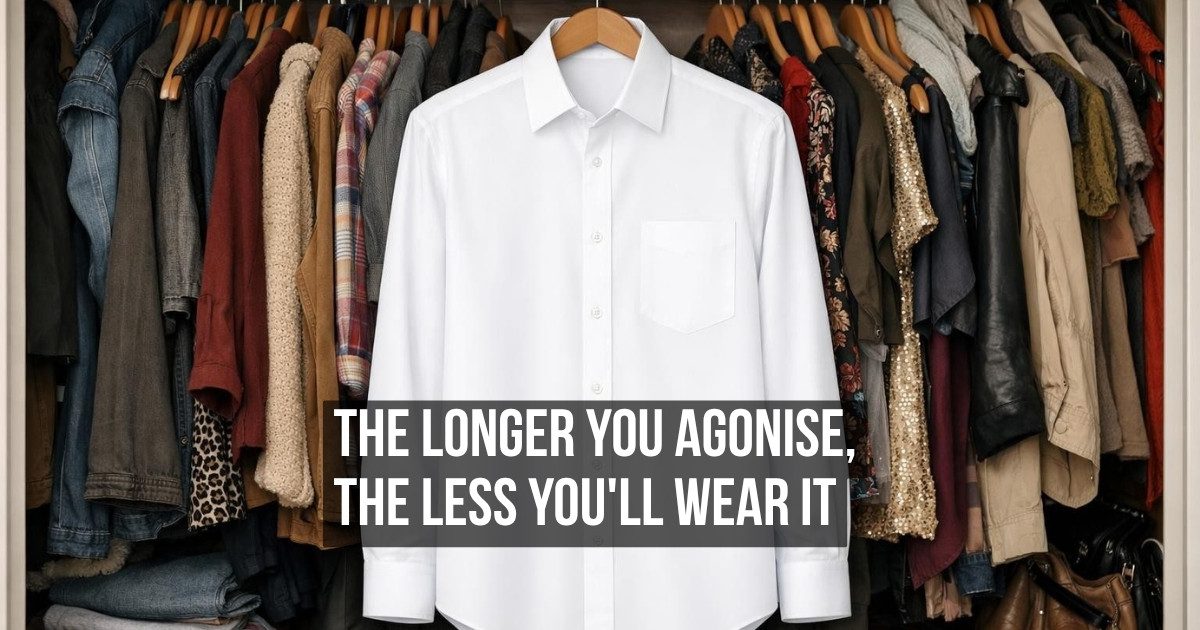
Open your wardrobe. The items you reach for every morning — the worn-in jeans, the reliable dark jumper, the same three T-shirts in rotation — were almost certainly purchased quickly and without anguish. Now look at the pieces hanging untouched at the end of the rail: the statement jacket bought after forty-five minutes of deliberation, the patterned shirt that looked perfect in the shop mirror, the dress tried on in three sizes before a decision was made. These are the items that consumed the most decision-making energy and deliver the least value per wear. The correlation isn’t coincidental. The deliberation itself is a warning signal that the item doesn’t fit your actual life.
The Effort-Value Inversion
In most domains, effort correlates with outcome. More preparation produces better results. More research leads to better purchases. Clothing breaks this pattern because the decision being made is not primarily rational. A clothing purchase involves aesthetic judgment, identity projection, social signalling, body perception, and mood — none of which align consistently with long deliberation. When a garment requires extensive thought, the extended processing time often indicates that the item is triggering competing evaluations that won’t resolve in the changing room.
You love the colour but the fit is slightly off. The fabric is beautiful but the style doesn’t match anything you own. It looks incredible in the mirror but you can’t picture wearing it to any specific place you actually go. Each of these tensions generates deliberation — the mental effort of trying to resolve a mismatch between what you see and what you need. The resolution usually comes not from solving the mismatch but from exhausting the deliberation: you buy the item because you’ve invested too much time and attention to walk away empty-handed.
The Sunk Cost of the Changing Room
Behavioural economists have documented the sunk cost fallacy extensively: the tendency to continue investing in a decision because of the resources already committed, regardless of whether the outcome justifies the investment. In clothing retail, the sunk cost is time, attention, and the social awkwardness of occupying a changing room for twenty minutes and leaving without purchasing.
Retail environments amplify this. A sales assistant who has fetched three sizes creates a social obligation. A partner or friend whose opinion was solicited creates an audience for the decision. The longer the process takes, the more invisible pressure accumulates to justify the time with a purchase. Research by consumer psychologist Sheena Iyengar has shown that decision effort itself increases the perceived value of the chosen option — a cognitive bias called effort justification. The harder you worked to choose it, the more your brain convinces you it was worth choosing. But effort justification is a post-hoc rationalisation, not a quality assessment. The jacket isn’t better because you agonised over it. You just need to believe it is because you did.
The Identity Gap
The clothes that provoke the most deliberation are often the ones that represent an aspirational identity rather than a current one. The bold print that would suit “confident you.” The tailored blazer that would work for “professional you.” The edgy boots that belong to “weekend you.” These versions of yourself are real enough to generate desire but infrequent enough to generate doubt. The deliberation is the doubt, expressed as indecision about hem length and sizing when the actual uncertainty is about who you are.
The items you buy instantly and wear constantly are the ones that align with your default identity — the person you are most days, in most settings, without effort. A plain dark T-shirt doesn’t require identity negotiation. It’s just you. The sequined top requires you to be someone you are for approximately four hours per year, and you know this at the point of purchase even as you hand over the card.
Why the Quick Purchases Work
Fast decisions in clothing are not careless decisions. They are pattern-matched decisions. You’ve worn dark jeans for fifteen years. You know the fit, the fabric weight, the wash tone you prefer, the rise that works with your torso. When you encounter a pair that matches the template, recognition is instant, evaluation is minimal, and confidence is high. The purchase takes thirty seconds because the decision was effectively made years ago and merely executed in the moment.
These habitual purchases produce high cost-per-wear value because they enter immediate rotation. They match existing outfits. They require no special occasion, no mood calibration, no identity performance. They are default garments for the default self, and they accumulate wear because nothing about wearing them requires a decision on any given morning.
The Wardrobe Archaeology
Every wardrobe contains strata of purchasing decisions. The actively worn layer — typically 20 to 30 percent of total items, according to estimates by fashion sustainability researchers — consists predominantly of quick, confident purchases. The dormant layer — clothing worn once or twice and then retired to the back of the rail — is disproportionately populated by agonised-over pieces that never found a context in daily life.
Fashion psychologist Carolyn Mair has described this pattern as “purchase-to-closet failure” — the predictable trajectory of garments bought under conditions of high deliberation and low lifestyle fit. The purchase feels significant in the shop. The first wearing feels slightly effortful. The second wearing doesn’t happen because the first didn’t feel natural enough. The garment migrates from the front of the rail to the back, from the back to the shelf, and eventually from the shelf to the charity bag — still in good condition, barely worn, and carrying the faint psychological residue of money spent and identity not quite achieved.
The paradox sits quietly in every wardrobe: the clothes that cost the most thought produce the least use, and the clothes bought without thinking become the ones you can’t live without. The deliberation isn’t helping you choose better. It’s telling you that the item doesn’t belong in your life — and you’re too deep in the process to listen.
Something went wrong. Please refresh the page and/or try again.
Help us improve your journey
We use cookies to personalize your experience and understand how you use our site. By clicking 'Yes, I'm in!', you help us show you content you'll actually love. If you prefer to keep things simple, you can stick to the essentials. You can change your mind anytime!
Necessary
Always active
The technical storage or access is strictly necessary for the legitimate purpose of enabling the use of a specific service explicitly requested by the subscriber or user, or for the sole purpose of carrying out the transmission of a communication over an electronic communications network.
Preferences
The technical storage or access is necessary for the legitimate purpose of storing preferences that are not requested by the subscriber or user.
Analytics
The technical storage or access that is used exclusively for statistical purposes.The technical storage or access that is used exclusively for anonymous statistical purposes. Without a subpoena, voluntary compliance on the part of your Internet Service Provider, or additional records from a third party, information stored or retrieved for this purpose alone cannot usually be used to identify you.
Advertising
The technical storage or access is required to create user profiles to send advertising, or to track the user on a website or across several websites for similar marketing purposes.




Leave a Reply