The Uncomfortable Truth That Comfortable Office Chairs Can Cause More Back Pain Than Hard Ones
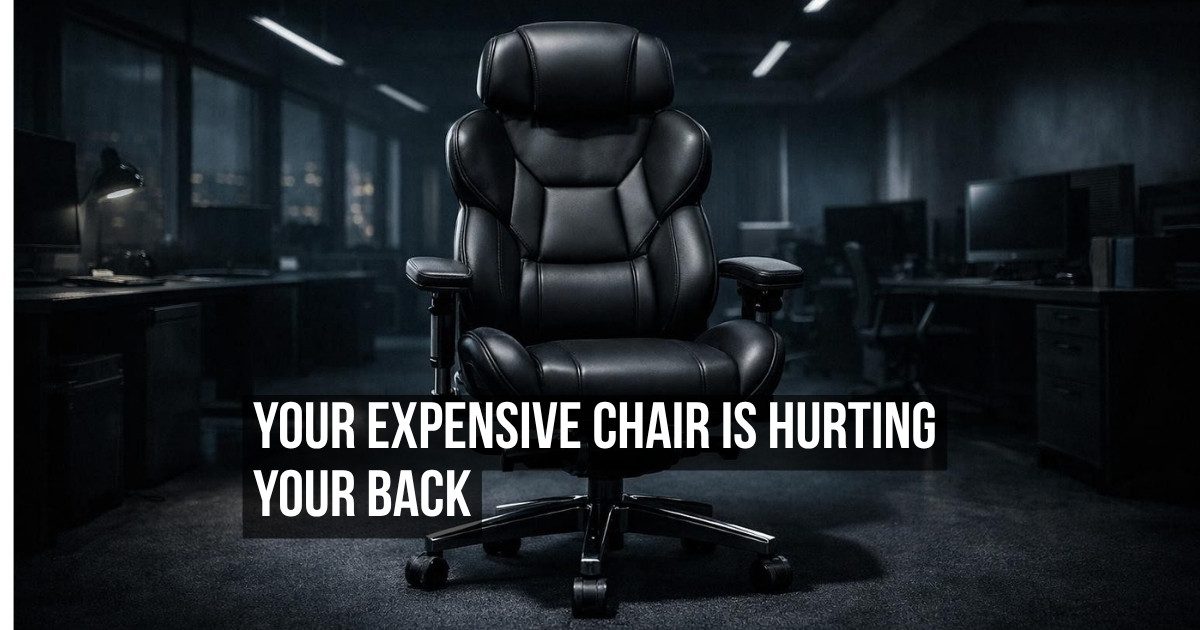
You spend 800 pounds on an ergonomic office chair. Adjustable lumbar support, contoured seat pan, synchro-tilt mechanism, breathable mesh back. You sit down and feel immediately supported, cradled, comfortable. Eighteen months later, your lower back aches more than it did when you were sitting on a wooden kitchen chair during lockdown. The chair is not defective. Your body is responding exactly as physiology predicts it should: extended comfort produces extended stillness, and extended stillness produces pain.
The Stillness Trap
The core promise of an ergonomic chair is that it will support your body in a position that minimises musculoskeletal stress. The promise is partially fulfilled — a well-designed chair does reduce peak loading on the lumbar spine compared to a flat bench. But it simultaneously eliminates the discomfort signals that would prompt you to shift position, stand up, or change your posture. An uncomfortable chair creates a natural movement incentive: your body fidgets, adjusts, and eventually forces you to stand because staying still has become intolerable. A comfortable chair removes that incentive entirely.
Research published in the European Spine Journal found that office workers in high-comfort seating moved significantly less frequently than those in standard seating, with postural changes occurring approximately 40 percent less often. Reduced movement means reduced variation in spinal loading, which means the same intervertebral discs, ligaments, and muscles bear the same compressive forces for longer uninterrupted periods. The chair didn’t cause the pain. The stillness the chair enabled caused the pain.
Intervertebral Discs and the Hydration Cycle
Spinal discs are not rigid spacers. They are pressurised, fluid-filled structures that depend on movement for their own maintenance. When the spine is loaded in a single position, the disc on the compressed side loses fluid, becoming thinner and less resilient. When the load shifts — through standing, bending, or rotating — the decompressed side draws fluid back in, restoring height and elasticity. This hydraulic cycle is essential for disc health, and it only functions with regular positional change.
Sitting in a ergonomic chair that holds your lumbar spine in one supposedly optimal curve for hours at a time suppresses this hydraulic cycle. The disc loses fluid from the compressed regions but doesn’t recover because the loading pattern never changes. Over weeks and months, the chronically dehydrated disc becomes stiffer, less shock-absorbent, and more susceptible to the small injuries that accumulate into chronic lower back pain. The “optimal” position is only optimal if you don’t stay in it.
The Lumber Support Paradox
Adjustable lumbar support is the headline feature of most premium office chairs. The theory: the lumbar spine has a natural inward curve (lordosis), and supporting this curve reduces disc pressure and muscle fatigue. Studies using intradiscal pressure measurements have confirmed that supported lordosis does reduce pressure in the L4-L5 and L5-S1 segments compared to unsupported slumping. So far, so good.
The paradox emerges over time. When an external support maintains your lumbar curve, the muscles that would normally do this work — the multifidus, erector spinae, and transversus abdominis — are progressively unloaded. Muscles that are not loaded do not maintain strength. Physiotherapists describe this as “support-induced deconditioning”: the chair takes over the stabilisation function that your own muscles should perform, and those muscles weaken in response. Remove the chair — stand in a queue, walk on uneven ground, bend to pick up a box — and the weakened stabilisers are unprepared for the demand. The result is vulnerability to the exact injuries the chair was supposed to prevent.
Hard Chairs and Forced Variability
Consider the wooden chair. No padding. No lumbar support. No tilt mechanism. Within ten minutes, your sit bones ache. You shift your weight to the left, then the right. You lean forward, then back. You cross your legs, uncross them, tuck one foot under your thigh. Within thirty minutes, you stand up and walk to the kitchen, not because you chose to but because remaining seated became genuinely uncomfortable.
Each of those involuntary adjustments produced a positional change that varied spinal loading, activated different muscle groups, and pumped fluid through intervertebral discs. The discomfort was the mechanism. The wooden chair didn’t support your body. It agitated your body into movement, and movement is what spines actually need.
This doesn’t mean wooden chairs are medically superior. Prolonged sitting on a hard surface produces its own problems: ischial bursitis, nerve compression, and pressure-point pain that can become chronic. But the forced variability that hard seating produces — the constant micro-repositioning and periodic standing — provides a physiological benefit that comfortable seating systematically eliminates.
The Real Ergonomic Solution Nobody Wants to Hear
The evidence from occupational health research is consistent and unglamorous: no chair is good enough to sit in all day. A systematic review published in Applied Ergonomics analysed 32 studies on seated office work and concluded that the strongest predictor of musculoskeletal complaints was not chair type, desk height, or monitor position. It was total sitting duration without interruption. Workers who broke sitting bouts every 30 minutes had significantly fewer complaints than those who sat for 60 or more continuous minutes, regardless of chair quality.
The optimal strategy is not a better chair. It is less sitting. A 1,200-pound Herman Miller Aeron used for eight uninterrupted hours will produce more discomfort than a 50-pound IKEA stool used for 25-minute intervals between standing breaks. The expensive chair makes long sitting feel possible. The cheap stool makes long sitting feel intolerable. In this specific context, intolerable is healthier.
Your ergonomic chair is not hurting your back. Your relationship with your ergonomic chair is. It made sitting so comfortable that you stopped doing the one thing your spine actually requires: not sitting. The cushion, the support, the adjustability — all of it conspired to remove the signals your body sends when it needs to move. The pain that follows is not a failure of the chair’s engineering. It is the predictable consequence of an engineering solution that was too good at solving the wrong problem.
Something went wrong. Please refresh the page and/or try again.
Help us improve your journey
We use cookies to personalize your experience and understand how you use our site. By clicking 'Yes, I'm in!', you help us show you content you'll actually love. If you prefer to keep things simple, you can stick to the essentials. You can change your mind anytime!
Necessary
Always active
The technical storage or access is strictly necessary for the legitimate purpose of enabling the use of a specific service explicitly requested by the subscriber or user, or for the sole purpose of carrying out the transmission of a communication over an electronic communications network.
Preferences
The technical storage or access is necessary for the legitimate purpose of storing preferences that are not requested by the subscriber or user.
Analytics
The technical storage or access that is used exclusively for statistical purposes.The technical storage or access that is used exclusively for anonymous statistical purposes. Without a subpoena, voluntary compliance on the part of your Internet Service Provider, or additional records from a third party, information stored or retrieved for this purpose alone cannot usually be used to identify you.
Advertising
The technical storage or access is required to create user profiles to send advertising, or to track the user on a website or across several websites for similar marketing purposes.




Leave a Reply