Every Drawer in Your Home Contains at Least One Object You Cannot Explain Keeping
The Drawer Audit
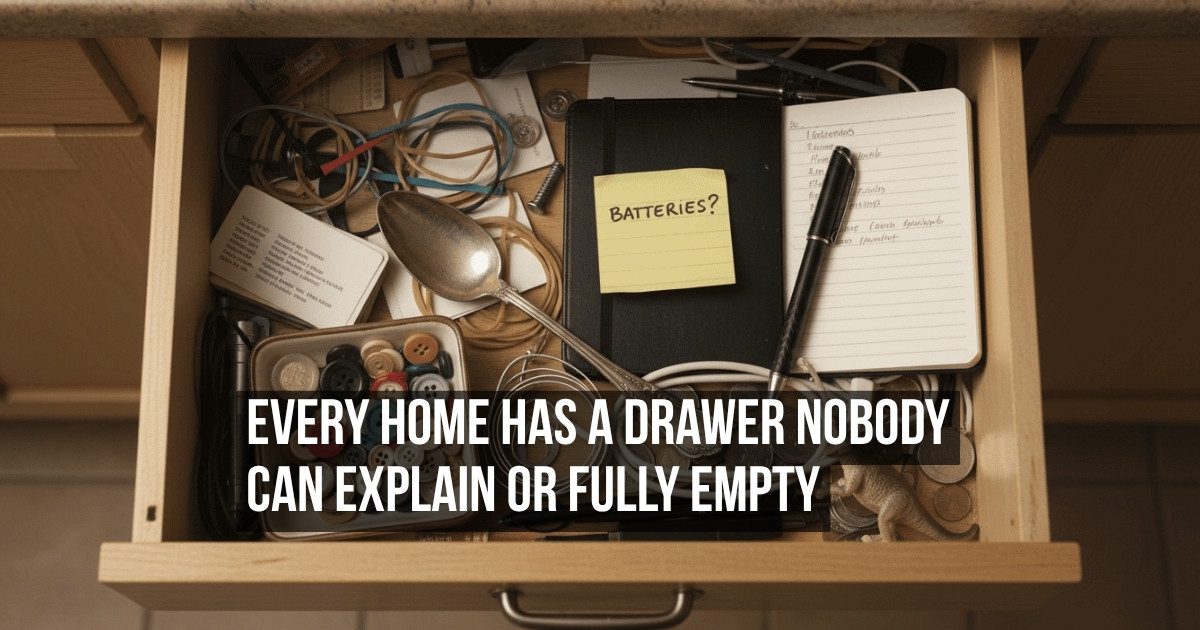
Open the top drawer of your desk. Not the organized one you show guests. The other one. Inside you will find a phone charger for a device you no longer own, a takeaway menu from a restaurant that has closed, two batteries of uncertain charge, a key that fits nothing you can identify, and a pen from a hotel you stayed at in 2019.
You have looked at these objects before. You have considered throwing them away. And every time, something stopped you — not logic, not need, but a resistance so quiet you probably mistook it for laziness.
Why You Keep Things You Cannot Justify
The standard explanation is clutter. Disorganization. The vague intention to “sort it out eventually.” But if that were the full story, the process would be painless. You would open the drawer, identify the useless items, discard them, and move on. The fact that you do not — that something resists — suggests the attachment is not about the object.
Environmental psychologist Toby Israel, who studies how people relate to their physical spaces, describes everyday objects as identity anchors — items that tether you to a specific version of yourself. The hotel pen is not a pen. It is proof that you once traveled to that city, stayed in that room, lived that particular week. Discarding it feels, on some barely conscious level, like discarding the experience.
The dead phone charger is trickier. It serves no function. But it belonged to a phone that was the center of your life for two years — the device that held the conversations, the photographs, the late-night scrolling that constituted an entire chapter of your daily existence. The charger is the last physical trace of that chapter. Throwing it away feels like admitting it is over, even though it has been over for years.
The Inventory of Former Selves
Walk through your home with this lens and every drawer becomes an archaeological site. The running shoes you wore when you used to run. The cookbooks from the year you decided to learn French cuisine. The sketchpad from the month you thought drawing might become a thing. Each object belongs to a version of you that no longer exists but that you are not ready to formally retire.
Keeping these things is not about the possibility of using them again. You know you will not. It is about maintaining the theoretical option — the idea that the person who ran, who cooked, who sketched, could return at any moment if circumstances allowed. The object is a placeholder for an identity you do not want to declare dead.
The Weight of Possibility
A 2017 study by Catherine Roster and colleagues, published in the Journal of Environmental Psychology, found that clutter is not primarily a space problem. It is a decision problem. Each unkept object represents a choice you have deferred — not about the object, but about who you are now versus who you were. Clearing a drawer requires a series of micro-verdicts: this version of me is done, that ambition is officially cancelled, this chapter is closed. Most people would rather leave the drawer shut.
The mystery key is the most honest item in the collection. You have no idea what it opens. You keep it because the alternative — discovering too late that it opened something important — feels worse than the minor burden of storage. It is a bet against regret. Every unexplained object in your home is the same bet, applied at different scales.
Your Drawers Are Writing Your Autobiography
You are not disorganized. You are archiving — badly, inefficiently, without a system, but archiving nonetheless. Every object you cannot explain keeping is a sentence in a story about who you were, who you hoped to become, and who you are quietly choosing not to be.
The drawer is not cluttered. It is a memoir that nobody will ever read, written in hotel pens and dead chargers and keys that open nothing anymore.
Something went wrong. Please refresh the page and/or try again.
Help us improve your journey
We use cookies to personalize your experience and understand how you use our site. By clicking 'Yes, I'm in!', you help us show you content you'll actually love. If you prefer to keep things simple, you can stick to the essentials. You can change your mind anytime!
Necessary
Always active
The technical storage or access is strictly necessary for the legitimate purpose of enabling the use of a specific service explicitly requested by the subscriber or user, or for the sole purpose of carrying out the transmission of a communication over an electronic communications network.
Preferences
The technical storage or access is necessary for the legitimate purpose of storing preferences that are not requested by the subscriber or user.
Analytics
The technical storage or access that is used exclusively for statistical purposes.The technical storage or access that is used exclusively for anonymous statistical purposes. Without a subpoena, voluntary compliance on the part of your Internet Service Provider, or additional records from a third party, information stored or retrieved for this purpose alone cannot usually be used to identify you.
Advertising
The technical storage or access is required to create user profiles to send advertising, or to track the user on a website or across several websites for similar marketing purposes.




Leave a Reply