Nobody Has Fully Explained Why Elevator Silence Feels So Unbearable Even Among People Who Like Each Other
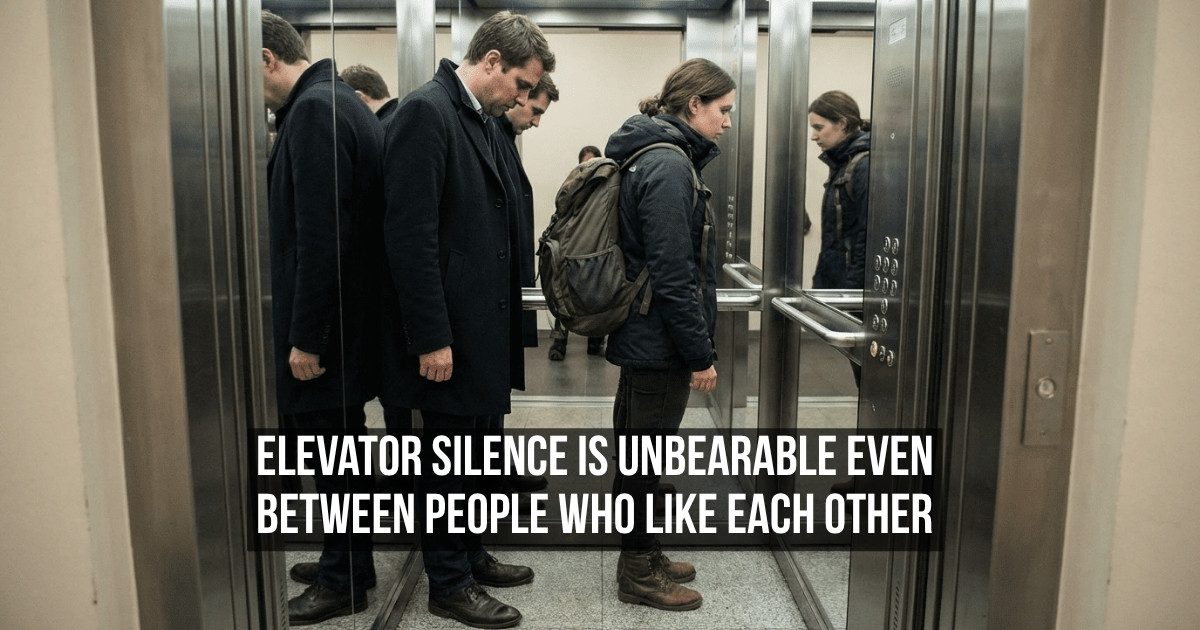
You step into a lift with your neighbour — someone you genuinely like, someone you had a relaxed ten-minute conversation with last Saturday at the letterbox. The doors close. Fourteen seconds of vertical travel stretch ahead of you. And in that sealed metal box, something shifts. The conversation evaporates. Eye contact becomes impossible. You both stare at the floor indicator with the focus of air traffic controllers tracking a descent. What exactly happened between the lobby and the fourth floor?
The Proxemics Problem
Edward T. Hall’s research on personal space in the 1960s established four zones of interpersonal distance: intimate (0–45 cm), personal (45–120 cm), social (120–360 cm), and public (360 cm and beyond). Normal social interaction between acquaintances occurs in the personal or social zone. An elevator compresses multiple people into intimate distance — the range typically reserved for romantic partners, parents and young children, or very close friends.
Being forced into intimate proximity with someone who belongs in your social zone creates a mismatch between spatial signal and relational reality. Your body reads the distance as intimate. Your brain knows the relationship is not. The dissonance produces a low-level alarm response: something about this situation doesn’t match. Silence, gaze aversion, and stillness are the behavioural strategies humans deploy to manage the contradiction — a collective nonverbal agreement to pretend the closeness isn’t happening.
No Exit, No Control
Most social encounters are voluntarily entered and voluntarily exited. You choose to approach someone at a party. You choose when to excuse yourself. Elevators remove both elements of choice. You didn’t choose this proximity, and you can’t leave until the machine decides to release you. The loss of autonomy activates what psychologists call reactance — an instinctive resistance to perceived constraint on freedom.
Reactance doesn’t manifest as anger in an elevator (the ride is too short and the norm violation too mild). Instead, it expresses as withdrawal. People become quieter, more still, more internally focused. Studies of elevator behaviour conducted in high-rise buildings in Tokyo and New York found that passengers consistently reduced their body movement by approximately 40 percent once the doors closed, compared to their movement in the lobby moments before. Conversation volume dropped by roughly half, even among groups who had been speaking animatedly seconds earlier.
The Gaze Problem
Where do you look? In normal social space, gaze alternates between the other person’s face, the middle distance, and the surrounding environment. Elevators collapse the environment to a featureless box. There is no middle distance. The only visual options are the other person’s face — which, at 60 centimetres, constitutes an uncomfortable stare — or a fixed point like the floor indicator, the buttons, or the door.
Researchers at the University of London who tracked eye movement in elevators found that passengers looked at the floor indicator 57 percent of the time, the door 23 percent, and the floor 11 percent. Other passengers received less than 5 percent of total gaze time. The floor indicator has no informational value to a passenger who already pressed their button. Its function is social, not navigational — it provides a legitimate target for eyes that have nowhere else to go.
Why Talking Makes It Worse
Attempting conversation in an elevator often intensifies the discomfort rather than alleviating it. Normal conversation relies on gestural accompaniment — hand movements, postural shifts, approach-and-retreat dynamics. In a crowded elevator, none of these channels are available. Speech without its usual physical scaffolding feels oddly exposed, like singing without accompaniment. The voice sounds louder against the sealed walls. The words feel more conspicuous because everyone else is performing silence.
There’s a social surveillance component too. In a lobby or corridor, a conversation between two people is semi-private — others can hear fragments but aren’t positioned as an audience. In an elevator, every word reaches every occupant with perfect clarity. The conversation becomes a performance, whether you want it to or not. Most people instinctively choose to avoid performing.
Cultural Calibration
The intensity of elevator discomfort varies significantly across cultures, though the basic phenomenon appears universal. In high-density cities like Hong Kong, Shanghai, and Tokyo, where elevator use is frequent and spatial tolerance generally higher, the silence tends to be complete but neutral — an accepted convention rather than an awkward absence. In cultures with stronger social greeting norms — parts of the southern United States, Brazil, parts of West Africa — elevator silence can feel actively rude, creating pressure to speak that conflicts with the spatial pressure to withdraw.
The contrast highlights that elevator silence is not purely a spatial reflex. It involves a negotiation between competing social scripts: the greeting script that says “acknowledge people near you” and the spatial script that says “disengage from people who are too close.” Neither script wins cleanly. The result is the uniquely uncomfortable compromise that elevator rides produce worldwide.
Fourteen Seconds of Negotiation
The average elevator ride in a residential building lasts between 10 and 30 seconds. In that window, occupants navigate forced intimacy, involuntary confinement, gaze management, conversational calculus, and an unspoken social contract that nobody ever articulated but everybody follows. The silence is not emptiness. It is the active, collaborative product of multiple people simultaneously managing a situation that violates normal social geometry — and agreeing, without a word, to pretend it doesn’t.
You don’t stand silently in an elevator because you have nothing to say. You stand silently because everything about the space is telling your nervous system that the normal rules don’t apply here, and the safest response is to wait it out. The ding of arrival isn’t just a floor announcement. It’s a release signal. And the relief you feel when the doors open has nothing to do with reaching your destination.
Something went wrong. Please refresh the page and/or try again.
Help us improve your journey
We use cookies to personalize your experience and understand how you use our site. By clicking 'Yes, I'm in!', you help us show you content you'll actually love. If you prefer to keep things simple, you can stick to the essentials. You can change your mind anytime!
Necessary
Always active
The technical storage or access is strictly necessary for the legitimate purpose of enabling the use of a specific service explicitly requested by the subscriber or user, or for the sole purpose of carrying out the transmission of a communication over an electronic communications network.
Preferences
The technical storage or access is necessary for the legitimate purpose of storing preferences that are not requested by the subscriber or user.
Analytics
The technical storage or access that is used exclusively for statistical purposes.The technical storage or access that is used exclusively for anonymous statistical purposes. Without a subpoena, voluntary compliance on the part of your Internet Service Provider, or additional records from a third party, information stored or retrieved for this purpose alone cannot usually be used to identify you.
Advertising
The technical storage or access is required to create user profiles to send advertising, or to track the user on a website or across several websites for similar marketing purposes.




Leave a Reply