Every Supermarket Aisle Is Deliberately Engineered Against You and None of It Is an Accident
The decision to buy cereal, bread, or a bottle of wine feels personal. It is not. Every element of the environment surrounding that decision has been designed, tested, and optimized by people whose commercial interests are specifically opposed to yours. The same logic that governs how subscriptions are designed to be forgotten operates here too — systems built around your inattention, not your benefit.
The Floor Plan Is Not Neutral
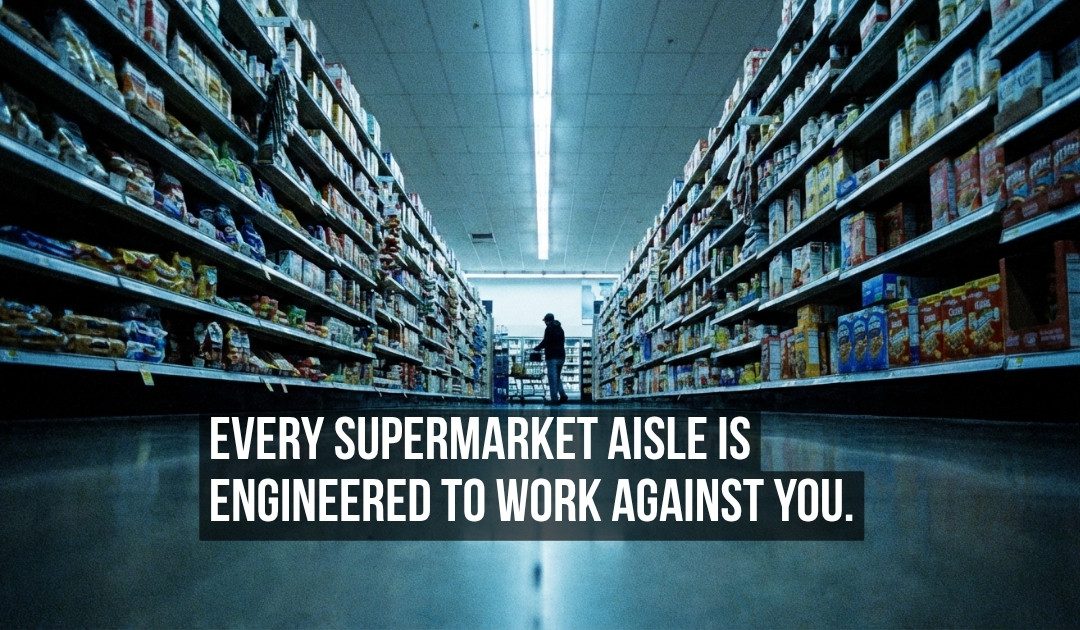
The basic architecture of virtually every large supermarket in the world follows identical logic: high-demand staples — milk, bread, eggs — are placed at the furthest possible points from the entrance. The journey required to reach them passes through as many other product categories as possible. The route is not a convenience. It is a monetization engine.
Product placement is a paid service. A consumer research investigation by Which? in the United Kingdom found that premium shelf space — specifically eye-level positioning and end-of-aisle displays — is purchased by manufacturers, not earned through quality or consumer preference. The item at eye level is there because its manufacturer paid the highest placement fee. The product you assume dominates through market success dominates through retail economics.
Sensory design reinforces the financial architecture. The bakery is positioned near the entrance not because it is the highest-traffic department but because the smell of fresh bread activates appetite and measurably increases total basket spend. Supermarkets use ambient music at specific tempos: a 1982 study by researcher Ronald Miliman established that slower background music increases dwell time and correlates with higher spending. The practice has been standard retail design ever since.
Loss Leaders and the Anchor Effect
Loss leaders — products priced at minimal margin or below cost — are deployed to drive foot traffic and create price anchor effects. A dramatically reduced item at the store entrance shifts the consumer’s perception of value across the entire store. The mid-range wines deeper in the aisles seem reasonable. They are not necessarily reasonable. The anchor moved the reference point. This is structurally identical to how the organic food premium operates — a perception of superior value manufactured before the product is ever evaluated on its merits.
The standard supermarket trolley roughly doubled in size between the 1970s and the 2010s. Research consistently shows that a larger container produces larger purchases — a half-full large trolley activates filling behavior that a full small basket does not. The container size is a nudge device, and it works.
Understanding the engineering does not make the shopper immune to it. Decades of consumer psychology research confirm that awareness of persuasion techniques reduces their effect by only a modest margin. The environment is structurally more powerful than the individual intention to resist it.
The self-checkout, now standard across most large supermarkets, removes the friction of a cashier reviewing items — a friction that consumer behaviour researchers have found creates a moment of evaluative pause occasionally prompting the removal of impulse purchases from a basket. The efficiency of the self-checkout serves the retailer, not the shopper, in ways rarely articulated.
Loyalty card schemes that discount prices in exchange for detailed purchasing data produce a dual benefit for retailers: reduced apparent prices that drive footfall, alongside granular behavioural data that funds targeted advertising and shelf placement optimisation. The card saves you money. It also tells the store everything it needs to improve the next manipulation. The strategy of displacing responsibility for environmental harm onto the consumer — rather than the producer — is documented in how big oil invented the carbon footprint: the same structural pattern of manufactured individual accountability.
Shopping with a list, eating before you go, and using the small basket rather than the trolley are not trivial preferences. They are structural defenses against a structural manipulation — one that has been refined for decades and tested on millions of shoppers who assumed they were making independent choices.
Something went wrong. Please refresh the page and/or try again.
Help us improve your journey
We use cookies to personalize your experience and understand how you use our site. By clicking 'Yes, I'm in!', you help us show you content you'll actually love. If you prefer to keep things simple, you can stick to the essentials. You can change your mind anytime!
Necessary
Always active
The technical storage or access is strictly necessary for the legitimate purpose of enabling the use of a specific service explicitly requested by the subscriber or user, or for the sole purpose of carrying out the transmission of a communication over an electronic communications network.
Preferences
The technical storage or access is necessary for the legitimate purpose of storing preferences that are not requested by the subscriber or user.
Analytics
The technical storage or access that is used exclusively for statistical purposes.The technical storage or access that is used exclusively for anonymous statistical purposes. Without a subpoena, voluntary compliance on the part of your Internet Service Provider, or additional records from a third party, information stored or retrieved for this purpose alone cannot usually be used to identify you.
Advertising
The technical storage or access is required to create user profiles to send advertising, or to track the user on a website or across several websites for similar marketing purposes.




Leave a Reply