The Receipt in Your Wallet Is Coated in a Chemical That Enters Your Bloodstream Through Your Fingertips
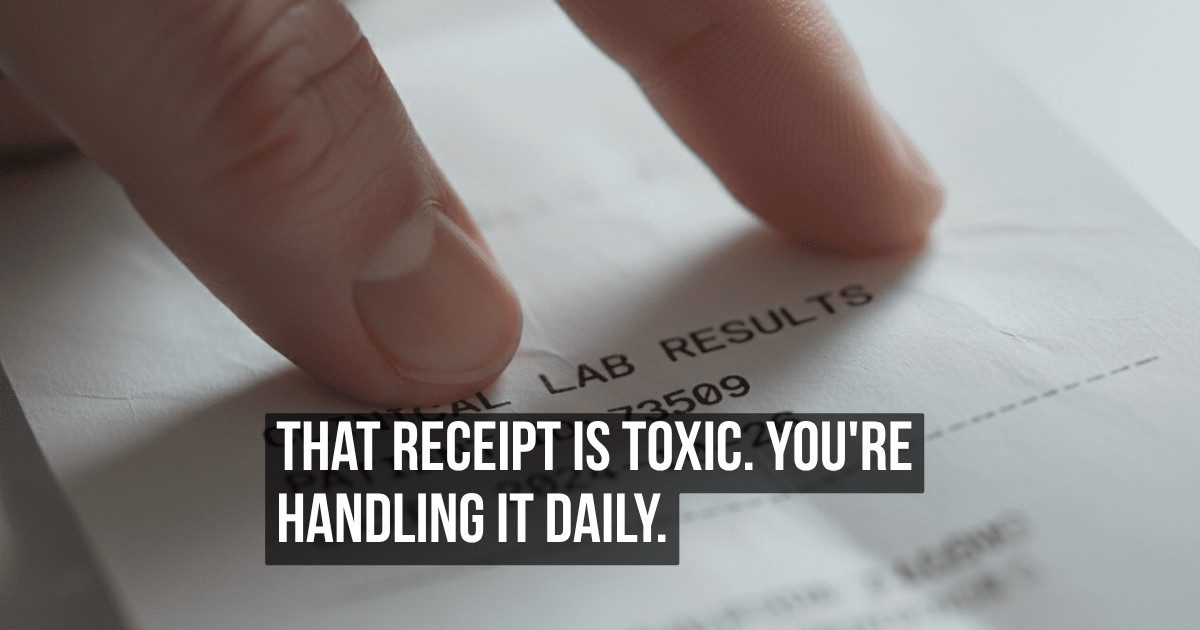
Pick up the nearest thermal paper receipt — the kind dispensed by supermarket tills, ATMs, petrol station pumps, and parking meters. Hold it between your fingers for ten seconds. In that brief contact, a measurable quantity of bisphenol A, or its increasingly common substitute bisphenol S, has crossed the barrier of your skin and entered your bloodstream. The receipt you crumple into your pocket without a thought is one of the most direct chemical exposure pathways in daily life, and almost nobody treats it as one.
How Thermal Paper Works
Thermal printers use heat instead of ink. A heated print head selectively activates a chemical coating on the paper’s surface, producing the text and numbers you see. The coating requires a colour developer — a chemical that reacts to heat by turning dark. For decades, the industry’s preferred developer was bisphenol A, commonly known as BPA. The chemical sits on the paper’s surface in a free, unbound state, which is precisely what makes it effective as a developer and problematic as a health concern. Unlike BPA embedded in a plastic polymer, BPA on receipt paper has no matrix holding it in place. Touch it, and it transfers.
What the Research Shows
A 2014 study published in PLOS ONE by researchers at the University of Missouri demonstrated that handling thermal receipts for just two minutes with dry hands produced detectable BPA transfer. With wet or greasy hands — the condition of most hands after handling food, applying hand sanitiser, or pumping petrol — absorption increased by up to tenfold. Cashiers, who handle dozens or hundreds of receipts per shift, showed significantly higher urinary BPA levels than non-cashier control groups in multiple occupational health studies.
BPA is classified as an endocrine disruptor. At the molecular level, it mimics oestrogen and can bind to oestrogen receptors, potentially interfering with hormonal signalling. The European Food Safety Authority and the US National Institutes of Health have both funded extensive research into BPA’s effects, with studies linking chronic low-level exposure to reproductive abnormalities in animal models, metabolic disruption, and developmental effects. The EU moved in 2024 to ban BPA in thermal paper, with implementation phasing in across member states.
The Substitute That Isn’t Safer
As regulatory pressure mounted against BPA, manufacturers pivoted. The replacement of choice: bisphenol S. Marketed under “BPA-free” labels, BPS has been adopted by the majority of receipt paper producers in North America and Europe. The label reassures consumers. The chemistry should not.
BPS shares a structural backbone with BPA. Both are bisphenol compounds. Both exhibit endocrine-disrupting properties in laboratory studies. A 2017 review published in Environmental Health Perspectives found that BPS demonstrated oestrogenic activity comparable to BPA in several in vitro assays. A 2020 study in the journal Chemosphere reported that BPS persists longer in the human body than BPA, meaning the replacement chemical may actually accumulate to higher levels over time despite similar rates of exposure.
The industry did not solve the problem. It renamed it.
The Occupational Blind Spot
Consider the cashier at your local supermarket. Over an eight-hour shift, they handle between 200 and 500 receipts. Each contact transfers a small quantity of BPA or BPS through the fingertips. Over a working week, the cumulative exposure is substantial. Occupational health studies in France, South Korea, and the United States have all documented elevated bisphenol levels in retail workers compared to office-based controls.
Gloves would reduce exposure dramatically, but most retail employers do not provide them for cashier roles, and most cashiers do not wear them. Hand sanitiser — ubiquitous in retail settings since 2020 — actually worsens the problem. Alcohol-based sanitisers strip the skin’s lipid barrier, increasing permeability, and the residual moisture on the hand surface accelerates BPA transfer from paper. A cashier who sanitises before handling receipts absorbs more chemical than one who doesn’t.
Digital Receipts and the Illusion of Progress
The push toward e-receipts, driven primarily by cost savings and environmental branding, would eliminate the thermal paper exposure pathway entirely. Adoption, however, remains patchy. Major retailers including some Apple Store locations, IKEA, and certain supermarket chains offer digital receipt options. Most small businesses, restaurants, petrol stations, and public transport ticketing systems still rely on thermal paper. In the UK, it’s estimated that 11.2 billion thermal receipts are printed annually.
Even where digital options exist, they are rarely the default. You have to ask. You have to provide an email address. You have to wait while the cashier navigates an unfamiliar screen. The friction is just enough to ensure that most transactions still produce a physical receipt, and most physical receipts still end up in someone’s hand, pocket, or wallet — in continuous low-level contact with skin.
The Paper You Were Never Warned About
Thermal receipts are everywhere. Parking metres, self-checkout machines, bank tills, pharmacy counters, train ticket machines. The average consumer handles multiple receipts per day, usually without thinking about what’s on the surface. Unlike food packaging, which has been subjected to decades of migration testing and regulatory scrutiny, receipt paper occupies a peculiar regulatory position: it’s not food contact material, it’s not a cosmetic, and it’s not a medical device. It falls through the gaps between regulatory categories, touched more often than most regulated surfaces but governed by fewer rules than almost any of them.
The receipt in your wallet is the most chemically active piece of paper you touch on a regular basis. It’s coated in a substance that enters your body through your skin, mimics your hormones, and was replaced with a substitute that does the same thing under a friendlier name. And the only reason you don’t know this is that nobody in the supply chain has any incentive to tell you.
Something went wrong. Please refresh the page and/or try again.
Help us improve your journey
We use cookies to personalize your experience and understand how you use our site. By clicking 'Yes, I'm in!', you help us show you content you'll actually love. If you prefer to keep things simple, you can stick to the essentials. You can change your mind anytime!
Necessary
Always active
The technical storage or access is strictly necessary for the legitimate purpose of enabling the use of a specific service explicitly requested by the subscriber or user, or for the sole purpose of carrying out the transmission of a communication over an electronic communications network.
Preferences
The technical storage or access is necessary for the legitimate purpose of storing preferences that are not requested by the subscriber or user.
Analytics
The technical storage or access that is used exclusively for statistical purposes.The technical storage or access that is used exclusively for anonymous statistical purposes. Without a subpoena, voluntary compliance on the part of your Internet Service Provider, or additional records from a third party, information stored or retrieved for this purpose alone cannot usually be used to identify you.
Advertising
The technical storage or access is required to create user profiles to send advertising, or to track the user on a website or across several websites for similar marketing purposes.




Leave a Reply