The Reason New Clothes Feel Amazing for Exactly One Day and Then Become Invisible
The First Wear
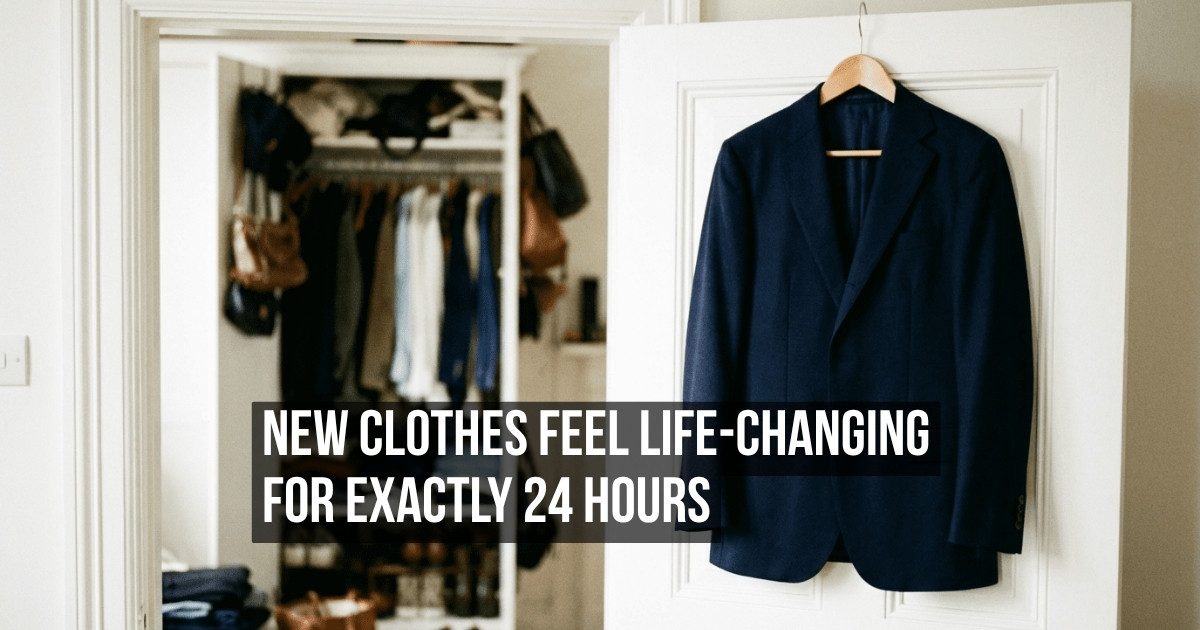
You bring the bag home. You take the jacket out, try it on again in front of the mirror, adjust the collar. It looks exactly as good as it did in the store. Better, even, because now it is yours. You plan what to wear it with. You think about the first occasion. You might even sleep slightly excited about putting it on tomorrow morning.
By Thursday, the jacket is just a jacket. By the following week, you reach past it in the closet without a flicker of recognition. The object has not changed. Your brain simply stopped seeing it.
The Adaptation Machine
Psychologists call this hedonic adaptation, and it is not a flaw. It is a feature — one of the most efficient systems your brain runs. Any stimulus that remains constant gets progressively downgraded in your attention hierarchy. New things get noticed because noticing new things was, for most of human evolution, a survival advantage. A new shape in the grass might be a snake. A new sound at night might be a predator. Your brain evolved to detect change, not to appreciate permanence.
A new jacket triggers that detection system. For approximately 24 to 72 hours, your brain tags it as novel and routes extra attention toward it. You notice the texture against your wrists. You catch your reflection and register the silhouette. You feel slightly different walking into a room. Then the novelty signal fades, and the jacket joins the background — the wallpaper of your wardrobe that your brain no longer bothers to render in high definition.
The Closet Full of Ghosts
Open your wardrobe right now. Every single item in there once gave you the same feeling. The blue shirt. The sneakers. That scarf you found in a market in Barcelona. Each one had a first day — a day when you noticed it, chose it deliberately, felt slightly elevated by wearing it. Now they hang in a row, functionally invisible, waiting to be reached for out of habit rather than desire.
Research by Thomas Gilovich and Amit Kumar at Cornell University, published across multiple studies between 2014 and 2020, consistently found that people derive longer-lasting satisfaction from experiences than from material purchases. Not because objects are inherently less valuable, but because experiences are encoded differently — they become part of your narrative identity, while objects become part of your environment. And your brain is specifically designed to stop paying attention to the environment the moment it becomes predictable.
Why the Store Feels Different
Retail environments are engineered around this principle without ever naming it. The lighting, the mirrors, the careful folding, the deliberate scarcity of sizes on the rack — all of it exists to extend the novelty window long enough for you to pay. The jacket under store lighting, held at arm’s length, examined from three angles in a mirror that flatters by design, is a fundamentally different object from the same jacket hanging in your bedroom next to fourteen other jackets.
The store sells you the first day. It cannot sell you the second.
What You Were Actually Buying
The pleasure of new clothes is not the clothes. It is the novelty — the brief neurological event of encountering something your brain has not yet catalogued and dismissed. That window is real. The feeling is genuine. But it is biologically temporary, and no amount of spending can extend it.
You were never buying a jacket. You were buying a 48-hour feeling that the jacket happened to carry. And the jacket, for its part, will hang in your closet for years — a perfectly functional reminder that your brain was never interested in what you own, only in what just changed.
[…] consciousness and dietary sophistication. By 2020 it had spread to mass-market chains, diluting the signal. Specialty milks — barista oat versus standard oat, macadamia, specific brand preferences — now […]
Something went wrong. Please refresh the page and/or try again.
Help us improve your journey
We use cookies to personalize your experience and understand how you use our site. By clicking 'Yes, I'm in!', you help us show you content you'll actually love. If you prefer to keep things simple, you can stick to the essentials. You can change your mind anytime!
Necessary
Always active
The technical storage or access is strictly necessary for the legitimate purpose of enabling the use of a specific service explicitly requested by the subscriber or user, or for the sole purpose of carrying out the transmission of a communication over an electronic communications network.
Preferences
The technical storage or access is necessary for the legitimate purpose of storing preferences that are not requested by the subscriber or user.
Analytics
The technical storage or access that is used exclusively for statistical purposes.The technical storage or access that is used exclusively for anonymous statistical purposes. Without a subpoena, voluntary compliance on the part of your Internet Service Provider, or additional records from a third party, information stored or retrieved for this purpose alone cannot usually be used to identify you.
Advertising
The technical storage or access is required to create user profiles to send advertising, or to track the user on a website or across several websites for similar marketing purposes.




Leave a Reply