How the Thermostat War in Shared Offices Follows Predictable Game Theory Patterns Nobody Recognises
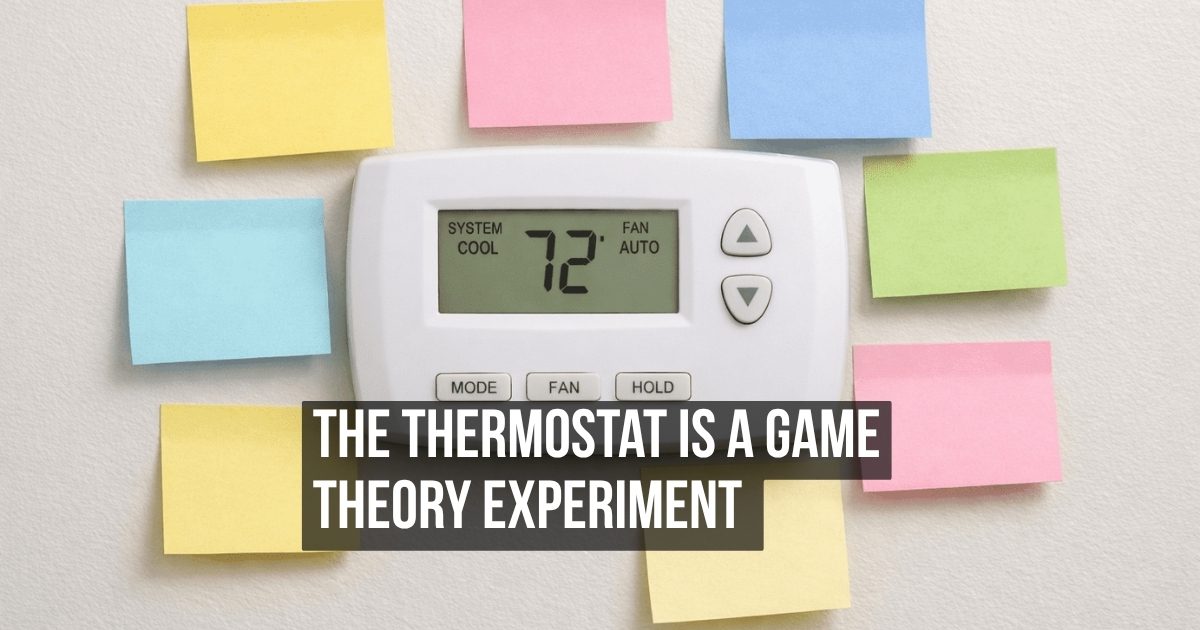
It starts every Monday. Someone adjusts the thermostat to 23 degrees. Within thirty minutes, someone else pushes it down to 20. By lunchtime, it’s back at 22. By 3 p.m., a passive-aggressive email circulates about “comfortable working temperatures.” Nobody wins. Nobody compromises. The thermostat war continues, week after week, in every shared office on the planet — and the pattern follows predictable mathematical structures that the combatants never recognise because they’re too busy being either too hot or too cold.
The Biological Asymmetry
The thermostat war is not a disagreement between unreasonable people. It is a conflict rooted in genuine physiological difference. Thermal comfort depends on metabolic rate, body composition, clothing insulation, and ambient humidity. A 2015 study published in Nature Climate Change found that the standard office temperature model, established in the 1960s, was calibrated to the metabolic rate of a 40-year-old, 70-kilogram male. Women, who on average have lower resting metabolic rates, were found to prefer ambient temperatures approximately 2.5 degrees Celsius higher than their male colleagues.
This isn’t preference. It’s physiology. A lower metabolic rate produces less internal heat, which means the body reaches thermal discomfort at a higher ambient temperature. The woman who keeps adjusting the thermostat up is not being fussy. She is measurably colder, in the same room, wearing comparable clothing, because her body generates less heat per kilogram of body mass. The man who pushes it down is not being inconsiderate. He is measurably warmer, for the inverse reason. Both are responding rationally to their own thermal reality. The problem is that they share a thermostat.
The Game Theory Framework
The thermostat conflict maps precisely onto a class of problems game theorists call “common pool resource dilemmas” — situations where multiple agents share a resource that can only be set to a single state, and each agent’s ideal state differs from the others’. The thermostat is the shared resource. The temperature is the single state. Each occupant has an optimal point, and no single setting satisfies everyone.
In game theory terms, the thermostat war is a repeated game with imperfect information. Each player (office worker) can make a move (adjust the thermostat) but does not know when the next player will counter-move. The Nash equilibrium — the stable outcome where no player benefits from changing strategy — depends on the cost of making a move. If adjusting the thermostat is free (no social penalty, no physical effort), the equilibrium is perpetual oscillation: each player adjusts, the other readjusts, and the temperature cycles endlessly between competing preferences.
This is, in fact, exactly what happens in most offices. The thermostat oscillates around a compromise temperature that nobody chose and nobody is satisfied with, maintained not by agreement but by the exhaustion of the players who eventually stop adjusting because the social friction exceeds the thermal discomfort.
Escalation Dynamics
Thermostat wars escalate through a predictable sequence. Stage one: anonymous adjustment. Someone changes the temperature without announcement. Stage two: detection and counter-adjustment. Another occupant notices and resets it. Stage three: attribution. People begin tracking who adjusts the thermostat and when. Stage four: policy proposals. Emails are sent suggesting fixed temperatures, scheduled changes, or democratic votes. Stage five: institutional intervention. Management locks the thermostat or installs a cover, often set at a temperature that satisfies nobody, which is the bureaucratic equivalent of a ceasefire nobody wanted.
The locked thermostat is a fascinating game-theoretic outcome. It represents an externally imposed solution that eliminates the game by removing agency from all players. Nobody can adjust, so nobody does. The result is a fixed temperature that no individual would have chosen but that the organisation prefers to the alternative: a productive-hours cost generated by the ongoing conflict. Studies on office productivity by the Helsinki University of Technology have estimated that thermal dissatisfaction reduces cognitive task performance by 2 to 4 percent per degree of deviation from an individual’s optimal temperature. For an office of 50 people, the aggregate productivity loss from thermal discomfort is not trivial.
The Personal Heating Arms Race
When institutional solutions fail or are absent, individuals adapt unilaterally. Desk fans appear in summer. Under-desk heaters appear in winter. Some workers keep cardigans on chair backs year-round. Others arrive in short sleeves regardless of the season. Each adaptation is a private solution to a public problem — and each one undermines the thermostat’s purpose. A space heater under one desk raises the local temperature, which triggers someone nearby to lower the thermostat, which makes someone across the room colder, which produces another space heater. The arms race is self-reinforcing.
Energy auditors have documented offices where the HVAC system was cooling the space while six desk heaters were simultaneously warming it. The total energy consumption was higher than if the thermostat had been set to a reasonable compromise and the heaters removed. But compromises require negotiation, and the thermostat war’s defining characteristic is that negotiation never happens. Nobody convenes a meeting to discuss the optimal temperature for the room. The conflict is conducted entirely through hardware adjustments and silent resentment.
The Ventilation Variable Nobody Considers
Most thermostat disputes focus on temperature while ignoring the variable that has a greater impact on thermal comfort: air movement. A gentle air current of 0.2 metres per second can make a room at 24 degrees feel like 22 degrees, because moving air accelerates evaporative cooling from the skin surface. Conversely, still air at 22 degrees can feel stuffy and warm because heat accumulates in the boundary layer around the body without being carried away.
Offices with good ventilation and gentle air movement experience significantly fewer thermostat disputes than sealed offices with recirculated, motionless air. The ASHRAE Standard 55, the most widely cited thermal comfort guideline, explicitly includes air speed as a variable in its comfort model. Most office workers, however, have no control over air movement and limited awareness that it matters. They adjust the only variable available to them — the thermostat — to solve a problem that the thermostat alone cannot fix.
The Equilibrium Nobody Reaches
The thermostat war has no natural resolution because it is not, fundamentally, a dispute about temperature. It is a dispute about whose physical comfort takes priority in a shared space, and that question has no answer that satisfies everyone. Game theory predicts exactly what offices experience: oscillation, escalation, institutional lockdown, and private workarounds — a sequence so consistent across cultures, climates, and industries that it qualifies as a behavioural universal. The thermostat on the wall of your office is not a climate control device. It is a coordination problem in a plastic housing, and nobody in the building has the mathematical framework to recognise that the war they’re fighting was solved on paper decades ago — by a branch of mathematics they’ve never heard of, applied to a problem they’ve never thought to formalise.
Something went wrong. Please refresh the page and/or try again.
Help us improve your journey
We use cookies to personalize your experience and understand how you use our site. By clicking 'Yes, I'm in!', you help us show you content you'll actually love. If you prefer to keep things simple, you can stick to the essentials. You can change your mind anytime!
Necessary
Always active
The technical storage or access is strictly necessary for the legitimate purpose of enabling the use of a specific service explicitly requested by the subscriber or user, or for the sole purpose of carrying out the transmission of a communication over an electronic communications network.
Preferences
The technical storage or access is necessary for the legitimate purpose of storing preferences that are not requested by the subscriber or user.
Analytics
The technical storage or access that is used exclusively for statistical purposes.The technical storage or access that is used exclusively for anonymous statistical purposes. Without a subpoena, voluntary compliance on the part of your Internet Service Provider, or additional records from a third party, information stored or retrieved for this purpose alone cannot usually be used to identify you.
Advertising
The technical storage or access is required to create user profiles to send advertising, or to track the user on a website or across several websites for similar marketing purposes.




Leave a Reply