How Supermarket Trolley Wheel Design Shapes the Speed and Direction of Every Shopper in the Store
Grab a supermarket trolley and push it. Within three steps, you’ll notice two things: it wants to go left, and the front wheels wobble. Both behaviours are engineered. Not accidentally, and not because the trolley is broken. The wheels on a supermarket trolley are among the most deliberately designed components in retail infrastructure, and their quirks determine how fast you walk, which direction you drift, and how long you spend in the store — all without a single instruction being spoken.
The Four-Castor Configuration
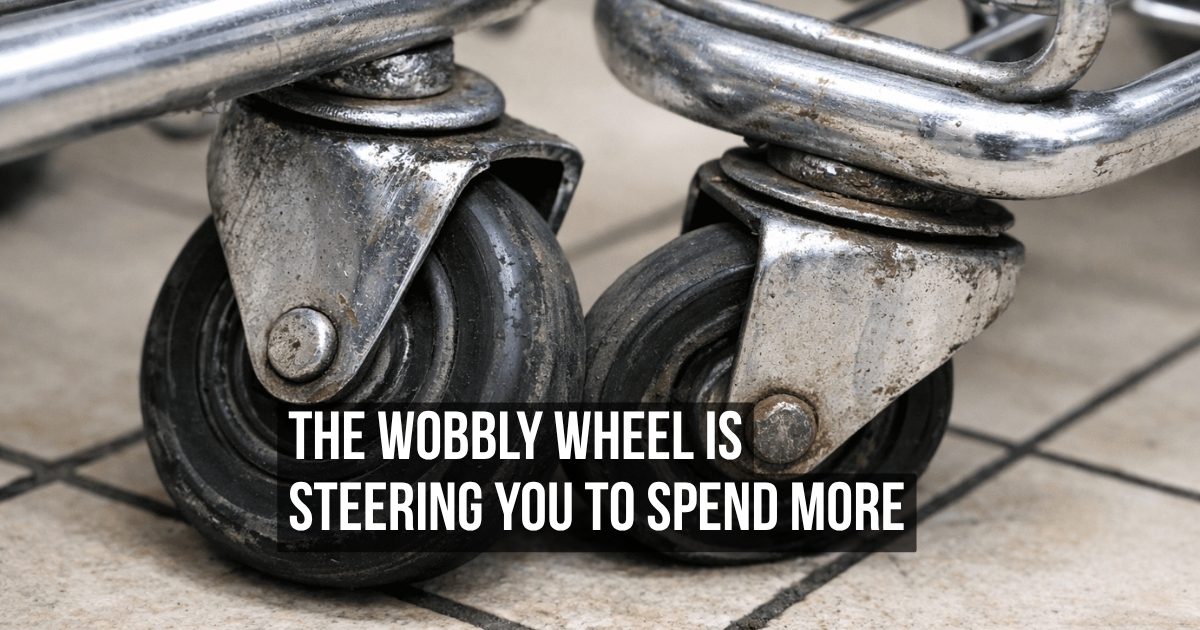
Most supermarket trolleys use four swivelling castors — all four wheels rotate freely around a vertical axis, enabling the trolley to move in any direction. This is distinct from shopping carts in some North American retailers, which use two fixed rear wheels and two swivelling front wheels, creating a design that tracks straighter but turns less sharply.
The four-castor design is deliberately less stable than the two-fixed, two-swivel configuration. The instability forces the shopper to maintain continuous physical engagement with the trolley: steering, correcting, adjusting. A trolley that rolled perfectly straight could be pushed with one hand while the shopper stared at their phone. A trolley that drifts and wobbles demands two hands on the bar and eyes on the path — which, not coincidentally, is the aisle of merchandise the retailer wants you to see.
The Drift and the Dominant Hand
Push a trolley straight down an aisle and it will drift gently to one side. Most shoppers experience a leftward drift, though this varies with individual grip asymmetry and floor conditions. The drift serves a commercial purpose: a trolley that pulls toward the shelving on one side increases the shopper’s proximity to products on that side, which increases visual exposure and, statistically, the probability of unplanned purchases. Research by retail consultancy Envirosell found that customers who spent more time in closer proximity to shelf displays made an average of 1.5 additional unplanned purchases per trip.
In some stores, the drift is deliberately calibrated by adjusting the castor mounting angles fractionally. A castor set at a 90-degree angle rolls neutrally. A castor offset by one or two degrees creates a consistent directional bias. Whether any given store intentionally adjusts castor angles is difficult to verify — retailers are unsurprisingly reluctant to discuss trolley dynamics as a sales tool — but the physics are straightforward and the commercial incentive is clear.
Speed Control Through Friction
Trolley wheels generate friction through their castor bearings, wheel material, and wheel diameter. Smaller wheels generate more rolling resistance. Cheaper bearings introduce more drag. The combined effect: supermarket trolleys travel at approximately 2 to 3 kilometres per hour under normal pushing force — slower than a comfortable walking pace, which averages 4.5 to 5 km/h. The trolley forces you to walk more slowly than you would without it.
Slower movement through the store increases exposure time. A shopper moving at 3 km/h through a 200-metre store circuit spends four minutes in the aisles. At 5 km/h, they would spend 2.4 minutes. The extra 96 seconds of trolley-imposed deceleration represent the difference between passing a promotional endcap at scanning speed and passing it slowly enough to notice the price, read the offer, and place the item in the trolley. The friction is not a design failure. It is a dwell-time multiplier.
The Coin Lock and Behavioural Economics
In many European supermarkets, trolleys are secured in corrals and released by inserting a coin — typically one euro or one pound. The coin is returned when the trolley is re-docked. The system was introduced primarily to reduce trolley retrieval costs: Aldi reportedly estimated that it saved millions annually in labour costs by eliminating the need for staff to collect abandoned trolleys from car parks.
The behavioural effect extends beyond retrieval. The coin deposit creates a psychological ownership effect: having invested something (even a coin that will be returned), the shopper treats the trolley with marginally more care. Studies on deposit-return systems in environmental behaviour have consistently found that even small financial commitments reduce littering, increase return rates, and shift the user’s relationship with the object from indifference to stewardship. The coin lock doesn’t just keep trolleys in the corral. It reframes the trolley from communal property to temporary personal equipment.
The Size Inflation
Supermarket trolleys have grown. A standard trolley in the 1970s held approximately 90 litres. A modern deep trolley holds 210 to 240 litres. The larger trolley doesn’t merely accommodate bigger shops. It makes smaller shops look inadequate. Behavioural research by marketing professor Martin Lindstrom found that doubling the size of a shopping cart increased average purchase volume by approximately 40 percent. The items in a half-empty large trolley look lonely, creating unconscious social pressure to fill the space.
Some retailers have experimented with smaller trolleys and basket-trolley hybrids, particularly for convenience-format stores. These formats consistently produce lower average transaction values. The smaller vessel constrains purchases physically and psychologically: once the basket feels full, the shopping trip feels complete. The large trolley removes both constraints, enabling the shopper to continue adding items without confronting the visual evidence of accumulation until they reach the checkout.
The Machine You Never Think About
The supermarket trolley is the only vehicle most adults operate daily without a thought for its engineering. Its wheels determine your speed. Its drift determines your proximity to products. Its size determines your purchasing volume. Its instability determines your engagement with the aisle. Every one of these parameters is a variable that the retailer can adjust, and the shopper experiences as a neutral, unremarkable feature of an unremarkable metal cart. The trolley doesn’t feel like technology. It feels like a trolley. And that invisibility is what makes it one of the most effective pieces of behavioural infrastructure in the retail environment.
Something went wrong. Please refresh the page and/or try again.
Help us improve your journey
We use cookies to personalize your experience and understand how you use our site. By clicking 'Yes, I'm in!', you help us show you content you'll actually love. If you prefer to keep things simple, you can stick to the essentials. You can change your mind anytime!
Necessary
Always active
The technical storage or access is strictly necessary for the legitimate purpose of enabling the use of a specific service explicitly requested by the subscriber or user, or for the sole purpose of carrying out the transmission of a communication over an electronic communications network.
Preferences
The technical storage or access is necessary for the legitimate purpose of storing preferences that are not requested by the subscriber or user.
Analytics
The technical storage or access that is used exclusively for statistical purposes.The technical storage or access that is used exclusively for anonymous statistical purposes. Without a subpoena, voluntary compliance on the part of your Internet Service Provider, or additional records from a third party, information stored or retrieved for this purpose alone cannot usually be used to identify you.
Advertising
The technical storage or access is required to create user profiles to send advertising, or to track the user on a website or across several websites for similar marketing purposes.




Leave a Reply