Why Walking Faster to Save Time on Your Commute Almost Never Actually Gets You There Any Sooner
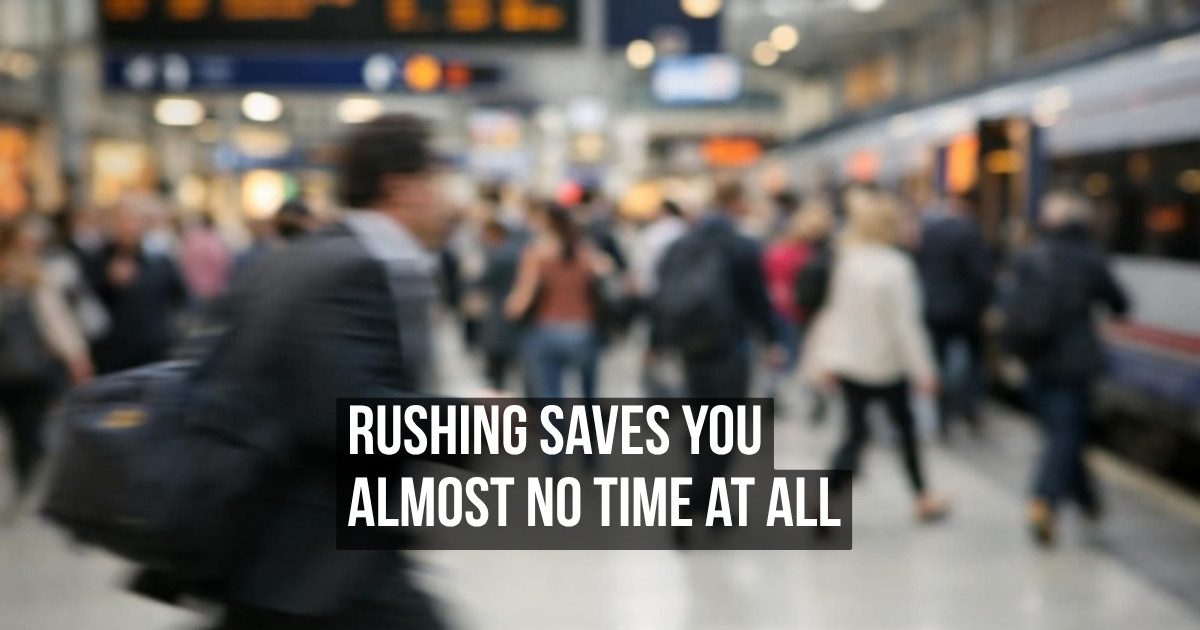
You’re running three minutes late. Your body knows this before your brain articulates it. Your stride lengthens, your pace quickens, your gait shifts from stroll to march. You weave past slower pedestrians, accelerate through crosswalks, and arrive at the station or office entrance breathing slightly harder, coat half-open, feeling like you clawed back time through sheer physical effort. Except you almost certainly didn’t. The maths of urban commuting is brutally indifferent to walking speed, and the time you think you saved exists mostly in the satisfying fiction of effort expended.
The Numbers Don’t Cooperate
The average comfortable walking speed for an adult is approximately 5 kilometres per hour. A brisk, deliberate pace pushes this to about 6.5. An aggressive rush-hour march might hit 7. Consider a typical 800-metre walk from a train station to an office. At 5 km/h, the walk takes 9 minutes and 36 seconds. At 7 km/h — a pace most people would describe as noticeably fast and slightly uncomfortable — the walk takes 6 minutes and 51 seconds. The gain: 2 minutes and 45 seconds. For that saving, you arrived flushed, slightly sweaty, and mildly agitated. The net benefit is less than the time you’ll spend standing at the lift.
On shorter walks — say, 400 metres from a bus stop to a front door — the savings compress further. The difference between a comfortable pace and an aggressive one is roughly 80 seconds. Barely enough to notice. Certainly not enough to offset the physiological stress response that fast walking triggers: elevated heart rate, cortisol release, and a subjective sense of urgency that persists well after the walk is over.
The Traffic Light Equaliser
Urban walks are not continuous-distance problems. They are interrupted by pedestrian crossings, traffic lights, junctions, and pavement congestion. Each interruption resets the advantage of speed. Walk as fast as you like — if the light turns red when you arrive at the crossing, you wait the same 45 seconds as the person ambling behind you. In many cities, traffic light cycles are timed to create natural cohorts of pedestrians who arrive at successive crossings in groups, regardless of individual pace.
A 2016 simulation study by transport researchers at ETH Zurich modelled pedestrian commute times across an urban grid with traffic-signal-controlled intersections. The study found that the time saved by increasing walking speed by 30 percent was reduced by approximately half when signal timing was factored in. In some configurations, faster walkers actually lost time relative to slower walkers because their increased speed caused them to arrive at intersections during the red phase of the cycle that a slower pace would have avoided.
The Door-to-Door Fallacy
Most commuters mentally model their journey as a single continuous segment: home to office. In reality, the walking portion typically represents only 15 to 25 percent of total commute time. The dominant time components are waiting (for a train, bus, or ride), travelling in a vehicle (whose speed you don’t control), and transitioning (going through turnstiles, waiting for lifts, navigating corridors). Walking faster optimises the smallest segment while leaving the largest segments unchanged.
If your total commute is 45 minutes and the walking segment is 10 minutes, shaving 2 minutes off the walk — the maximum realistic saving from pace alone — reduces your commute by 4.4 percent. Arriving one train earlier, by contrast, might save 5 to 10 minutes. The high-impact optimisation is timing, not speed. But speed feels like effort, and effort feels like progress, so people instinctively walk faster rather than plan better.
The Psychological Payoff of Rushing
If the time savings are negligible, why does walking fast feel so effective? Because the brain conflates physical effort with productivity. Walking briskly activates the sympathetic nervous system — the fight-or-flight pathway — producing a state of heightened alertness and a subjective sense of urgency that feels like making progress. The feeling is genuine. The progress is not.
There’s also a social performance dimension. Walking fast in a professional context signals purposefulness. The person striding through a train station at speed looks busy, important, in demand. The person strolling looks casual, possibly unemployed, certainly not in a hurry. Walking speed in urban environments is partly locomotion and partly communication — a visible declaration of status and purpose that has nothing to do with getting anywhere faster.
When Speed Actually Matters
Speed does matter in one specific commuting scenario: catching a vehicle that is about to depart. If you can see your bus pulling up to the stop, or your train’s doors are about to close, the difference between a walk and a sprint is the difference between making the connection and waiting for the next one. In these moments, speed saves not the 90 seconds of the walk but the 5 to 15 minutes of the next departure interval.
But these are binary, threshold events — you either make the connection or you don’t. Habitual fast walking doesn’t increase the probability of catching a departing vehicle. It increases the probability of arriving at the platform two minutes early and standing there, breathing heavily, watching the departure board count down the same minutes you would have spent walking at a comfortable pace.
The urban commute is dominated by systems — transit schedules, traffic signals, elevator queues, crowd flows — that operate on their own timelines and are indifferent to your walking speed. The impulse to walk faster is the impulse to exert control over a process that is mostly beyond your control. It feels productive. It costs energy, comfort, and composure. And it delivers, on average, just under three minutes of saved time per trip — time that the lift, the queue, or the red light will quietly reclaim before you reach your desk.
Something went wrong. Please refresh the page and/or try again.
Help us improve your journey
We use cookies to personalize your experience and understand how you use our site. By clicking 'Yes, I'm in!', you help us show you content you'll actually love. If you prefer to keep things simple, you can stick to the essentials. You can change your mind anytime!
Necessary
Always active
The technical storage or access is strictly necessary for the legitimate purpose of enabling the use of a specific service explicitly requested by the subscriber or user, or for the sole purpose of carrying out the transmission of a communication over an electronic communications network.
Preferences
The technical storage or access is necessary for the legitimate purpose of storing preferences that are not requested by the subscriber or user.
Analytics
The technical storage or access that is used exclusively for statistical purposes.The technical storage or access that is used exclusively for anonymous statistical purposes. Without a subpoena, voluntary compliance on the part of your Internet Service Provider, or additional records from a third party, information stored or retrieved for this purpose alone cannot usually be used to identify you.
Advertising
The technical storage or access is required to create user profiles to send advertising, or to track the user on a website or across several websites for similar marketing purposes.




Leave a Reply