The Paradox of Password Security: Why Stronger Passwords Make Most People’s Accounts Less Safe
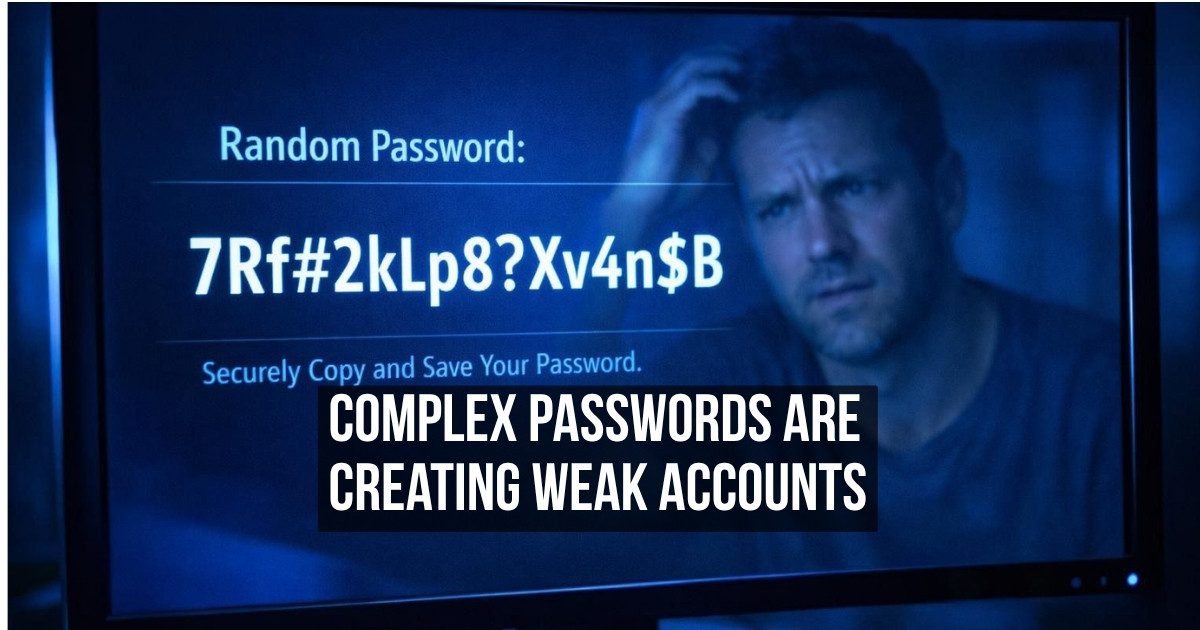
Your IT department forces you to create a password with at least twelve characters, one uppercase letter, one number, one special symbol, and no resemblance to any password you’ve used in the past six months. You comply. You produce something like “Tr0ub4dor&3” — a string so convoluted that you forget it by Tuesday. So you write it on a sticky note. Or save it in a browser. Or create a variation pattern: “Tr0ub4dor&4” for the next rotation. Each of these workarounds is a security vulnerability. And each was caused directly by the password policy that was supposed to prevent one.
The Complexity Trap
The logic behind complex passwords is mathematically sound. A twelve-character password using uppercase, lowercase, numbers, and symbols draws from a pool of roughly 95 possible characters per position, producing a theoretical search space of 95 to the power of 12 — approximately 5.4 times 10 to the power of 23 possible combinations. Brute-forcing this by trying every combination would take centuries, even with powerful hardware. The maths works perfectly. The humans don’t.
Research by Microsoft’s security team found that when faced with mandatory complexity requirements, the vast majority of users converge on predictable patterns: capitalising the first letter, placing numbers at the end, substituting vowels with digits (a becomes 4, e becomes 3, o becomes 0), and appending a special character. These patterns reduce the effective search space from trillions of combinations to a few thousand common templates that attackers know to try first. The password that looks complex to the compliance system is trivially guessable to a machine that knows human habits.
The Rotation Paradox
Mandatory password rotation — requiring users to change passwords every 30, 60, or 90 days — was standard security practice for decades. The theory: even if a password is compromised, regular rotation limits the window of vulnerability. In practice, researchers at the University of North Carolina, Chapel Hill, analysed 10,000 historical passwords from university accounts and found that users who were forced to rotate passwords made minimal, predictable modifications. If the old password was “Monkey12!” the new one was overwhelmingly likely to be “Monkey13!” or “Monkey12@”. The researchers developed a cracking algorithm that, given a user’s previous password, could guess the current one within five attempts 41 percent of the time.
The National Institute of Standards and Technology, the US agency that publishes widely adopted digital security guidelines, acknowledged this failure in its revised 2017 guidelines. NIST SP 800-63B explicitly recommended against mandatory periodic password changes, stating that forced rotation leads to weaker passwords through predictable transformation patterns. Many organisations, however, still enforce rotation policies written before the guidance changed.
The Post-It Problem
A person managing accounts across email, banking, social media, work systems, and streaming services maintains an average of 70 to 100 passwords, according to a 2021 survey by password manager NordPass. Requiring each to be unique, complex, and regularly rotated creates a memory load that no human brain can sustain. The result is externalisation: passwords written on paper, stored in unencrypted files, saved in browser autofill, or reused across multiple services.
Password reuse is the single most exploitable vulnerability in consumer digital security. When a low-security service suffers a data breach — a forum, a shopping site, a niche app — the exposed email-password combination is tested automatically against banking, email, and social media platforms by credential-stuffing attacks. If the user reused the password, the attacker gains access. The breach didn’t happen because the password was weak. It happened because the user, overwhelmed by complexity demands, used the same strong password everywhere.
What Actually Works
The most effective password strategy is the one most complexity policies actively discourage: long, simple passphrases. “correct horse battery staple” — the famous example from webcomic xkcd — contains 28 characters, is easy to remember, and has an entropy level that exceeds most twelve-character complex passwords. The phrase is long enough to resist brute force, unpatterned enough to resist dictionary attacks, and memorable enough that the user doesn’t need to write it down.
Password managers offer another solution: generating and storing unique, random, high-entropy passwords for every account, protected by a single strong master password or biometric authentication. Adoption rates, however, remain low. A 2023 survey by the Ponemon Institute found that only 33 percent of respondents used a password manager, despite 85 percent acknowledging that password reuse posed a security risk. The gap between knowing the right behaviour and performing it is one of the most consistent findings in cybersecurity research.
The System That Produces Its Own Failure
The central paradox of password security is that every measure designed to strengthen passwords also increases the cognitive burden on users, which drives compensatory behaviours that weaken security. Complexity requirements produce pattern-following. Rotation requirements produce incremental changes. Uniqueness requirements produce externalisation. The policies are not wrong in theory. They are catastrophic in practice, because they model security around an ideal user who doesn’t exist: someone with perfect memory, infinite patience, and no tendency to take shortcuts.
The person who uses “Monkey12!” across fifteen accounts is not careless. They are rational. They have too many accounts, too many rules, and too little cognitive bandwidth to maintain a unique twelve-character string with mandatory complexity for every login in their life. The security system demanded more than human memory can deliver, and the gap between what was demanded and what was possible is where every credential breach begins. Stronger passwords made accounts safer in principle. In practice, they made the humans guarding them weaker.
Something went wrong. Please refresh the page and/or try again.
Help us improve your journey
We use cookies to personalize your experience and understand how you use our site. By clicking 'Yes, I'm in!', you help us show you content you'll actually love. If you prefer to keep things simple, you can stick to the essentials. You can change your mind anytime!
Necessary
Always active
The technical storage or access is strictly necessary for the legitimate purpose of enabling the use of a specific service explicitly requested by the subscriber or user, or for the sole purpose of carrying out the transmission of a communication over an electronic communications network.
Preferences
The technical storage or access is necessary for the legitimate purpose of storing preferences that are not requested by the subscriber or user.
Analytics
The technical storage or access that is used exclusively for statistical purposes.The technical storage or access that is used exclusively for anonymous statistical purposes. Without a subpoena, voluntary compliance on the part of your Internet Service Provider, or additional records from a third party, information stored or retrieved for this purpose alone cannot usually be used to identify you.
Advertising
The technical storage or access is required to create user profiles to send advertising, or to track the user on a website or across several websites for similar marketing purposes.




Leave a Reply