You Curate Your Personality Differently for Every Group and Call It Authenticity
The Playlist of Selves
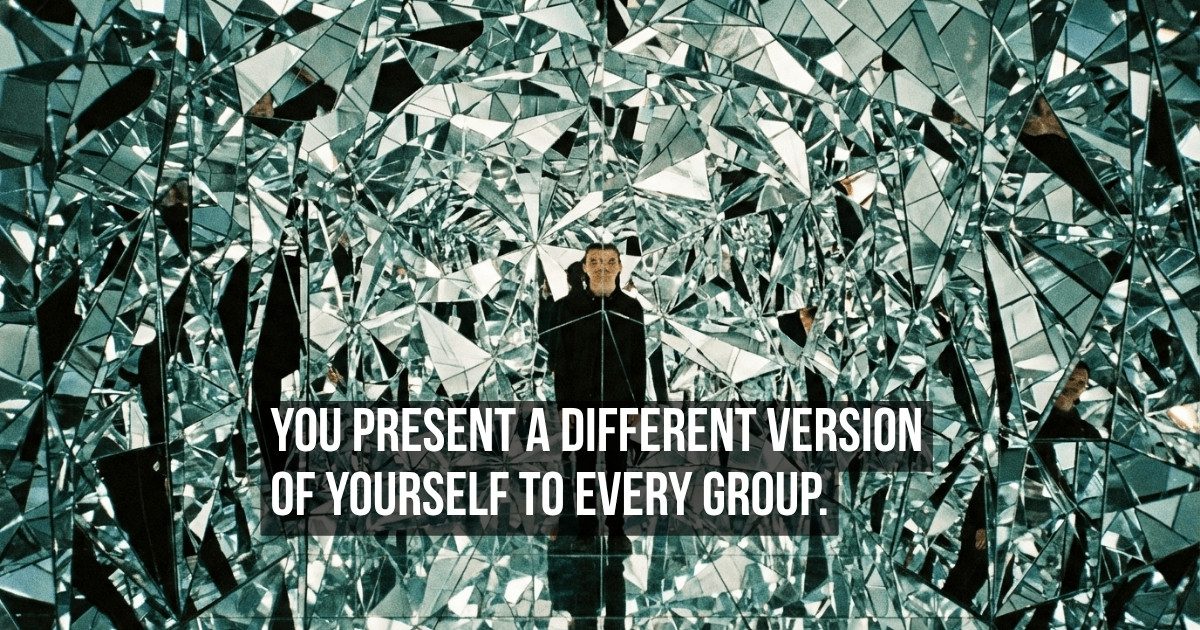
You with your work colleagues: measured, professional, slightly funnier than you actually are. You with your oldest friends: louder, more profane, referencing a version of yourself from fifteen years ago. You with your parents: careful, edited, omitting approximately forty percent of your actual life. You with a first date: curated, strategic, performing the most interesting possible version of yourself while leaving out everything that might complicate the impression.
Same person. Four completely different presentations. And if someone asked you which one is “the real you,” you would hesitate longer than you would like to admit.
The Myth of a Consistent Self
Modern culture places enormous value on authenticity — the idea that somewhere underneath the social performances, there is a stable, coherent self that remains constant across contexts. “Just be yourself” is delivered as advice so frequently that it has become meaningless, mainly because nobody has satisfactorily defined which self they are referring to.
Social psychologist Mark Snyder identified this dynamic in the 1970s with his concept of self-monitoring. High self-monitors adjust their behavior significantly based on social context. Low self-monitors behave more consistently regardless of audience. Neither group is being more “authentic” than the other. They are simply running different social strategies.
The uncomfortable finding was that high self-monitors — the ones who adapt most dramatically — consistently report richer social networks, more diverse friendships, and higher professional advancement. Adapting is not a betrayal of the self. It might be one of its core competencies.
The Merge Problem
You know this system works because you have felt the specific dread of worlds colliding. Your college friends meet your work colleagues at a birthday party, and a low-grade alarm goes off in your chest. Not because anyone will misbehave. Because two audiences that received different versions of you are now in the same room, and the contradictions are suddenly visible.
The person who laughs at dark jokes with one group is also the person who speaks carefully about inclusion with another. The person who describes their job enthusiastically at a networking event is also the person who texts their best friend “I cannot stand this place” at 3 PM on a Wednesday. Neither version is a lie. Both are incomplete truths shaped by context.
Why You Cannot Stop
The reason you adapt is not insecurity, although it can feel that way in retrospect. It is social intelligence. Every human group has implicit rules about what can be said, how emotions should be expressed, and which topics are appropriate. Reading those rules and adjusting accordingly is not dishonesty. It is fluency.
A 2013 study by Murat Ozkalp and colleagues found that individuals who engage in what they termed “adaptive self-presentation” reported higher quality relationships on average — not because they were deceiving people, but because they were responsive to what each relationship needed. The friend who needs you to be direct gets directness. The parent who needs you to be gentle gets gentleness. Neither version is manufactured. Both are drawn from the same source, filtered differently.
The Question You Keep Avoiding
The real discomfort is not that you behave differently in different contexts. Everyone does. The discomfort is that you call it authenticity when it is actually selection. You are always choosing which truths to present and which to withhold, which jokes to deploy and which to swallow, which version of your history to narrate.
You are not being fake. But you are not being whole, either. And the version of you that exists when absolutely nobody is watching — the one scrolling alone at midnight, unperformed and unobserved — might be the closest thing to the self that authenticity culture keeps telling you to find.
[…] You could not cancel it yourself because the social cost felt too high — not the actual cost, but the imagined judgment. Would they think you are flaky? Distant? Uninterested? The fear of being perceived as someone who […]
Something went wrong. Please refresh the page and/or try again.
Help us improve your journey
We use cookies to personalize your experience and understand how you use our site. By clicking 'Yes, I'm in!', you help us show you content you'll actually love. If you prefer to keep things simple, you can stick to the essentials. You can change your mind anytime!
Necessary
Always active
The technical storage or access is strictly necessary for the legitimate purpose of enabling the use of a specific service explicitly requested by the subscriber or user, or for the sole purpose of carrying out the transmission of a communication over an electronic communications network.
Preferences
The technical storage or access is necessary for the legitimate purpose of storing preferences that are not requested by the subscriber or user.
Analytics
The technical storage or access that is used exclusively for statistical purposes.The technical storage or access that is used exclusively for anonymous statistical purposes. Without a subpoena, voluntary compliance on the part of your Internet Service Provider, or additional records from a third party, information stored or retrieved for this purpose alone cannot usually be used to identify you.
Advertising
The technical storage or access is required to create user profiles to send advertising, or to track the user on a website or across several websites for similar marketing purposes.




Leave a Reply