How Pineapple on Pizza Became a Tribal Identity and What That Reveals About Our Need for Meaningless Conflict
Food preferences turned into tribal warfare, and a fruit topping is ground zero.
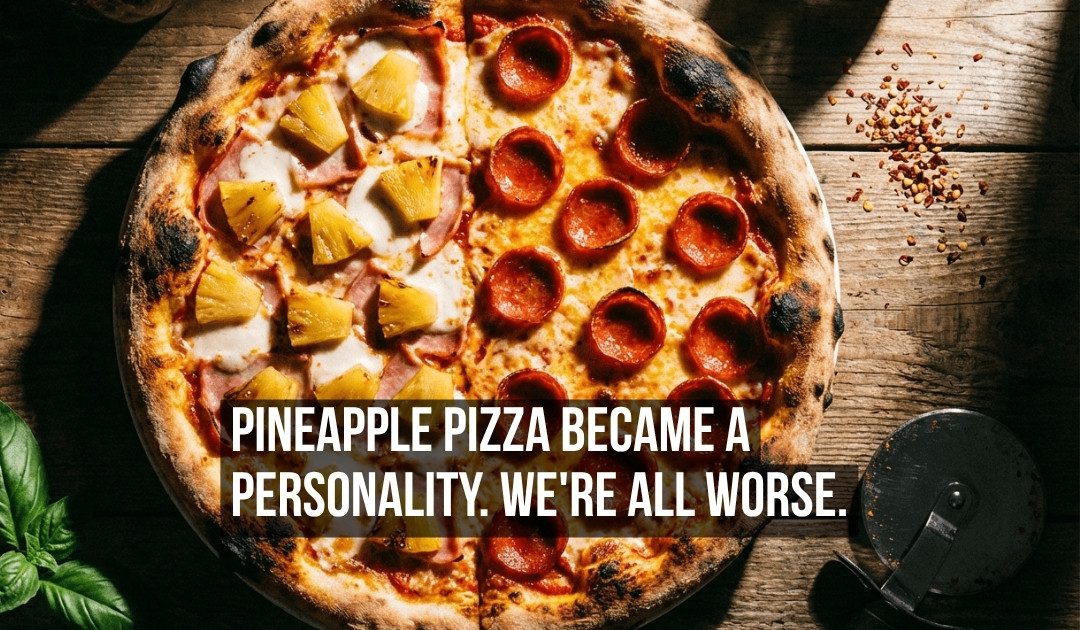
The pineapple-on-pizza debate has achieved something remarkable: it’s transformed a minor culinary preference into a litmus test for personality, a signifier of taste hierarchies, and a mandatory conversation topic that won’t die despite having nothing left to say. People don’t just like or dislike pineapple on pizza anymore—they perform their position, declare allegiance, and judge others based on topping choices that ultimately mean nothing.
What started as mild culinary disagreement has metastasized into cultural phenomenon where food preference becomes identity marker. The position you take on Hawaiian pizza supposedly reveals something profound about who you are. It doesn’t. It reveals you’ve been successfully recruited into manufactured controversy that serves no one except platforms profiting from engagement.
The Preference Performance
Watch how people discuss pineapple on pizza and you’ll notice the performance. It’s never “I don’t personally enjoy it.” It’s “pineapple on pizza is an abomination,” delivered with theatrical disgust, often to strangers who didn’t ask. The intensity is calibrated to demonstrate that you care deeply about proper pizza, that you have standards, that you’re the kind of person who gets worked up about fruit toppings.
This performance serves specific social function. It provides safe controversy—something you can argue about passionately without actual stakes. No one’s politics are implicated. No systemic injustice gets exposed. It’s pure, consequence-free tribal signaling where you demonstrate your affiliation and judge others for theirs. This is exactly the mechanism described in recycling is a corporate lie—tribal identity forming around performative positions that substitute for engagement with actual systemic issues.
The debate has also become mandatory participation. Mention pizza in any context and someone will bring up pineapple. The topic appears in dating profiles, ice-breaker questions, casual conversations. You’re expected to have a position, ideally a strong one, because tepid neutrality reads as lack of personality.
The Authenticity Theater
The anti-pineapple position often frames itself as defending authentic Italian cuisine, which would be more compelling if Italian pizza traditions weren’t already thoroughly bastardized in most contexts. The person eating Domino’s while declaring pineapple pizza sacrilege has abandoned authenticity long before the fruit arrived.
This selective authenticity concern reveals the real function—it’s not about preserving culinary tradition but about establishing hierarchy. There are acceptable pizza deviations and unacceptable ones, and knowing which is which signals cultural capital. You demonstrate sophistication by rejecting the “wrong” toppings, regardless of whether you can articulate why beyond inherited talking points.
The irony is that Hawaiian pizza’s invention in Canada makes it exactly as authentic as many “traditional” pizzas served outside Italy. But authenticity isn’t the actual concern—it’s rhetorical tool for justifying taste hierarchies that have nothing to do with tradition and everything to do with performing the right kind of taste.
The Manufactured Intensity
What’s most suspicious about the pineapple debate is its disproportionate intensity. People express stronger opinions about this than about substantive issues affecting their lives. The emotional investment in whether fruit belongs on flatbread exceeds their engagement with actual problems.
This displacement serves a function. Passionate opinions about inconsequential topics provide sense of conviction without requiring anything meaningful. You can feel strongly, argue forcefully, judge others—all the emotional satisfaction of taking a stand without any actual risk or responsibility.
The debate also provides endless content. Every platform recycles the controversy because it generates reliable engagement. People will argue about pineapple on pizza indefinitely because the stakes are simultaneously high enough to care about and low enough to involve no real consequences. It’s perfect engagement bait.
The Binary Trap
The debate’s framing as binary choice—you either accept pineapple or you’re defending pizza’s honor—eliminates more interesting middle ground. You could occasionally enjoy Hawaiian pizza without it defining your culinary identity. You could be indifferent. You could recognize that food preferences are subjective and largely meaningless.
But these positions don’t generate content or enable tribal signaling. The binary creates teams, and teams create engagement, which platforms reward. So the debate persists in its most reductive form because that’s what serves algorithmic interests.
The binary also prevents acknowledging that most people don’t actually care that much. They have mild preferences at most. But mild preferences don’t provide personality shorthand or conversation fodder, so they get amplified into strong positions through repeated performance. This compulsory performance of opinions is what kindness has become emotional labor identifies as a broader cultural pattern—the demand that social interactions always signal something about your tribe.
The Taste Hierarchy
Underlying the debate is assumption that taste preferences reveal something about character or sophistication. The person who rejects pineapple is supposedly more discerning, more authentic, more serious about food. The person who enjoys it lacks refined palate or cultural awareness.
This hierarchy is nonsense. Taste preferences are largely accidents of exposure, conditioning, and biochemistry. They don’t correlate with any meaningful personal qualities. But treating them as significant allows constructing identity around consumption choices, which fits perfectly with consumer culture’s logic.
The hierarchy also serves to police enjoyment. You’re not supposed to simply like what you like—you’re supposed to like the “right” things. Food becomes another domain where spontaneous pleasure gets subordinated to performance of appropriate taste.
The Missing Perspective
What the pineapple debate most thoroughly avoids is that it doesn’t matter. Someone else enjoying pineapple on pizza affects you in no way. Your passionate opposition accomplishes nothing except signaling tribal affiliation to others similarly invested in meaningless food controversy.
The energy devoted to this could address actual food issues—industrial agriculture, food deserts, unsustainable farming, nutrition access. But those topics require uncomfortable examination of systems we participate in. Much easier to argue about toppings while pretending you’re defending something important.
The debate persists because it serves everyone except those seeking actual substance. It gives people something to have opinions about. It provides platforms with engagement. It creates content that requires no research or expertise. Everyone profits from the controversy except those who could be having more interesting conversations about literally anything else.
Pineapple on pizza is a topping choice that became a personality because we desperately need something to disagree about that doesn’t require examining anything real.
The fruit isn’t the problem—the fact that we turned it into one is.
Something went wrong. Please refresh the page and/or try again.
Help us improve your journey
We use cookies to personalize your experience and understand how you use our site. By clicking 'Yes, I'm in!', you help us show you content you'll actually love. If you prefer to keep things simple, you can stick to the essentials. You can change your mind anytime!
Necessary
Always active
The technical storage or access is strictly necessary for the legitimate purpose of enabling the use of a specific service explicitly requested by the subscriber or user, or for the sole purpose of carrying out the transmission of a communication over an electronic communications network.
Preferences
The technical storage or access is necessary for the legitimate purpose of storing preferences that are not requested by the subscriber or user.
Analytics
The technical storage or access that is used exclusively for statistical purposes.The technical storage or access that is used exclusively for anonymous statistical purposes. Without a subpoena, voluntary compliance on the part of your Internet Service Provider, or additional records from a third party, information stored or retrieved for this purpose alone cannot usually be used to identify you.
Advertising
The technical storage or access is required to create user profiles to send advertising, or to track the user on a website or across several websites for similar marketing purposes.




Leave a Reply