The Precise Mechanics Behind Why Zippers Fail and What That Reveals About Everyday Product Engineering
A zipper is one of the most mechanically elegant inventions in daily life: two rows of identical teeth, each useless alone, interlocked by a sliding wedge that converts parallel strips into a continuous, flexible seal. The design has been functionally unchanged since Gideon Sundback perfected it in 1913. And yet, zippers fail. They split. They jam. They lose their pull tabs. They separate at the bottom. They are, after buttons, the most replaced fastener on the planet. Understanding why they fail reveals something important about how everyday products are engineered — and where the engineering deliberately stops.
How a Zipper Actually Works
The slider — the Y-shaped channel you pull — is the critical component. As it moves upward, the two columns of teeth enter the narrow end of the Y and are forced together under precisely calibrated pressure. Each tooth has a projection on its top surface and a corresponding hollow on its bottom surface. As the slider compresses them, each projection seats into the hollow of the tooth on the opposite strip. The result is an interlocking chain where every tooth is held in place by the teeth above and below it and the tooth directly across from it.
The geometry is unforgiving. The teeth must be identically sized, identically spaced, and identically shaped. A deviation of less than a tenth of a millimetre in tooth pitch — the distance between consecutive teeth — is sufficient to cause a misalignment that propagates down the chain, producing a split. The slider’s internal channel must maintain its compression angle within tight tolerances: too loose and the teeth don’t fully engage; too tight and the slider jams. The entire system depends on precision, and precision is expensive.
The Three Ways Zippers Die
Zipper failures fall into three categories, each with a distinct mechanical cause.
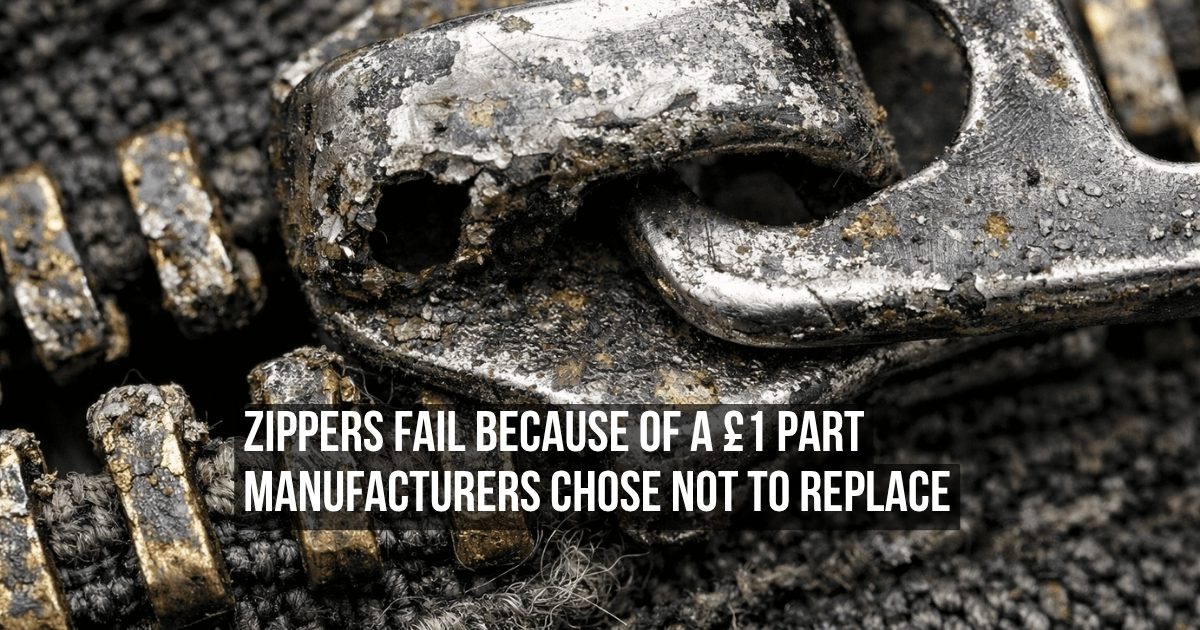
Splitting: the most common failure mode. The zipper closes behind the slider, then the teeth separate below it, creating an open gap in what should be a sealed chain. The cause is almost always a worn slider. After hundreds of cycles, the slider’s internal channel widens fractionally through metal fatigue. The widened channel no longer compresses the teeth tightly enough to achieve full engagement. The teeth enter the Y, pass through, and fail to interlock. The fix is remarkably simple: replacing the slider, which costs roughly one pound, restores full function. Most people, however, assume the entire zipper is broken and replace the garment.
Jamming: the slider stops moving, typically because fabric has been caught in the channel or because a tooth is bent out of alignment. Fabric jams are the result of the zipper’s design weakness: the gap between the teeth and the slider’s edge is wide enough to admit thin fabric, which then compresses against the internal channel and wedges the mechanism. Tooth misalignment is usually caused by mechanical trauma — a snagged tooth, a compressed bag, or a laundry cycle that bent a metal tooth out of its seating position.
Bottom stop failure: the reinforced stop at the base of a separating zipper (the kind used in jackets and coats) detaches or wears through, allowing the teeth to pull free from the slider entirely. Bottom stops endure the highest mechanical stress of any component because they absorb the full tension of the garment when the wearer moves, bends, or stretches. A bottom stop that fails after two seasons of use was probably manufactured at the minimum viable specification for its expected stress load.
YKK and the Quality Benchmark
The letters YKK appear on approximately half of all zippers manufactured worldwide. Yoshida Kogyo Kabushikikaisha, founded in Tokyo in 1934, produces an estimated 10 billion zippers per year and controls a market share that no other manufacturer approaches. YKK’s dominance rests on vertical integration: the company manufactures its own alloys, dies, tapes, and machinery, controlling every variable from raw material to finished product.
YKK zippers are, by industry consensus, the most reliable mass-produced zippers available. Their tooth tolerances are tighter, their sliders maintain compression longer, and their tape-to-garment attachment is more durable than most competitors. The premium is modest — a YKK zipper costs a garment manufacturer roughly 15 to 30 cents more than a generic equivalent. For a jacket retailing at 80 pounds, this represents a material cost increase of less than 0.4 percent. Many brands absorb the cost. Others do not, choosing generic zippers that are functionally adequate at point of sale but significantly more failure-prone over the garment’s lifetime.
The Tolerance Decision
Every zipper is manufactured to a specification that balances precision against cost. A zipper with teeth machined to tolerances of plus or minus 0.02 millimetres will last thousands of cycles without splitting. A zipper with tolerances of plus or minus 0.08 millimetres will function adequately for hundreds of cycles before wear accumulates to the failure threshold. The first costs more to produce. The second costs more to replace. The decision between them is made not by the zipper manufacturer but by the garment brand’s procurement team, working to a bill of materials that has been cost-optimised before the designer has finished the sketch.
This is the hidden truth of everyday product engineering: the point at which a product fails is, in many cases, the point at which its manufacturer decided to stop spending. A zipper doesn’t split because zippers are fundamentally unreliable. It splits because the specific zipper installed in your specific garment was manufactured at a tolerance level selected to minimise cost, not to maximise lifespan. Better zippers exist at every price point. The question is whether the brand selling the garment considered the zipper a feature worth investing in.
The Repair Economy Nobody Built
A split zipper on a jacket is, in engineering terms, a 90-second repair: remove the old slider, compress a new one onto the teeth, test the closure. A tailor or alterations shop charges five to ten pounds for the service. Yet the majority of garments with failed zippers are discarded rather than repaired, because the repair infrastructure barely exists in most cities, the knowledge that sliders are replaceable is not widespread, and the cultural assumption — reinforced by fast fashion’s economics — is that a broken zipper means a broken garment.
The zipper is one of the smallest, cheapest, and most mechanically precise components in any garment. Its failure rate is determined by manufacturing tolerances chosen before you ever saw the jacket in the shop. Its repair cost is a fraction of replacement cost. And the fact that most people discard rather than repair speaks not to the zipper’s engineering but to a consumer culture that has made replacing things easier than understanding how they work — even when the understanding requires nothing more than knowing which part of the mechanism actually failed and why.
Something went wrong. Please refresh the page and/or try again.
Help us improve your journey
We use cookies to personalize your experience and understand how you use our site. By clicking 'Yes, I'm in!', you help us show you content you'll actually love. If you prefer to keep things simple, you can stick to the essentials. You can change your mind anytime!
Necessary
Always active
The technical storage or access is strictly necessary for the legitimate purpose of enabling the use of a specific service explicitly requested by the subscriber or user, or for the sole purpose of carrying out the transmission of a communication over an electronic communications network.
Preferences
The technical storage or access is necessary for the legitimate purpose of storing preferences that are not requested by the subscriber or user.
Analytics
The technical storage or access that is used exclusively for statistical purposes.The technical storage or access that is used exclusively for anonymous statistical purposes. Without a subpoena, voluntary compliance on the part of your Internet Service Provider, or additional records from a third party, information stored or retrieved for this purpose alone cannot usually be used to identify you.
Advertising
The technical storage or access is required to create user profiles to send advertising, or to track the user on a website or across several websites for similar marketing purposes.




Leave a Reply