Why Every Limited Edition Product You Buy Was Always Planned for Mass Production From the Start
Supreme releases a brick. It sells out in four minutes. A red clay brick, branded with a white logo, retailing for 30 dollars and reselling for 200. The brick has no function beyond being a Supreme brick. But it was “limited edition,” and that phrase activated a purchasing reflex powerful enough to make thousands of adults compete for the right to own construction material at luxury markup. The scarcity was the product. And the scarcity was engineered from the beginning.
Manufacturing Desire Through Artificial Constraint
The mechanics of a limited edition release follow a precise formula. Announce a product. Attach a number — “only 5,000 units” or “available for 48 hours only.” Generate social media anticipation through teasers, countdowns, and influencer seeding. Drop the product. Watch it sell out. Celebrate the sellout as proof of demand. Repeat.
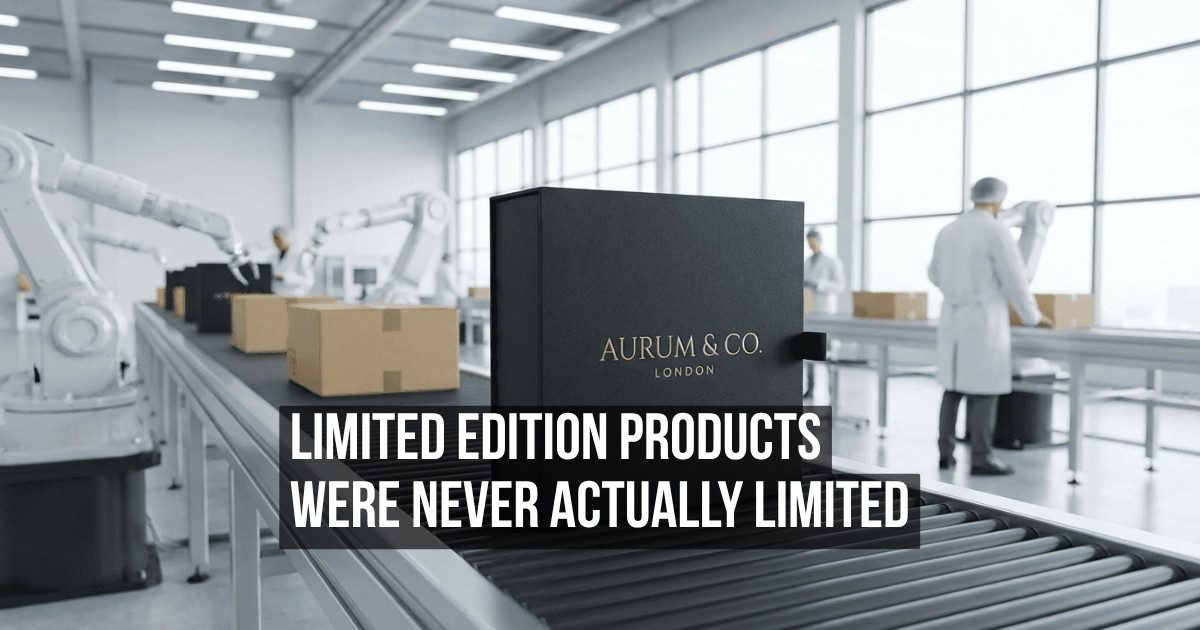
What the formula conceals is the production decision that preceded the marketing. The brand chose to make 5,000 units. Not because raw materials were scarce, not because manufacturing capacity was limited, but because 5,000 units at full margin with zero leftover inventory produces a better financial outcome than 50,000 units at a lower price with warehousing costs and potential discounting. Limited editions are not supply-constrained products. They are demand-management tools disguised as exclusive offerings.
The Sellout as Marketing Event
When a product sells out instantly, the brand earns something more valuable than revenue: a news cycle. “Nike Dunk Sells Out in Under Three Minutes” generates headlines, social media discourse, and a perception of desirability that no paid advertising campaign can replicate. The sellout functions as proof of cultural relevance — a signal that this brand commands enough demand to exceed supply, even when supply was deliberately calibrated to be exceeded.
Adidas and Nike have refined this into a science. Limited colourway releases of established shoe models — identical in construction to general-release versions, differentiated only by colour and availability — sell for three to ten times their retail price on resale platforms. StockX, the sneaker resale marketplace, processed over 4 billion dollars in transactions in a single year, much of it driven by products whose scarcity was a marketing decision, not a material constraint.
The Collaboration Industrial Complex
Brand collaborations have become the primary vehicle for manufactured scarcity. Uniqlo partners with a designer. McDonald’s partners with a musician. A luggage company partners with a streetwear label. Each collaboration produces a “limited” run that generates disproportionate attention relative to the product’s actual innovation. The collaboration is newsworthy. The product is often unremarkable. A branded T-shirt remains a T-shirt regardless of whose name appears on the tag.
In 2023, a collaboration between a fast-fashion retailer and a luxury house produced a collection that sold out online within minutes. Customers who lined up outside stores reported queue times exceeding six hours. The garments were manufactured in the same facilities, using comparable materials, as the retailer’s standard range. The luxury house contributed a label, a logo, and the perception of exclusivity. The retailer contributed scale, distribution, and the audience. Both parties profited from a scarcity that existed solely because they decided it would.
Scarcity and the Brain
The psychological mechanism is well-documented. Scarcity increases perceived value. Robert Cialdini’s foundational research on persuasion identified scarcity as one of six universal principles of influence: when something appears less available, people assign it greater worth — independent of its intrinsic quality. Functional MRI studies have shown that scarcity cues activate regions of the brain associated with reward anticipation and loss aversion. The fear of missing out on a limited product triggers a neurological response similar to the fear of losing something already owned.
This means the purchase decision in a limited edition context is not primarily about the product. It is about the scarcity itself. Remove the constraint, and the same product at the same price would attract a fraction of the interest. The Supreme brick, unlimited, is a brick. The Supreme brick, limited to 1,000 units, is a collector’s item worth hundreds. The object did not change. The availability did.
The “Limited” That Comes Back
Pay attention long enough and you’ll notice a pattern. The limited edition that sold out reappears six months later in a “second drop.” The exclusive colourway returns as a “restock.” The collaboration that was “one time only” gets a sequel. Starbucks brings back seasonal drinks every year with the same “limited time” framing, each return generating the same urgency as the first. McDonald’s McRib follows an identical playbook — periodic removal and reintroduction designed to manufacture demand through absence.
The product was never truly limited. It was rotated. Scarcity was not a condition of production but a rhythm of release — a pulsing availability strategy that keeps demand permanently elevated by ensuring the product is never quite available enough to feel ordinary.
Every limited edition product in your wardrobe, on your shelf, or in your kitchen was produced in exactly the quantity the brand intended. The scarcity you experienced was not an accident of supply meeting unexpected demand. It was the first line of the marketing plan, written months before you ever heard the product existed. You didn’t beat the system by getting one. You performed the role the system was built for.
Something went wrong. Please refresh the page and/or try again.
Help us improve your journey
We use cookies to personalize your experience and understand how you use our site. By clicking 'Yes, I'm in!', you help us show you content you'll actually love. If you prefer to keep things simple, you can stick to the essentials. You can change your mind anytime!
Necessary
Always active
The technical storage or access is strictly necessary for the legitimate purpose of enabling the use of a specific service explicitly requested by the subscriber or user, or for the sole purpose of carrying out the transmission of a communication over an electronic communications network.
Preferences
The technical storage or access is necessary for the legitimate purpose of storing preferences that are not requested by the subscriber or user.
Analytics
The technical storage or access that is used exclusively for statistical purposes.The technical storage or access that is used exclusively for anonymous statistical purposes. Without a subpoena, voluntary compliance on the part of your Internet Service Provider, or additional records from a third party, information stored or retrieved for this purpose alone cannot usually be used to identify you.
Advertising
The technical storage or access is required to create user profiles to send advertising, or to track the user on a website or across several websites for similar marketing purposes.




Leave a Reply