Buying Plants Has Almost Nothing to Do With Wanting to Keep Them Alive
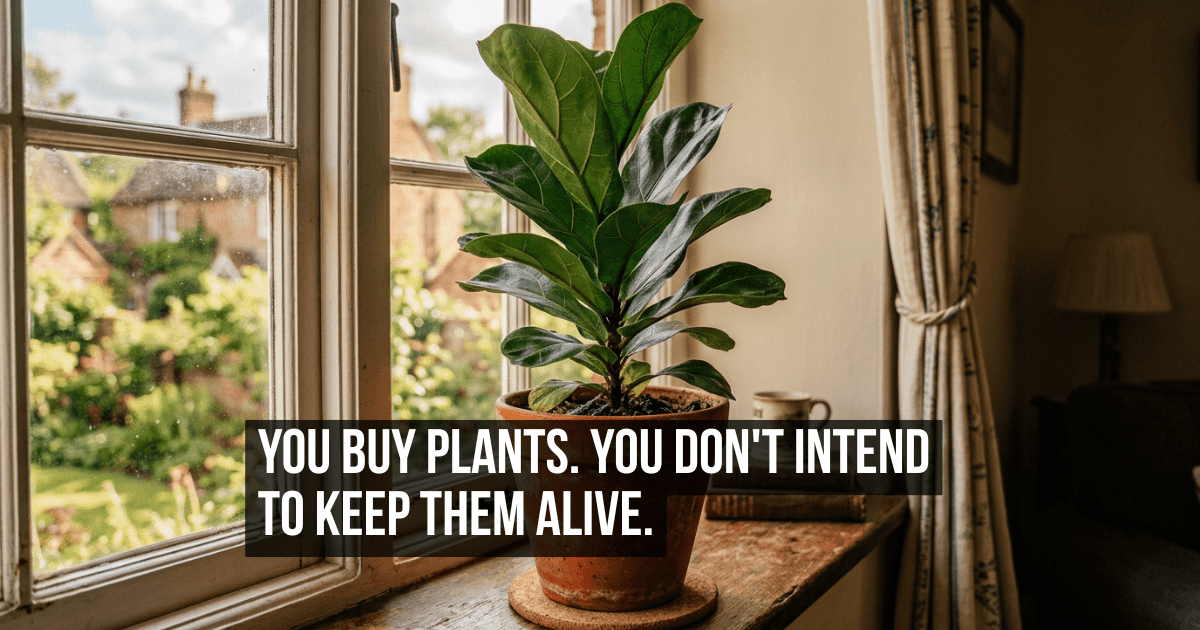
The pot had a specific look, or the leaves had a quality that seemed low-maintenance, or the shop was right there and it was a good morning. So you bought the plant. You carried it home. You found it a spot with what you estimated to be adequate light, and you watered it, twice, with genuine intention.
It is now unclear what month that was.
Plants Are Not About Plants
Plant ownership has surged consistently across urban populations for the better part of a decade — a trend accelerated, but not created, by the extended indoor periods of 2020 and 2021. The houseplant market in the UK alone was valued at over £1.7 billion in 2022, with growth concentrated among younger urban adults living in smaller spaces. The plants being sold are, at a structural level, rarely the plants being kept alive.
The gap between purchase and survival rate is not a horticulture problem. It’s a psychology problem.
People who study consumer behavior around what researchers call “aspirational goods” — objects purchased to express or achieve an identity rather than to meet a functional need — have found that living plants sit in an unusual category. Unlike most objects, they require ongoing participation. They need water, light, repotting, attention. They are, in this sense, a commitment — a version of a self you intend to inhabit.
The Identity the Plant Is Supposed to Signal
The person with thriving plants in every room occupies a specific cultural position: connected to nature, attentive, domestic without being conventional, alive to the slow rhythms of growing things. It’s a coherent identity, and it’s one that a great many people aspire to, which is why the plants sell.
The problem is that the aspiration is purchased in a single transaction, but the identity requires sustained daily behavior that the original desire doesn’t necessarily produce. Wanting to be the plant person and being the plant person are separated by a watering schedule, and watering schedules are easy to miss.
Researchers studying what they call the “intention-behavior gap” — the consistent failure of stated intentions to predict actual behavior — find that aspirational purchases reliably close the gap on the day of acquisition and tend to widen it over the following weeks. The plant is purchased by the self that wants to grow things. It dies in the care of the self that forgot it needed water on Thursday.
The Plant You Choose Says Something Specific
Not all plants are aspirational in the same direction. The monstera deliciosa was the statement plant of the late 2010s — large, tropical, maximally legible, tolerant enough of neglect to survive inconsistent care. The fiddle leaf fig offered drama and difficulty in equal measure: a plant for someone who wanted visible effort. Succulents emerged as the option for people who aspired to aspire to plants but were honest about their follow-through.
The choice of species contains the self-knowledge the purchase usually lacks. Buying a fiddle leaf fig is, in a real sense, buying a version of yourself you’re not entirely sure you can maintain. Buying the cactus is a more calibrated optimism. Neither outcome is guaranteed. The cactus also dies.
Why You’ll Buy Another One
There’s a resilience to the plant purchase that’s worth examining. Most people who’ve killed a houseplant will eventually buy another one — sometimes the same species, under identical conditions, with equivalent levels of renewed optimism.
The repeat purchase isn’t irrational. It’s evidence that the aspiration persists, even when the execution doesn’t. You still want to be the person the plant requires. That desire doesn’t die when the fern does.
The plant isn’t the point. The person you imagine while buying it is the point. And that person is worth returning to, even if the pot eventually empties.
Something went wrong. Please refresh the page and/or try again.
Help us improve your journey
We use cookies to personalize your experience and understand how you use our site. By clicking 'Yes, I'm in!', you help us show you content you'll actually love. If you prefer to keep things simple, you can stick to the essentials. You can change your mind anytime!
Necessary
Always active
The technical storage or access is strictly necessary for the legitimate purpose of enabling the use of a specific service explicitly requested by the subscriber or user, or for the sole purpose of carrying out the transmission of a communication over an electronic communications network.
Preferences
The technical storage or access is necessary for the legitimate purpose of storing preferences that are not requested by the subscriber or user.
Analytics
The technical storage or access that is used exclusively for statistical purposes.The technical storage or access that is used exclusively for anonymous statistical purposes. Without a subpoena, voluntary compliance on the part of your Internet Service Provider, or additional records from a third party, information stored or retrieved for this purpose alone cannot usually be used to identify you.
Advertising
The technical storage or access is required to create user profiles to send advertising, or to track the user on a website or across several websites for similar marketing purposes.




Leave a Reply