The Scientific Case for Talking to Your Plants That Mainstream Culture Refuses to Take Seriously
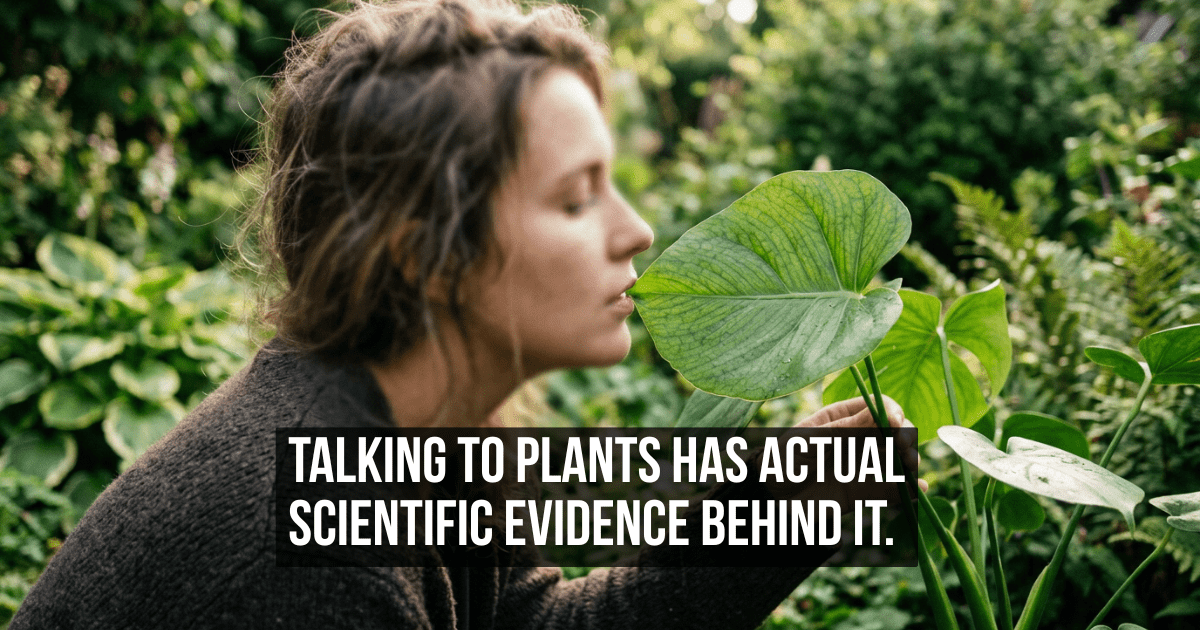
Talking to your plants occupies a specific zone of cultural mockery: eccentric but harmless, the kind of behavior attributed to elderly aunts and people who have given their succulents names. The person who does it knows, at some level, that they are being slightly ridiculous. The research that examines the practice is considerably less comfortable with that conclusion.
The question of whether plants respond to sound, and specifically to human voice, has been studied in serious plant biology for several decades. The findings are not proof of anything like sentience or comprehension. They are, however, persistent enough and reproducible enough to make the blanket dismissal of the practice look like it is doing less scientific work than it appears to.
What Sound Does to Plants
Plants lack ears, nervous systems, and the neurological architecture for perception as animals understand it. They are, however, demonstrably responsive to vibration. Sound is vibration propagating through a medium, and plants register it through mechanosensory mechanisms — the ability to detect and respond to physical stimulation of their tissues.
A 2013 study from South Korea’s National Institute of Agricultural Biotechnology found that plants exposed to sound at specific frequencies — particularly between 125 and 250 Hz, which overlaps with the frequency range of the human speaking voice — showed measurable increases in gene expression related to growth regulation. The research identified specific genes associated with stomata regulation and root development that were more active in sound-treated plants. These are not peripheral processes. Stomata regulation affects water use and photosynthesis. Root development affects nutrient uptake.
A University of Missouri study published in 2014 examined how plants respond specifically to the vibrations produced by insect feeding — and found that plants could distinguish between different vibration patterns, activating different chemical defenses in response to different types of physical stimulation. The implication is that plants are not passive receptors of their environment. They actively monitor and respond to physical signals in ways that affect their physiology.
The CO₂ Variable
A less exotic but equally relevant mechanism involves carbon dioxide. Human breath contains approximately 4 percent CO₂ — roughly 100 times the ambient atmospheric concentration. Plants require CO₂ for photosynthesis. A person who regularly speaks to a plant in an enclosed space is, among other things, supplying it with a concentrated source of the primary input to photosynthesis at close range.
The CO₂ effect is real but modest at the scale of a single houseplant in an averagely ventilated room. Commercial greenhouse operators have used CO₂ supplementation for decades, and the dosages required to produce significant growth effects are considerably larger than a person’s breath can supply. The mechanism exists, but it is unlikely to fully explain growth differences observed in the studies. It remains a plausible contributing factor.
Why the Mockery Is So Reflexive
The cultural dismissal of plant communication is partly the residue of a sharp conceptual boundary between plant and animal life that has been increasingly complicated by biological research. The discovery of mycorrhizal networks — the fungal connections through which trees exchange nutrients and chemical signals across forest floors — received serious scientific attention and eventually some mainstream coverage, largely because it was discovered by researchers using recognizably scientific methods and published in peer-reviewed journals.
The talking-to-plants practice attracts mockery because it reached public awareness through anecdote and popular media rather than through a formal research route. The cultural category it occupies — anthropomorphizing inanimate things — triggers skepticism that the underlying question may not warrant. Whether a plant grows better when spoken to regularly is an empirical question. Whether the person speaking to it is projecting human qualities onto a non-conscious entity is a separate question, and the two are conflated in the dismissal.
What the Research Actually Supports
The honest summary is this: there is reproducible laboratory evidence that sound vibration at frequencies produced by the human voice affects plant gene expression and growth under controlled conditions. The effect size, the mechanisms, and the real-world implications for casual domestic plant care remain genuinely uncertain. The research does not prove that your monstera appreciates your conversation. It does suggest that the question is not as obviously absurd as the cultural consensus around it implies.
Whether that is enough to make you talk to your plants is, in the end, a personal decision. The plants, for their part, have been responding to vibration for considerably longer than humans have been mocking the practice.
Something went wrong. Please refresh the page and/or try again.
Help us improve your journey
We use cookies to personalize your experience and understand how you use our site. By clicking 'Yes, I'm in!', you help us show you content you'll actually love. If you prefer to keep things simple, you can stick to the essentials. You can change your mind anytime!
Necessary
Always active
The technical storage or access is strictly necessary for the legitimate purpose of enabling the use of a specific service explicitly requested by the subscriber or user, or for the sole purpose of carrying out the transmission of a communication over an electronic communications network.
Preferences
The technical storage or access is necessary for the legitimate purpose of storing preferences that are not requested by the subscriber or user.
Analytics
The technical storage or access that is used exclusively for statistical purposes.The technical storage or access that is used exclusively for anonymous statistical purposes. Without a subpoena, voluntary compliance on the part of your Internet Service Provider, or additional records from a third party, information stored or retrieved for this purpose alone cannot usually be used to identify you.
Advertising
The technical storage or access is required to create user profiles to send advertising, or to track the user on a website or across several websites for similar marketing purposes.




Leave a Reply