There Is a Specific Dread That Arrives Only on Sunday Evening Around Five
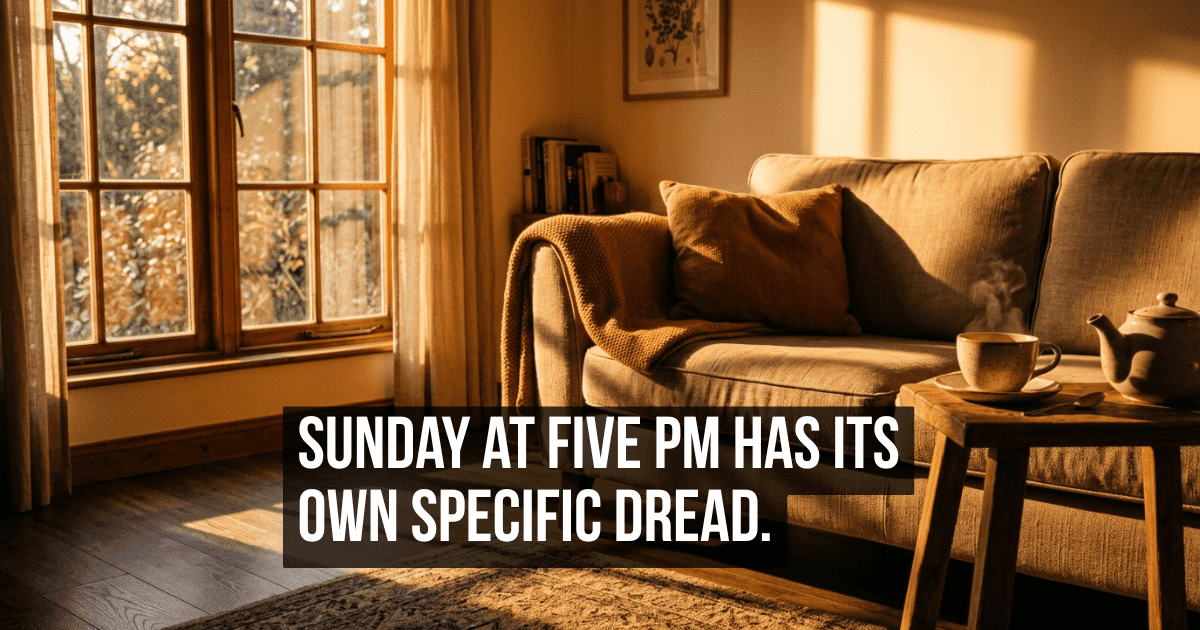
It arrives like weather. Around five o’clock on Sunday — sometimes four, sometimes six, depending on the day’s momentum — something shifts. The afternoon had been fine, maybe good. Then something dims. The light changes, or the quietness changes, or nothing changes at all and the feeling arrives anyway.
You know this feeling. Almost everyone does. And almost nobody can name it precisely.
A Feeling With No Clean Word
In English, the closest label is “Sunday Scaries” — functional but imprecise. The German Sonntagsangst, literally Sunday anxiety, is closer. What the feeling actually describes is a particular kind of grief that belongs to endings: not the end of the weekend exactly, but the closing of one mode of existing and the slow, involuntary reopening of another.
A 2018 LinkedIn survey found that 80 percent of working professionals reported experiencing Sunday anxiety. The number is so high it stops functioning as a diagnostic and starts functioning as a structural description. When four out of five people share the same psychological experience, it belongs less to individual pathology and more to the conditions that produce it.
It Is Not About Monday
The dread isn’t really about the coming day. That’s the misread most productivity advice makes — reframe Monday, plan something to look forward to, optimize Sunday nights for better sleep. All of which is reasonable, and none of which touches the real thing.
What arrives at five o’clock on Sunday is the collision between two entirely different relationships with time. The weekend operates on what could be called chosen time — the hours feel, at least nominally, like yours. Work time is organized differently: scheduled, segmented, externally governed. The Sunday dread is the moment you feel chosen time collapsing back into structured time, whether the week has officially started or not.
The timing — that specific golden-grey shift in late afternoon — carries extra weight because it echoes something older. Before artificial light made evenings productive, dusk marked the actual end of the active day. The body still carries this, and on a Sunday, the end of daylight lands on the end of the week with a double weight that no scheduling optimization can fully dissolve.
The Version of You That Has to Return
The Sunday dread has a feature that distinguishes it from ordinary anxiety about work: it’s rarely about the tasks. Most people facing a genuinely bad week feel something different — sharper, more specific, tied to known events. The five-o’clock feeling comes on even when Monday is manageable, even when nothing particular awaits.
What it’s mourning is a version of yourself. The weekend permits a version of you that is less performed, less optimized, less answerable — someone who eats lunch at an odd time, follows their attention without agenda, makes decisions that affect no one’s metrics. The dread is the awareness that this version has to fold back up.
Creative or autonomous workers often assume they should be immune to this. They’re usually not. The constraint isn’t the workplace specifically. It’s the obligation to be consistently legible — competent, reliable, scheduled. The Sunday self gets to be incoherent. The week doesn’t.
What the Feeling Is Actually Telling You
You can’t think your way out of it. People who report no Sunday dread typically either love their work unreservedly or have built lives where the line between work time and personal time has genuinely blurred — which is its own separate problem worth examining.
For everyone else, the feeling at five o’clock is accurate. It is grief for time that was yours, and won’t be again until Friday.
The most honest thing you can do with it is let it be what it is — a small, recurring acknowledgment that you have a life beyond work, and that you know it.
Something went wrong. Please refresh the page and/or try again.
Help us improve your journey
We use cookies to personalize your experience and understand how you use our site. By clicking 'Yes, I'm in!', you help us show you content you'll actually love. If you prefer to keep things simple, you can stick to the essentials. You can change your mind anytime!
Necessary
Always active
The technical storage or access is strictly necessary for the legitimate purpose of enabling the use of a specific service explicitly requested by the subscriber or user, or for the sole purpose of carrying out the transmission of a communication over an electronic communications network.
Preferences
The technical storage or access is necessary for the legitimate purpose of storing preferences that are not requested by the subscriber or user.
Analytics
The technical storage or access that is used exclusively for statistical purposes.The technical storage or access that is used exclusively for anonymous statistical purposes. Without a subpoena, voluntary compliance on the part of your Internet Service Provider, or additional records from a third party, information stored or retrieved for this purpose alone cannot usually be used to identify you.
Advertising
The technical storage or access is required to create user profiles to send advertising, or to track the user on a website or across several websites for similar marketing purposes.




Leave a Reply