Electric Cars Are Not Going to Save the Planet — They Were Designed to Save the Car Industry Instead
The EV revolution is designed to maintain automobile dependence, not eliminate emissions.
Electric vehicles are positioned as climate solution, the green alternative that lets you keep driving while reducing emissions. What this framing obscures is that cars—electric or otherwise—remain fundamentally unsustainable. The EV revolution isn’t about solving transportation’s environmental crisis. It’s about ensuring car manufacturers survive the transition to a post-fossil-fuel economy.
The goal isn’t eliminating emissions from transportation. It’s maintaining automobile dependence while switching energy sources. You still buy cars, still need parking, still require sprawling infrastructure. The auto industry continues profiting while claiming environmental virtue. This is the same pattern behind big oil invented the carbon footprint—corporations reframe systemic problems as individual choices to protect their business model.
The Manufacturing Reality
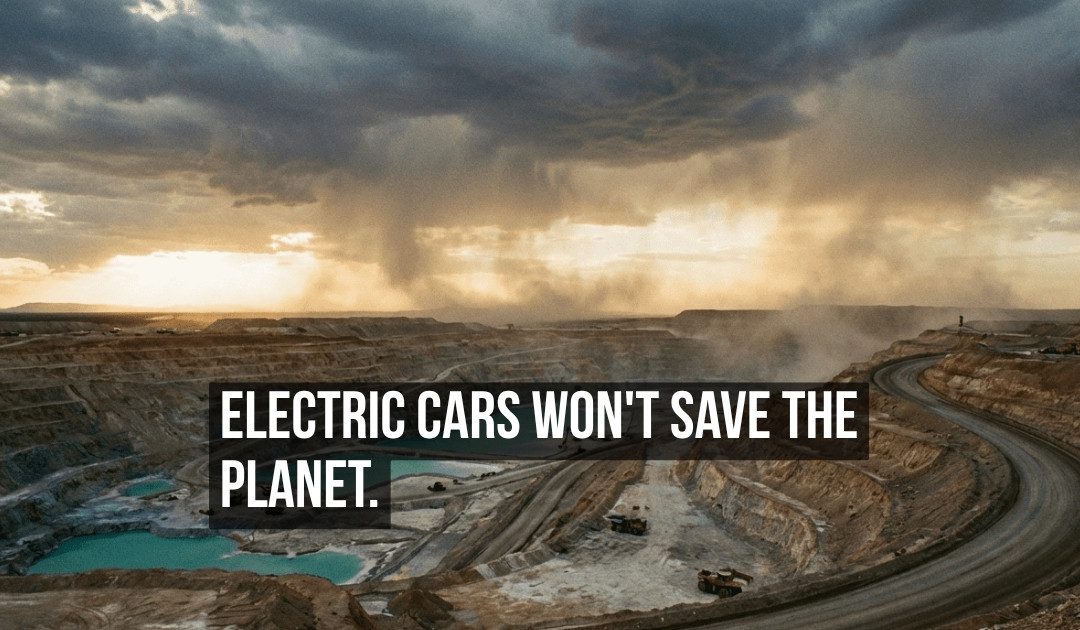
Electric vehicles require massive environmental cost before they travel a single mile. Battery production requires lithium, cobalt, nickel—metals extracted through environmentally destructive mining. Processing these materials is energy-intensive, often powered by fossil fuels. Manufacturing an EV generates significantly more emissions than manufacturing a conventional car.
Proponents argue the emissions savings during use compensate for manufacturing impact, which is true only if the EV runs for many years on clean electricity. But electricity grids remain substantially fossil-powered in most regions. And if you’re replacing a functional car with new EV, you’ve just created massive emissions for manufacturing a vehicle that’s slightly less bad than what you already had.
The mining especially problematic. Lithium extraction drains water in drought-prone regions. Cobalt mining in Congo involves child labor and environmental devastation. Nickel mining destroys rainforests. The battery in your green vehicle required environmental destruction its entire existence supposedly prevents. For how this connects to the broader pattern of green consumption myths, see recycling is a corporate lie.
The Infrastructure Demand
EVs also require enormous infrastructure investment: charging stations, upgraded electrical grids, parking with charging access. This infrastructure maintains car-dependent development patterns that are themselves unsustainable.
Cities designed around cars—sprawling suburbs, separated land uses, minimal public transit—don’t become sustainable just because cars are electric. They’re still designs that require everyone to own vehicles and drive everywhere. The fundamental problem of automobile dependence persists, just with different energy source.
Real transportation sustainability requires dense, walkable development with robust public transit. But EV promotion maintains opposite: car-dependent patterns that benefit auto manufacturers while claiming environmental progress.
The Inequality Dimension
The EV transition also exacerbates inequality. New electric vehicles cost significantly more than conventional cars, making them accessible primarily to wealthy consumers. The environmental virtue of EV ownership becomes class marker—those who can afford new cars are “doing their part” while those driving older vehicles face increasing stigma.
This creates two-tier system where wealthy get subsidized EVs through tax credits while poor continue driving aging combustion vehicles that become increasingly expensive as fuel efficiency standards tighten. The climate solution becomes another way class stratifies.
The global dimension even worse. Rich countries transition to EVs using materials extracted from poor countries that bear environmental costs of mining. The Western consumer drives clean vehicle powered by batteries created through environmental destruction elsewhere. The emissions and environmental harm are relocated, not eliminated.
The Disposal Problem
Battery disposal represents another unresolved crisis. Electric vehicle batteries degrade and require eventual replacement. Current recycling infrastructure is minimal. Most used batteries end in landfills or are improperly processed, creating toxic waste problems we’re deferring to future.
The industry promises recycling solutions are coming, but this is same promise made about plastic recycling. The economic incentives favor producing new batteries over recycling old ones. By the time first generation of EVs reaches end of life, we’ll face disposal crisis no one planned for.
The Demand Management Failure
Most fundamentally, EVs don’t address that individual car ownership is itself unsustainable regardless of power source. Cars sit unused 95% of the time, occupying valuable urban space. They require massive infrastructure investment. They enable sprawl. They’re phenomenally inefficient transportation compared to alternatives.
Real climate action in transportation means reducing car dependence: investing in public transit, redesigning cities for walkability, enabling car-free lifestyles. But this threatens auto industry profits, so it’s not promoted. Instead we get EVs—solution that maintains industry relevance while claiming environmental benefit.
The EV focus also delays other necessary changes. Cities plan EV charging infrastructure instead of transit expansion. Policy subsidizes vehicle purchases instead of mobility alternatives. Resources flow to maintaining automobile dependence rather than creating systems that eliminate need for most people to own cars.
The Honest Assessment
Electric vehicles are less bad than combustion vehicles for individual transport. But framing them as climate solution is corporate greenwashing. They’re strategy for maintaining auto industry profits during energy transition, not strategy for creating sustainable transportation.
Real sustainability requires confronting that car-dependent development patterns are incompatible with climate stability regardless of vehicle power source. This means densification, transit investment, walkable neighborhoods—changes that threaten entrenched industries, which is why EVs are promoted instead.
The electric vehicle revolution will save the car industry. Whether it contributes meaningfully to saving the planet remains profoundly doubtful.
Something went wrong. Please refresh the page and/or try again.
Help us improve your journey
We use cookies to personalize your experience and understand how you use our site. By clicking 'Yes, I'm in!', you help us show you content you'll actually love. If you prefer to keep things simple, you can stick to the essentials. You can change your mind anytime!
Necessary
Always active
The technical storage or access is strictly necessary for the legitimate purpose of enabling the use of a specific service explicitly requested by the subscriber or user, or for the sole purpose of carrying out the transmission of a communication over an electronic communications network.
Preferences
The technical storage or access is necessary for the legitimate purpose of storing preferences that are not requested by the subscriber or user.
Analytics
The technical storage or access that is used exclusively for statistical purposes.The technical storage or access that is used exclusively for anonymous statistical purposes. Without a subpoena, voluntary compliance on the part of your Internet Service Provider, or additional records from a third party, information stored or retrieved for this purpose alone cannot usually be used to identify you.
Advertising
The technical storage or access is required to create user profiles to send advertising, or to track the user on a website or across several websites for similar marketing purposes.




Leave a Reply