Your Brain Cannot Multitask — It Just Switches Rapidly Between Tasks and Pays a Price Each Time
Every time someone describes themselves as a good multitasker, they are claiming a skill they do not have. Not because of personal limitation — because the capability they are describing does not exist in human neuroscience. The same cognitive switching cost that makes multitasking impossible also explains why productivity and procrastination are neurologically identical — both involve a brain failing to commit its full resources.
The Switching Illusion
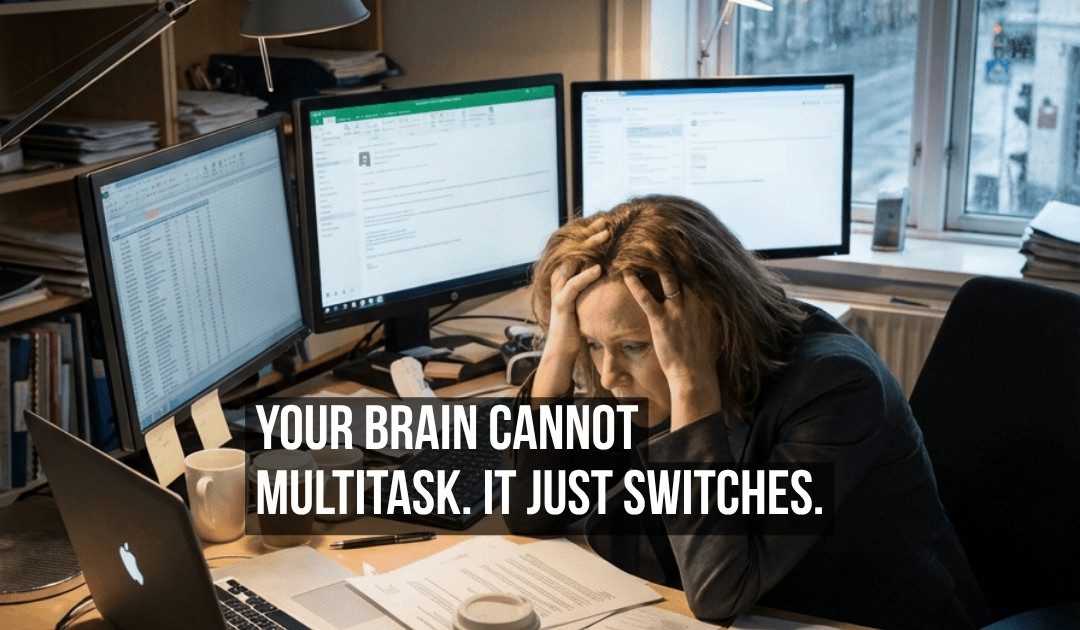
The human brain does not process two demanding cognitive tasks simultaneously. What it does is switch between them rapidly — a process called task-switching — while producing the subjective impression of parallel processing. The distinction matters enormously, because task-switching carries a measurable cost that parallel processing would not.
That cost is called attention residue, a term coined by organizational psychologist Sophie Leroy at the University of Washington. When you switch from one task to another, part of your cognitive attention remains partially engaged with the previous task. The residue from the abandoned task occupies working memory that should be fully deployed on the current one. The more you switch, the more residue accumulates, and the less cognitive capacity is actually available for anything you are doing.
Leroy’s research found that people who complete one task before switching to another consistently outperform those who switch while a task is still incomplete. The switch itself — not the tasks in isolation but the transition between them while unresolved threads remain — is what degrades performance. The parallel with overthinking and inaction as the same loop is structural: both are forms of cognitive fragmentation where attention circulates without resolving.
What the Research Numbers Show
A study from the University of California, Irvine by researcher Gloria Mark found that the average knowledge worker is interrupted or self-interrupts every three to five minutes. After each interruption, it takes an average of 23 minutes to return to the original task with full focus. Given the frequency of interruptions in a standard workday, most knowledge workers are never fully focused on anything at any point during their hours at a desk.
The costs extend beyond output quality. Continuous task-switching is associated with elevated stress markers and accelerating mental fatigue. The brain’s error-detection system works harder when managing frequent context shifts, consuming resources that compound exhaustion through the day. People who describe multitasking all day and feeling drained by 3pm are not reporting a productivity achievement. They are reporting cumulative cognitive damage.
There is one partial exception: pairing a cognitively demanding task with a genuinely automatic one — walking while thinking, listening to music while doing repetitive manual work — does not trigger the full attention residue cost because one task runs on a different processing track. This is not multitasking as commonly practiced. It is the specific pairing of cognitive and motor tasks that operate on separate neural systems.
The professional implications are particularly significant in open-plan offices, which were designed with collaboration as the stated priority but produce an environment structurally incompatible with deep cognitive work. A knowledge worker interrupted every few minutes cannot recover focus between interruptions. The result is not merely lower output quality — it is a workplace architecture that systematically prevents the sustained thinking that produces the most valuable professional work, while generating the constant appearance of activity that managers frequently interpret as productivity. The way doom scrolling might be rational applies here too — fragmented environments produce fragmented cognition, and both feel productive in the moment.
The clearest evidence for the cost of task-switching comes from studying its opposite. Cal Newport’s research on deep work — extended periods of uninterrupted focus on cognitively demanding tasks — documents consistent performance advantages in populations that practise it. The advantages are not motivational. They are structural: the brain operating without switching costs produces qualitatively different output from the brain operating under perpetual interruption, regardless of the individual’s intelligence or effort.
The brain that feels most productive under constant task-switching is often the brain most comprehensively deceived about its own performance. Focus is not a productivity technique. It is the only mode in which complex cognitive work actually gets done at the level it is capable of.
Something went wrong. Please refresh the page and/or try again.
Help us improve your journey
We use cookies to personalize your experience and understand how you use our site. By clicking 'Yes, I'm in!', you help us show you content you'll actually love. If you prefer to keep things simple, you can stick to the essentials. You can change your mind anytime!
Necessary
Always active
The technical storage or access is strictly necessary for the legitimate purpose of enabling the use of a specific service explicitly requested by the subscriber or user, or for the sole purpose of carrying out the transmission of a communication over an electronic communications network.
Preferences
The technical storage or access is necessary for the legitimate purpose of storing preferences that are not requested by the subscriber or user.
Analytics
The technical storage or access that is used exclusively for statistical purposes.The technical storage or access that is used exclusively for anonymous statistical purposes. Without a subpoena, voluntary compliance on the part of your Internet Service Provider, or additional records from a third party, information stored or retrieved for this purpose alone cannot usually be used to identify you.
Advertising
The technical storage or access is required to create user profiles to send advertising, or to track the user on a website or across several websites for similar marketing purposes.




Leave a Reply