How Busyness Replaced Achievement as the Primary Status Signal and Made an Empty Calendar Feel Like Failure
At some point in the past two decades, the answer to “how are you?” changed. Not always, and not everywhere — but frequently enough to be notable. The new answer is not a feeling but a schedule. “Crazy busy,” “slammed,” “juggling everything,” “not enough hours in the day.” The content of the response is a description of workload rather than wellbeing — and it carries, in contemporary professional culture, an unmistakably positive social charge. To be busy is to be important. To be available is to be redundant.
This is a recent development. Busyness as status symbol is not a timeless feature of work culture. It is a specific product of economic and cultural conditions that emerged in the late twentieth century and accelerated after 2010, and understanding it requires understanding what it replaced.
What Leisure Used to Signal
For most of recorded history, the ability to not work was the primary status marker. Aristocracies derived their social position, in part, from the ability to demonstrate productive leisure — hunting, travel, the arts, educated idleness. The upper classes of the nineteenth and early twentieth centuries signaled status through conspicuous leisure: the long holiday, the unhurried afternoon, the absence of visible employment. Thorstein Veblen’s concept of conspicuous leisure, introduced in 1899, described precisely this dynamic: the wealthy demonstrated their position by what they demonstrably did not have to do.
The post-industrial knowledge economy began reversing this dynamic from the 1980s onward. As the most economically rewarded occupations shifted from owning capital to deploying human capital — from inheriting wealth to earning it through professional service — the signal of status shifted accordingly. Busyness became evidence of being in demand, which became evidence of value, which became evidence of status. The leisure that had once signaled arrival now signaled irrelevance.
The Data Behind the Display
A 2017 study by Columbia Business School researchers Silvia Bellezza, Neeru Paharia, and Anat Keinan found that Americans interpreted busyness signals as indicators of higher social status, and that this interpretation had strengthened over the preceding two decades. Respondents rated a person who described their schedule as packed and their time as scarce as more successful and in greater demand than a person who described their life as relaxed and their schedule as open.
The same study found that the effect was stronger in the United States than in Italy, where dolce far niente — the sweetness of doing nothing — retains positive social valence and where a person with demonstrable leisure may still be interpreted as successful rather than idle. The busyness-as-status signal is culturally specific, most pronounced in Anglo-American work cultures, and is actively exported through those cultures’ media and professional norms.
The Empty Calendar as Failure
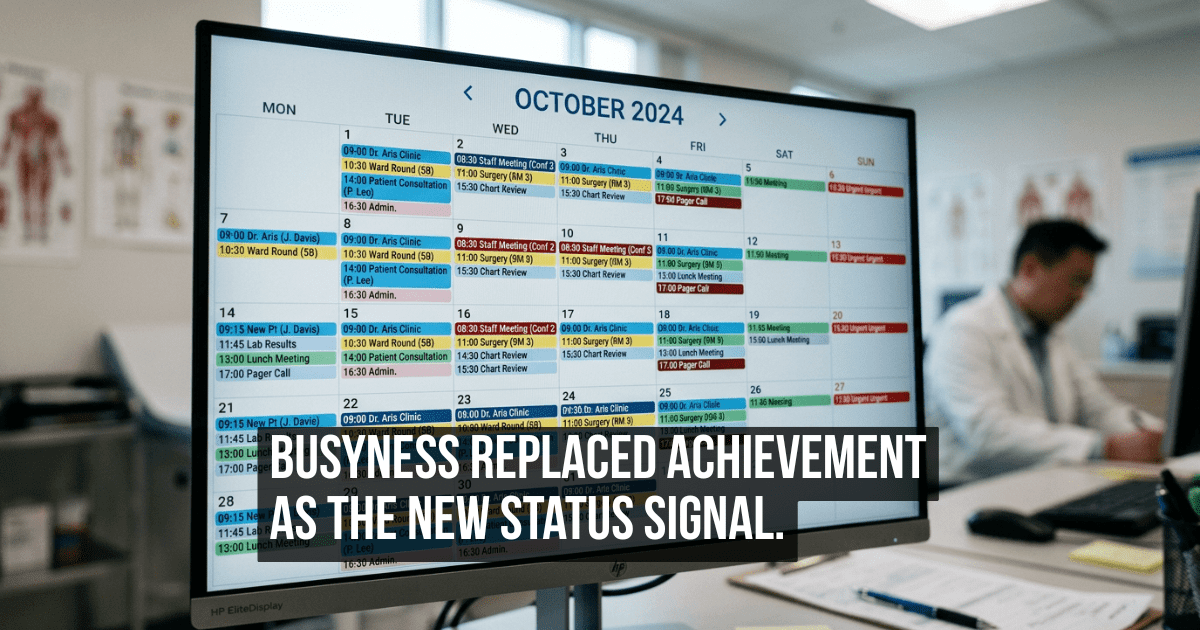
The inverse of the busyness signal is the anxiety produced by an empty schedule. Many knowledge workers report that a clear afternoon in their calendar generates unease rather than relief — a low-grade anxiety that the absence of meetings and tasks represents not productivity but marginality, not rest but evidence of not being needed. The calendar has become a status document. Its contents — the density of meetings, the back-to-back commitments — are read as evidence of organizational importance in the same way that a packed social schedule might once have indicated popularity.
Remote work has intensified this dynamic by making the calendar the primary evidence of a worker’s productivity and importance. Without the visible presence of a body at a desk, the Outlook grid becomes the proxy for participation — and a sparse grid reads, even to its owner, as slightly shameful.
What the Performance Costs
The problem with busyness as status is that busyness is not the same thing as achievement. The person in back-to-back meetings for eight hours has performed a full working day of visible occupation. Whether they have accomplished anything of consequence is a separate question. Research on cognitive productivity consistently finds that long, uninterrupted stretches of complex work produce more meaningful output than equivalent time fragmented into meetings, context-switches, and reactive tasks. The state most conducive to achievement is, in many knowledge professions, precisely the underfull calendar that busyness culture has made socially unacceptable to display.
The status signal and the productivity optimum are pointing in opposite directions. The worker who could most benefit from a clear afternoon to think is also the one most likely to fill it with meetings in order to avoid the appearance of having nothing to do.
Something went wrong. Please refresh the page and/or try again.
Help us improve your journey
We use cookies to personalize your experience and understand how you use our site. By clicking 'Yes, I'm in!', you help us show you content you'll actually love. If you prefer to keep things simple, you can stick to the essentials. You can change your mind anytime!
Necessary
Always active
The technical storage or access is strictly necessary for the legitimate purpose of enabling the use of a specific service explicitly requested by the subscriber or user, or for the sole purpose of carrying out the transmission of a communication over an electronic communications network.
Preferences
The technical storage or access is necessary for the legitimate purpose of storing preferences that are not requested by the subscriber or user.
Analytics
The technical storage or access that is used exclusively for statistical purposes.The technical storage or access that is used exclusively for anonymous statistical purposes. Without a subpoena, voluntary compliance on the part of your Internet Service Provider, or additional records from a third party, information stored or retrieved for this purpose alone cannot usually be used to identify you.
Advertising
The technical storage or access is required to create user profiles to send advertising, or to track the user on a website or across several websites for similar marketing purposes.




Leave a Reply