Why the Hotel Minibar Makes No Economic Sense and You Still Open It Every Single Time
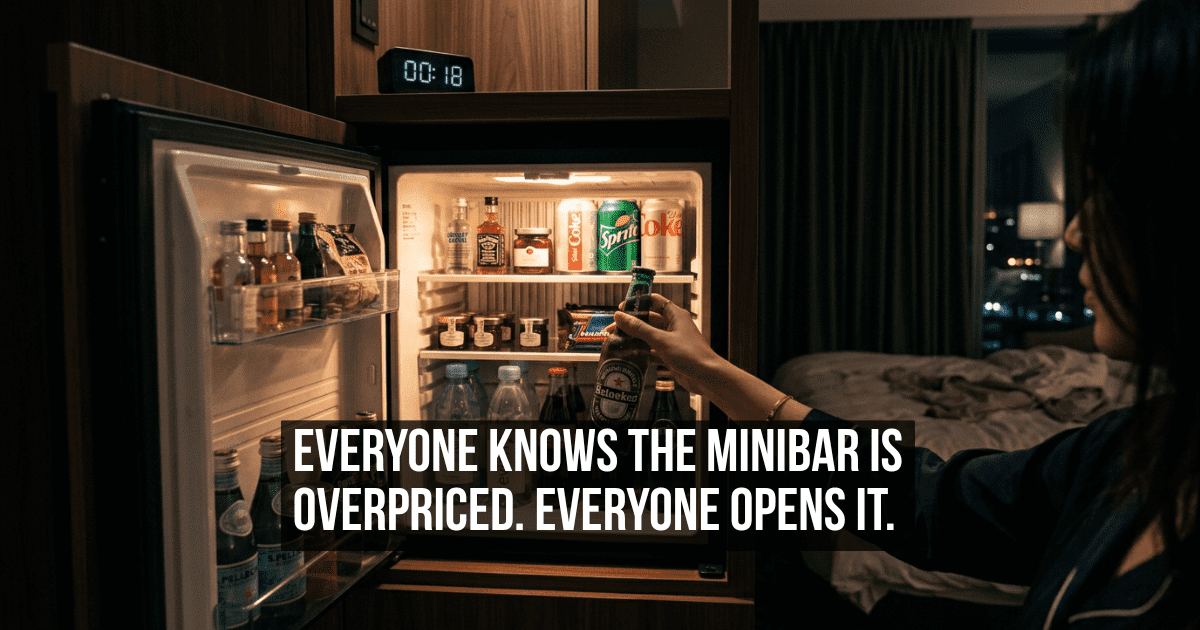
The hotel minibar is an object of near-universal recognition. A small refrigerator, positioned prominently, stocked with drinks and snacks at prices that are two to four times their retail equivalents. Everyone knows the prices are extreme. Hotel guests have complained about minibar pricing for as long as hotel minibars have existed. And then they open it anyway.
The minibar should not be commercially viable. By the logic of informed consumer behavior — the model in which people with clear price information make rational decisions — it should sit unopened in the corner while guests order delivery from restaurants, walk to convenience stores, or simply go without. Instead, hotel chains report that minibar consumption, though declining slightly with the advent of food delivery apps, remains a meaningful revenue line. The gap between what people know about the minibar and what they do with it is worth examining.
The Temporal Logic
The minibar operates at the intersection of several psychological conditions that collectively override the rational consumer. The first is timing. You arrive at the room at 11 PM. You have been traveling for hours. You are hungry or thirsty in the specific way that long-distance travel produces — not ravenously, but in a way that wants immediate resolution. The alternatives to the minibar require decision-making: navigating a delivery app, waiting twenty-five minutes, perhaps leaving the room.
The minibar requires nothing. It is already there. The transaction has already been started by the hotel, which placed the items at your eye level, in a cold container, lit and accessible. The cost of opening it is zero; the cost of not opening it is mild sustained discomfort. At this specific moment, having already paid for the room, already committed to the hotel, the incremental cost of the minibar item is psychologically distant from the decision being made. The eight-dollar water bottle isn’t being compared against a two-dollar convenience store bottle. It’s being compared against continued thirst at midnight.
The Sunk Cost Environment
Hotel stays produce a specific psychological environment that undermines normal cost sensitivity. Once the room rate is paid, the guest enters a mental accounting frame where additional hotel charges are absorbed into an existing expense category rather than treated as new expenditures. Behavioral economists call this the vacation permission frame: the decision to spend money on travel creates a broader license to spend in ways that wouldn’t occur at home.
The minibar benefits from this frame directly. A person who would never pay eight dollars for a chocolate bar at a supermarket will pay it from a minibar without registering the transaction as unusual, because the transaction occurs inside a broader economic event — the hotel stay — where normal spending parameters have already been suspended.
The Design That Does the Work
Hotel interior design has been studied extensively by hospitality researchers, and minibar placement reflects accumulated knowledge about what the eye goes to first in an unfamiliar room. Minibars are positioned near the desk or entertainment unit — typically at standing height, always in the immediate visual field of someone settling into the space. The items are arranged for visual appeal rather than nutritional logic: the chocolate is at the front, the bottle of whisky is visible through the glass.
Some hotels have moved to sensor-equipped minibars that charge automatically when items are lifted, rather than requiring a deliberate decision to consume. The friction of the decision — the moment in which the guest explicitly chooses to incur a charge — is removed. The item is in your hand before the purchase has been registered as a purchase.
Why the Knowledge Doesn’t Help
Knowing that the minibar is expensive does not, in practice, prevent minibar consumption, and this is actually the revealing part of the phenomenon. The person who opens the minibar at midnight, knowing the prices, knowing they could get the same items cheaper elsewhere, knowing they are being charged a premium for the privilege of immediacy — that person is making a genuine, informed choice in favor of comfort over cost efficiency. They are not being deceived. They are choosing, in the specific conditions of that moment, to pay the premium.
The minibar works not because it fools anyone but because it correctly identifies a set of conditions — fatigue, hunger, isolation, the suspension of normal cost-sensitivity that travel produces — and places itself at the exact point where those conditions converge. It is not a trap. It is a convenience product that prices itself for the conditions in which it is consumed. The outrage it generates is the outrage of someone who knew the price and paid it anyway — which is a complaint about themselves, directed more comfortably at the hotel.
Something went wrong. Please refresh the page and/or try again.
Help us improve your journey
We use cookies to personalize your experience and understand how you use our site. By clicking 'Yes, I'm in!', you help us show you content you'll actually love. If you prefer to keep things simple, you can stick to the essentials. You can change your mind anytime!
Necessary
Always active
The technical storage or access is strictly necessary for the legitimate purpose of enabling the use of a specific service explicitly requested by the subscriber or user, or for the sole purpose of carrying out the transmission of a communication over an electronic communications network.
Preferences
The technical storage or access is necessary for the legitimate purpose of storing preferences that are not requested by the subscriber or user.
Analytics
The technical storage or access that is used exclusively for statistical purposes.The technical storage or access that is used exclusively for anonymous statistical purposes. Without a subpoena, voluntary compliance on the part of your Internet Service Provider, or additional records from a third party, information stored or retrieved for this purpose alone cannot usually be used to identify you.
Advertising
The technical storage or access is required to create user profiles to send advertising, or to track the user on a website or across several websites for similar marketing purposes.




Leave a Reply