Why Voicemail Deserves a Comeback and Your Habit of Ignoring It Is Costing You More Than You Think
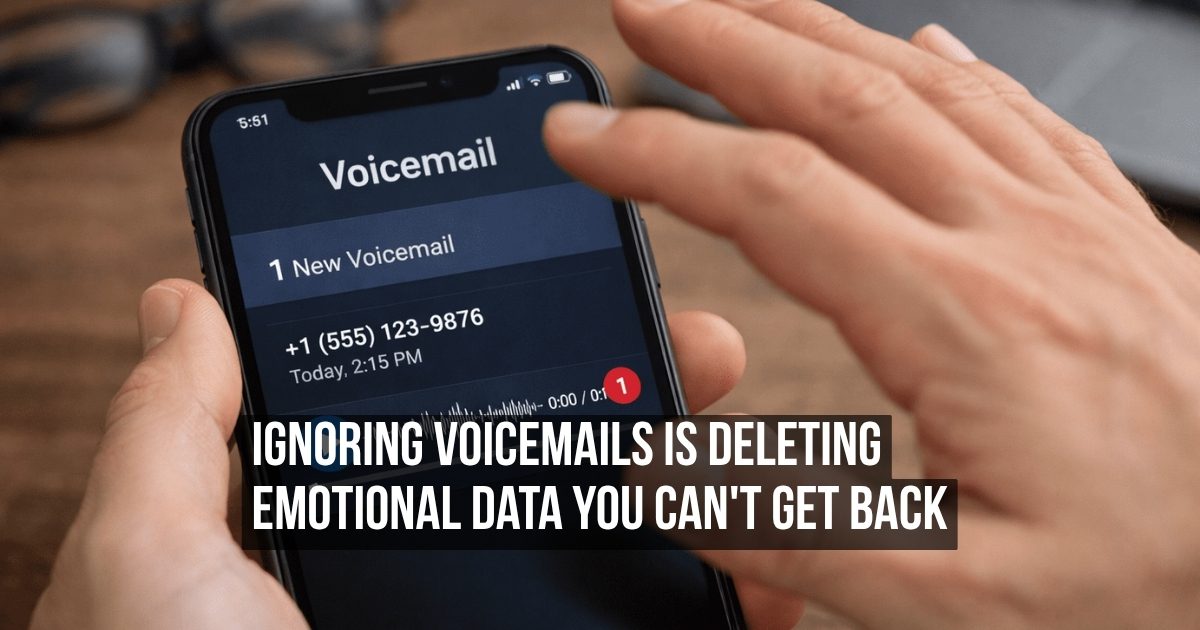
Your phone rings. You don’t answer. The caller is redirected to voicemail. They leave a message. You see the notification, feel a small ripple of dread, and do not listen to it. Hours later, you text them instead: “Hey, saw you called — what’s up?” The voicemail sits unplayed for days, eventually deleted without being heard. This behaviour is so widespread that YouGov polling has found a significant majority of adults under 35 report actively avoiding voicemail, with many describing the red notification badge as a source of genuine anxiety. The most asynchronous, least intrusive form of voice communication ever invented has become the most avoided. And the avoidance is costing more than anyone acknowledges.
What Voicemail Actually Is
Strip away the cultural baggage and voicemail is a remarkable communication format. It is asynchronous: the sender records at their convenience and the receiver listens at theirs. It carries vocal tone, emotional nuance, and conversational cadence that text cannot transmit. It requires no immediate response. It leaves no ambiguity about pronunciation or emphasis. It can convey complex, multi-part information without the character limits, autocorrect errors, and compositional labour of texting. By every functional measure except brevity, voicemail is a superior communication medium to text messaging for anything beyond simple logistical coordination.
And yet, a 2022 survey by Vonage found that voicemail usage has declined by approximately 8 percent year-on-year since 2018, with the steepest drops among users aged 18 to 34. The format is not dying because it failed. It is dying because the generation that would use it most has decided, collectively and without much deliberation, that listening to it is emotionally uncomfortable.
The Anxiety of the Uncontrolled Message
Text messages arrive pre-processed. You see the content before you engage with it. You can scan, evaluate, and decide whether to respond — all before the sender knows you’ve read it. Voicemail inverts this power dynamic. You don’t know what the message contains until you listen. The content is locked behind a play button, and pressing that button surrenders control: you must sit through the message at the speaker’s pace, with the speaker’s emotional tone, without the ability to skim or preview.
For a generation raised on text-based communication where the recipient controls the speed and timing of information intake, the voicemail’s temporal demands feel like an imposition. You can’t speed-read a voicemail. You can’t scroll to the important part. You have to listen to “Hey, it’s me, um, so I was just thinking about, like, whether you might be free this weekend” before you reach the actual information. The format respects the speaker’s natural speech patterns, including pauses, filler words, and tangents — all of which text communication has trained us to regard as inefficiency.
What Gets Lost in the Text Translation
When you text “saw you called, what’s up?” instead of listening to the voicemail, you initiate a new communication sequence that is almost always less efficient than the one you avoided. The voicemail likely contained the answer to “what’s up” — that’s why the person left it. By not listening, you’ve created a redundant exchange: a text asking a question that was already answered in a message you chose not to hear.
More significantly, voice carries information that text cannot. A friend calling to say “I’m fine” in a strained, quiet voice communicates something fundamentally different from a text reading “I’m fine.” A parent leaving a rambling voicemail about a doctor’s appointment is communicating not just the appointment details but their emotional state — anxiety, relief, confusion — through vocal cues that no text message can replicate. Research in affective computing by MIT’s Media Lab has shown that humans detect emotional states from voice with approximately 70 percent accuracy, compared to approximately 50 percent from text — barely better than chance.
Every unplayed voicemail is a packet of emotional data that was offered and refused. The caller chose voice because they had something that voice could carry better than text. The recipient’s refusal to engage with voice forces the emotional content to be translated into a format that strips it of the very qualities the caller considered important enough to speak aloud.
The Professional Blind Spot
In professional contexts, voicemail avoidance creates tangible friction. Lawyers, medical offices, tradespeople, and recruiters frequently use voicemail to convey time-sensitive, complex information. A plumber calling to confirm a slot, provide a quote, and ask a follow-up question can accomplish all three in a forty-second voicemail. The same exchange conducted over text requires three to six messages, each waiting for a reply, each susceptible to misinterpretation, and each consuming attention across a longer time window.
Recruiters have reported that candidates who refuse to listen to voicemails miss callback windows, misunderstand scheduling details, and occasionally lose opportunities because the information left in a voicemail was never heard and the follow-up text arrived too late. The voicemail was not ambiguous. It was unlistened to.
The Format That Respects Both Parties
A phone call demands synchronous availability: both parties must be free at the same moment. A text is asynchronous but limited: it carries no tone, no pace, no emotional texture. Voicemail occupies the middle ground that neither of the dominant formats covers. It allows one party to speak freely and at length, with full vocal expression, while the other party engages whenever convenient, without the pressure of real-time conversation.
This combination — expressive richness plus temporal flexibility — makes voicemail uniquely suited to a specific category of communication that has no good alternative: emotional check-ins, nuanced requests, apologies, complicated instructions, and anything that benefits from hearing the speaker’s voice without requiring an immediate response. These are precisely the communications that text handles worst and phone calls handle intrusively. Voicemail handles them gracefully, on both sides’ terms.
The voicemail is not a relic. It is a perfectly designed communication format that the current generation has rejected not because it doesn’t work but because it asks for something that texting has trained us to resist: thirty seconds of patient, linear listening during which we are not in control of the content, the pace, or the emotional register. The notification badge is not the problem. The discomfort of surrendering attention to someone else’s voice, for less than a minute, in exchange for information they thought important enough to speak aloud — that is what we’re avoiding. And the cost of avoiding it is measured in missed nuance, duplicated exchanges, and human signals that never reached the person they were meant for.
Something went wrong. Please refresh the page and/or try again.
Help us improve your journey
We use cookies to personalize your experience and understand how you use our site. By clicking 'Yes, I'm in!', you help us show you content you'll actually love. If you prefer to keep things simple, you can stick to the essentials. You can change your mind anytime!
Necessary
Always active
The technical storage or access is strictly necessary for the legitimate purpose of enabling the use of a specific service explicitly requested by the subscriber or user, or for the sole purpose of carrying out the transmission of a communication over an electronic communications network.
Preferences
The technical storage or access is necessary for the legitimate purpose of storing preferences that are not requested by the subscriber or user.
Analytics
The technical storage or access that is used exclusively for statistical purposes.The technical storage or access that is used exclusively for anonymous statistical purposes. Without a subpoena, voluntary compliance on the part of your Internet Service Provider, or additional records from a third party, information stored or retrieved for this purpose alone cannot usually be used to identify you.
Advertising
The technical storage or access is required to create user profiles to send advertising, or to track the user on a website or across several websites for similar marketing purposes.




Leave a Reply