Making Your Bed Every Morning Is Not About Tidiness and Never Was
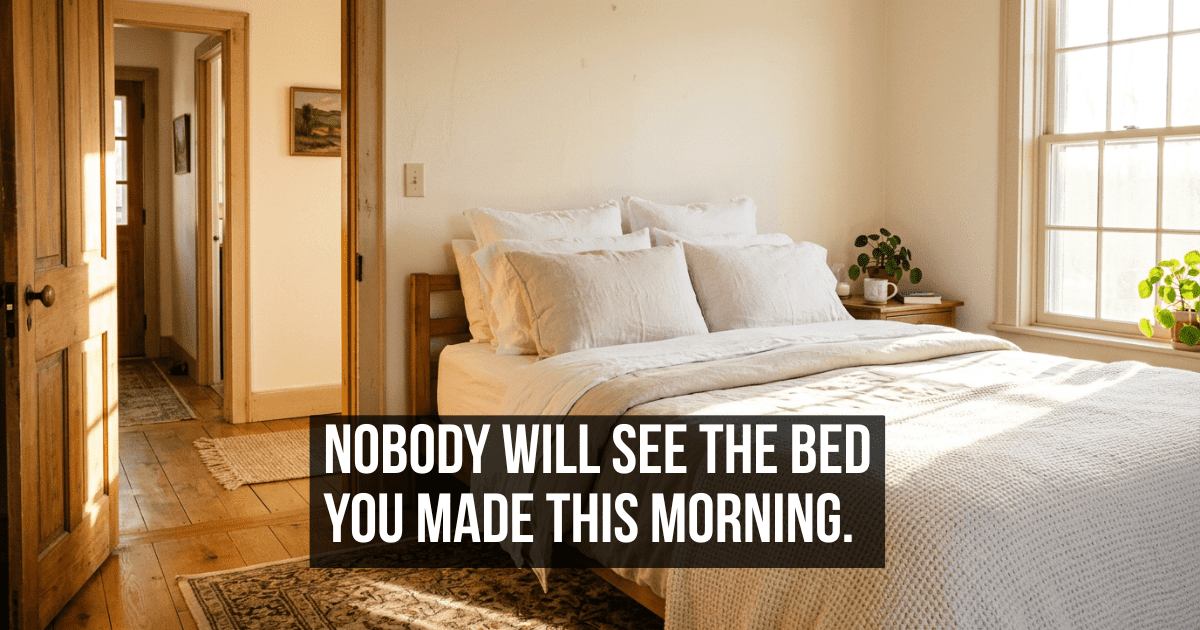
The sheets are pulled straight, the pillows arranged, the duvet smoothed flat. It takes ninety seconds, maybe two minutes. Nobody will see this room until tonight. The bed will be unmade again in twelve hours. And yet you did it anyway — or, if you didn’t, there’s a small and specific guilt about the fact that you didn’t.
Making your bed is one of the most argued-about minor habits in modern self-improvement culture, recommended by military veterans and neuroscientists and productivity books with identical urgency. But the case for it has almost nothing to do with tidiness.
The First Completed Thing
The most commonly cited argument for bed-making is military in origin: Admiral William McRaven’s 2014 commencement address at the University of Texas, later expanded into a book, argued that making your bed each morning provides a small, achievable task completed first thing — a foundation of order from which the rest of the day can proceed.
The logic is behavioral, not aesthetic. The made bed isn’t about the bed. It’s about what completing something does to the brain’s readiness for the next thing. Behavioral researchers studying completion effects — the cognitive and emotional benefits of finishing a discrete task — have found that small completions genuinely affect subsequent motivation. The Zeigarnik effect, which describes how incomplete tasks occupy mental bandwidth, works in reverse: a completed task, however small, creates a brief cognitive clearing.
The made bed isn’t order. It’s permission.
What Unmade Beds Actually Signal
The bedroom, for most people, is the last space in the home that belongs entirely to them. Unlike shared living areas or workspaces, it’s rarely seen by anyone else. The choice of whether to make the bed is therefore an unusually private one — made, or not made, for an audience of one.
A 2011 survey from the National Sleep Foundation found that people who reported making their bed most mornings were 19 percent more likely to report getting a good night’s sleep. The mechanism here isn’t cleanliness but psychological priming: the association between an ordered environment and a mind that can actually settle.
Coming home to an unmade bed isn’t just visually untidy. For many people it extends the uncompleted quality of the morning into the evening — the sense of a day that didn’t quite start properly, unresolved until the sheets are finally pulled straight at 11 p.m.
The Counterargument Worth Considering
For every person who swears by the made bed, there’s someone for whom it matters not at all. Certain European traditions actively discourage the immediately-made bed on hygiene grounds — the argument that an aired mattress left open for an hour is cleaner than one immediately sealed under a duvet has some empirical support. Some people are high-functioning and entirely unbothered by the state of their sheets.
The bed-making literature tends to ignore these people because their existence complicates the causality claim. Maybe made beds don’t produce good days. Maybe people who make beds and people who have good days are simply drawn from the same segment of the population — one with a slightly higher baseline tendency toward routine. What’s true regardless: the choice says something about what order means to you specifically.
The Ritual Is the Point
Whether or not you make your bed, the real question is what your mornings are built from. The bed-making habit is compelling not because it produces a clean room but because it provides something that functional days tend to need at their edges: a beginning that feels deliberate, and an ending that does the same.
The ninety seconds aren’t about tidiness. They’re about being the kind of person who finishes what they started, practiced on the easiest possible canvas, once a day, before anything more difficult begins.
Something went wrong. Please refresh the page and/or try again.
Help us improve your journey
We use cookies to personalize your experience and understand how you use our site. By clicking 'Yes, I'm in!', you help us show you content you'll actually love. If you prefer to keep things simple, you can stick to the essentials. You can change your mind anytime!
Necessary
Always active
The technical storage or access is strictly necessary for the legitimate purpose of enabling the use of a specific service explicitly requested by the subscriber or user, or for the sole purpose of carrying out the transmission of a communication over an electronic communications network.
Preferences
The technical storage or access is necessary for the legitimate purpose of storing preferences that are not requested by the subscriber or user.
Analytics
The technical storage or access that is used exclusively for statistical purposes.The technical storage or access that is used exclusively for anonymous statistical purposes. Without a subpoena, voluntary compliance on the part of your Internet Service Provider, or additional records from a third party, information stored or retrieved for this purpose alone cannot usually be used to identify you.
Advertising
The technical storage or access is required to create user profiles to send advertising, or to track the user on a website or across several websites for similar marketing purposes.




Leave a Reply