Why the Snooze Button Trains Your Brain to Distrust Every Wake-Up Signal It Receives
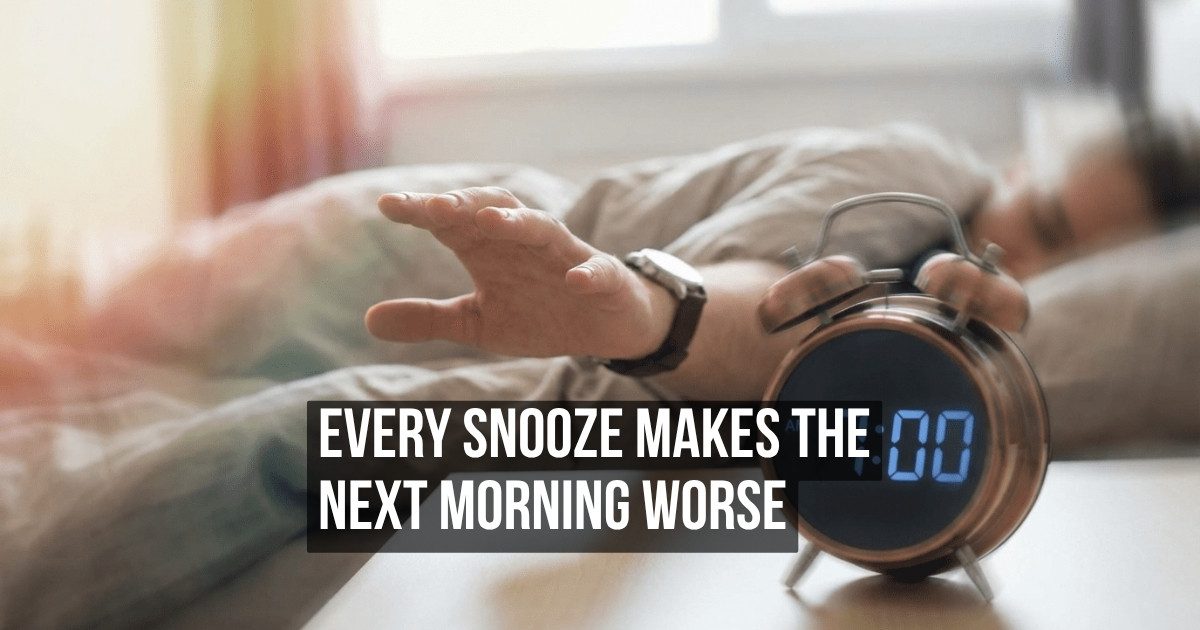
The alarm sounds at 6:30 a.m. You reach for it instantly, eyes still closed, thumb finding the snooze button with the precision of a surgeon. Nine minutes later, it fires again. You hit it again. And again. By the time you actually rise at 7:03, you have launched and aborted the waking process four times — and your brain has learned something specific from the experience: that the alarm does not actually mean what it says. The pattern is directly related to why your body never forgets stolen sleep — each snooze cycle compounds the sleep debt that accumulates invisibly across weeks.
A Habit Older Than Digital Clocks
The snooze button first appeared in 1956, when General Electric introduced it on the Snooz-Alarm clock. The nine-minute interval — still standard on most devices today — was not the result of sleep research. It was a mechanical constraint. The gear mechanisms inside early alarm clocks could only accommodate a snooze cycle of slightly more or slightly less than ten minutes, and engineers chose nine. Seventy years later, smartphone manufacturers kept the same interval by default, not because science endorsed it but because users expected it.
What nobody anticipated was the neurological consequence of building a postponement mechanism into the very tool designed to enforce a non-negotiable time boundary.
What Happens Inside Those Nine Minutes
When the first alarm jolts you from sleep, your brain initiates a cascade of arousal responses. Cortisol levels begin to rise. Heart rate increases. The prefrontal cortex — the region responsible for planning and decision-making — starts to come online. Hitting snooze interrupts this process mid-sequence. Your body receives a contradictory signal: wake up, but actually, don’t.
During those extra nine minutes, you do not return to restful sleep. You typically enter the lightest stage of non-REM sleep or hover in a drowsy half-consciousness that sleep researchers call sleep inertia. Waking from this state a second time leaves you groggier than if you had risen at the first alarm. The cognitive fog can persist for up to two hours — far longer than the brief perceived benefit of a few extra minutes in bed.
A 2022 study published in the Journal of Sleep Research found that habitual snooze users reported higher levels of morning drowsiness and lower subjective alertness compared to those who set a single alarm and honoured it. The paradox is clean: the tool meant to ease the transition into wakefulness makes it measurably harder. The compounding effect on sleep architecture is why morning routines are making you worse — the day starts with a self-inflicted cognitive deficit before any external pressure is applied.
Training Your Brain to Ignore Its Own Signals
Repetition shapes neural pathways. Every morning you override the alarm, your brain files a small but significant update: the sound that means “get up now” actually means “consider getting up eventually.” Over weeks and months, this rewires the urgency response. The alarm stops functioning as a genuine signal and starts functioning as a suggestion — the auditory equivalent of a suggestion box that nobody empties.
Behavioural psychologists call this extinction of stimulus control. A stimulus (the alarm) that was once reliably paired with an action (waking up) gradually loses its power because the expected consequence (getting out of bed) no longer follows. Pavlov’s dogs salivated at the bell because food always came. Snooze users stop responding to the alarm because nothing happens when it rings.
The implications reach beyond morning grogginess. People who habitually override their alarm often report difficulty respecting other self-imposed deadlines throughout the day. The first decision of the morning — “I set a boundary and I am going to break it” — establishes a template that echoes through every subsequent act of self-regulation. This is also why productivity culture has pathologized sleep — both reflect the same misalignment between how the body actually recovers and what external systems demand of it.
Why We Do It Anyway
If snoozing is neurologically counterproductive, why does virtually everyone do it? Because the perceived reward is immediate and the cost is invisible. Those extra minutes feel like stolen luxury. The alarm represents obligation; silencing it, even briefly, represents agency. In a world where most mornings are dictated by external schedules — commutes, school runs, shift start times — the snooze button is one of the few moments where you exercise control, however illusory, over time itself.
There is also a hedonic component. Returning to a warm bed after an alarm feels disproportionately pleasurable because the brain is comparing two states: the cold shock of waking versus the enveloping comfort of staying. The contrast amplifies the reward. What the brain fails to calculate in that moment is that the next awakening, nine minutes later, will feel worse.
The Design That Enables the Damage
Alarm clock manufacturers and smartphone developers could easily remove or limit the snooze function. They don’t, because snooze is a feature people actively seek. Removing it would feel punitive. Users would switch to a competitor that still offered it. The market incentive is to make mornings feel manageable, not to make them physiologically optimal.
Some newer alarm apps — Alarmy, I Can’t Wake Up, Sleep Cycle — have experimented with forcing users to solve puzzles, scan barcodes, or shake their phone vigorously before the alarm silences. These interventions work precisely because they bypass the snooze reflex and force cortical engagement. They are also, by every user review metric, described as “annoying” — which is another way of saying they actually work.
The snooze button endures because it solves an emotional problem while creating a biological one. Every morning, millions of people teach their brains that the boundary they set the night before was never real. The alarm becomes theatre. And the day begins with a small, rehearsed act of self-deception that nobody considers significant enough to question.
Something went wrong. Please refresh the page and/or try again.
Help us improve your journey
We use cookies to personalize your experience and understand how you use our site. By clicking 'Yes, I'm in!', you help us show you content you'll actually love. If you prefer to keep things simple, you can stick to the essentials. You can change your mind anytime!
Necessary
Always active
The technical storage or access is strictly necessary for the legitimate purpose of enabling the use of a specific service explicitly requested by the subscriber or user, or for the sole purpose of carrying out the transmission of a communication over an electronic communications network.
Preferences
The technical storage or access is necessary for the legitimate purpose of storing preferences that are not requested by the subscriber or user.
Analytics
The technical storage or access that is used exclusively for statistical purposes.The technical storage or access that is used exclusively for anonymous statistical purposes. Without a subpoena, voluntary compliance on the part of your Internet Service Provider, or additional records from a third party, information stored or retrieved for this purpose alone cannot usually be used to identify you.
Advertising
The technical storage or access is required to create user profiles to send advertising, or to track the user on a website or across several websites for similar marketing purposes.




Leave a Reply