Productivity and Procrastination Are Neurologically Identical and Your Brain Genuinely Cannot Tell the Difference Between Them
Neuroscientists discovered flow and distraction are identical—your brain can’t tell the difference.
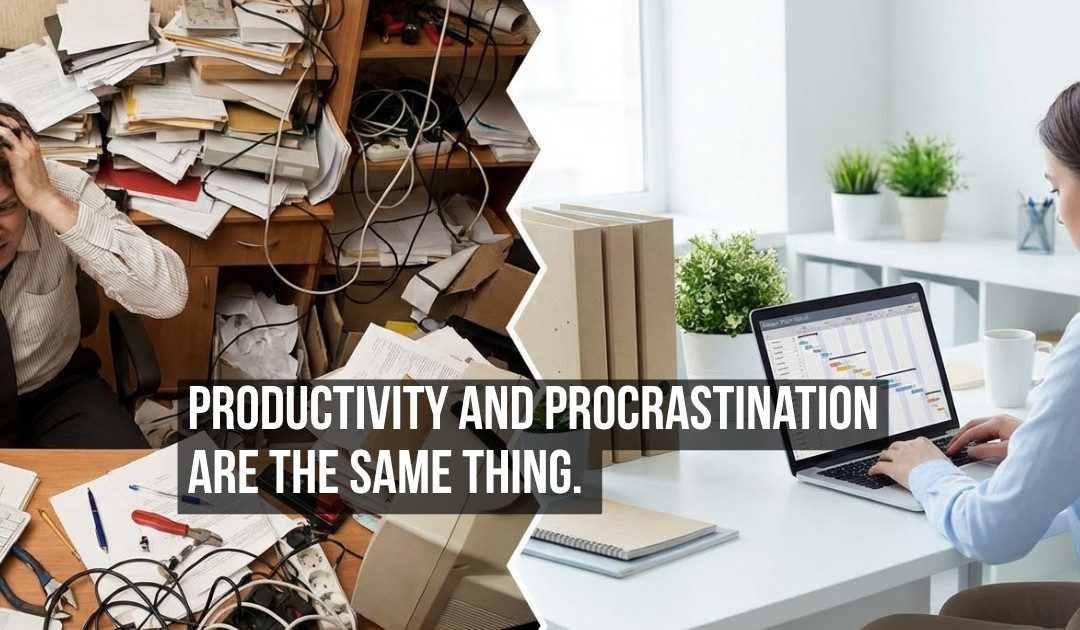
Procrastination is vilified as the enemy of productivity. Flow state is celebrated as the pinnacle of focused work. They’re positioned as opposites—one is distracted avoidance, the other is deep engagement. But neurologically, they’re remarkably similar. Both involve losing track of time, tuning out irrelevant stimuli, and experiencing effortless attention on a single task.
The primary difference isn’t the mental state itself but what triggers it and what you’re doing instead of something else. Procrastination is flow state directed at the wrong task. Flow is procrastination from everything except one chosen activity. The mechanisms are identical; only the value judgment differs. For more on how this plays out in real behavior, see future anxiety is procrastination—the planning and preparation that feel productive are often just a structured form of avoidance.
The Attention Paradox
Both procrastination and flow involve what researchers call “effortless attention”—sustained focus without conscious willpower. When you’re procrastinating by deep-diving Wikipedia or organizing your desk, you’re not struggling to maintain attention. When you’re in flow writing code or creating art, you’re also not struggling. The attention happens automatically in both cases.
This reveals something strange: the brain is perfectly capable of sustained focus. The problem isn’t attention capacity—it’s attention direction. You can focus for hours when doing the “wrong” thing. The issue is getting that same focus to activate for tasks you’ve deemed important.
What determines which activities trigger effortless attention seems partially arbitrary. Some people procrastinate by cleaning, others by reading, others by browsing. But they can’t reliably trigger the same attentional state for work they need to complete. The mechanism exists; the control doesn’t. This connection between thought loops and inaction is also at the center of overthinking and inaction being the same loop.
The Avoidance Engine
Both states also function as avoidance, which is the deepest similarity. Flow isn’t just engagement—it’s active exclusion of everything else. When you’re in flow, you’re not answering messages, not thinking about other obligations, not attending to discomfort. You’ve narrowed reality to single task.
Procrastination is explicitly avoidance—you’re doing anything except the task you should do. But flow is avoidance too—you’re doing one thing so intensely that everything else disappears. The difference is whether what you’re avoiding is important (procrastination) or less important (flow).
This makes the distinction somewhat arbitrary. The programmer in flow writing personal project while ignoring work deadline is simultaneously in flow and procrastinating. The state is identical; only external evaluation differs.
The Difficulty Threshold
Both states also activate around specific difficulty levels. Flow requires task difficulty matched to skill—too easy is boring, too hard is overwhelming. Procrastination often involves tasks that are either too easy (unfulfilling) or too hard (anxiety-inducing).
What’s interesting is that procrastination activities often hit the flow difficulty sweet spot perfectly. You procrastinate by doing things that are engaging without being stressful—browsing interesting content, organizing, doing easy creative tasks. These activities trigger flow precisely because they’re optimally difficult.
Meanwhile, the work you’re avoiding is often either tedious (too easy) or anxiety-inducing (too hard). The procrastination isn’t about inability to focus—it’s about the “important” task falling outside the difficulty range that triggers effortless attention. The way sleep deprivation compounds this pattern is explored in productivity culture pathologized sleep—exhaustion narrows the difficulty window until almost nothing qualifies as “optimally challenging.”
The Time Distortion
Both states involve similar time perception changes. In flow, hours feel like minutes. In procrastination, you look up and can’t believe how much time has passed. The subjective time distortion is identical—you’ve been so absorbed that time tracking stopped.
This time distortion might be the mechanism’s point. Both flow and procrastination remove you from temporal awareness. You’re not thinking about deadlines, not monitoring how long tasks take, not experiencing time pressure. The present moment expands to fill all attention.
The difference is that with flow, this is celebrated—you were so engaged you lost track of time. With procrastination, it’s lamented—you wasted hours without realizing. But the actual experience is the same.
The Reward System
Neurologically, both activate similar reward pathways. Flow triggers dopamine release through engagement with optimally challenging task. Procrastination triggers dopamine through engagement with immediately rewarding activity. The brain’s reward system doesn’t distinguish between productive and unproductive—it responds to engagement level.
This creates problem for productivity advice. You can’t simply willpower your way into flow, because flow, like procrastination, is reward-driven state that activates automatically when conditions are right. The conditions involve task difficulty, interest level, and immediate feedback—factors often outside your control for required work.
The Identity Question
Perhaps the deepest similarity is that both states involve temporary identity shift. In flow, you become the activity—you’re not “someone writing,” you’re writing itself. In procrastination, you similarly lose self-consciousness—you’re not aware of yourself avoiding work; you’re absorbed in whatever you’re doing.
This ego dissolution is why both states feel good despite different outcomes. The relief isn’t from the activity itself but from temporary escape from self-monitoring consciousness. You stop judging yourself, stop feeling anxious, stop maintaining the mental overhead of self-awareness.
The Missing Control
What we call productivity problem might be control problem. We want to activate flow for important tasks and prevent it for unimportant ones. But the mechanism doesn’t distinguish importance—it responds to immediate characteristics of the activity, not to long-term value judgments.
You can’t choose flow any more than you can choose procrastination. Both states happen to you based on conditions largely outside deliberate control. The illusion is that flow is achievement while procrastination is failure, when actually both are the same mechanism responding to task characteristics you often can’t change.
Procrastination and flow aren’t opposites—they’re the same attentional state directed at different targets. And you don’t control which target activates it nearly as much as you think you do.
Something went wrong. Please refresh the page and/or try again.
Help us improve your journey
We use cookies to personalize your experience and understand how you use our site. By clicking 'Yes, I'm in!', you help us show you content you'll actually love. If you prefer to keep things simple, you can stick to the essentials. You can change your mind anytime!
Necessary
Always active
The technical storage or access is strictly necessary for the legitimate purpose of enabling the use of a specific service explicitly requested by the subscriber or user, or for the sole purpose of carrying out the transmission of a communication over an electronic communications network.
Preferences
The technical storage or access is necessary for the legitimate purpose of storing preferences that are not requested by the subscriber or user.
Analytics
The technical storage or access that is used exclusively for statistical purposes.The technical storage or access that is used exclusively for anonymous statistical purposes. Without a subpoena, voluntary compliance on the part of your Internet Service Provider, or additional records from a third party, information stored or retrieved for this purpose alone cannot usually be used to identify you.
Advertising
The technical storage or access is required to create user profiles to send advertising, or to track the user on a website or across several websites for similar marketing purposes.




Leave a Reply