The Bottled Water Industry Exposed: How Marketing Turned Free Tap Water Into a Billion-Dollar Status Symbol
In 1977, Perrier ran an advertising campaign positioning sparkling water as a sophisticate’s drink — the kind of bottle you ordered at a restaurant when you wanted to signal taste without ordering wine. Within a decade, an entire industry had materialised around the radical proposition that the free liquid flowing from your kitchen tap was somehow inadequate. Today, the global bottled water market exceeds 350 billion dollars annually, and the product inside most of those bottles is chemically indistinguishable from what comes out of a municipal faucet. The same manufactured perception of inadequacy is documented in how big oil invented the carbon footprint — an industry-generated idea that shifted public attention from systemic failure to individual choice.
The Manufacturing of Distrust
Bottled water did not succeed because tap water failed. It succeeded because marketing convinced enough people that tap water might fail. The strategy was never to prove municipal water unsafe — that would invite regulatory scrutiny — but to create a persistent ambient anxiety about its quality. Words like “pure,” “natural,” and “mountain spring” don’t make factual claims. They manufacture a feeling. And feelings, unlike water quality reports, don’t require evidence.
Nestlé, Danone, PepsiCo, and Coca-Cola — the four corporations controlling roughly 40 percent of the global bottled water market — spend hundreds of millions annually on campaigns that frame hydration as a lifestyle choice rather than a biological necessity. Evian’s branding evokes Alpine glaciers. Fiji Water’s square bottle signals design consciousness. Smartwater adds electrolytes and celebrity endorsements. The water itself, in blind taste tests, is consistently indistinguishable from filtered tap.
What’s Actually in the Bottle
Approximately 25 percent of bottled water sold in the United States is sourced from municipal tap water, according to analyses by food safety advocates. Aquafina, PepsiCo’s flagship water brand, acknowledged in 2007 that its source was public water supplies, adding the phrase “Public Water Source” to its labels only after sustained pressure. Dasani, Coca-Cola’s entry, uses local tap water that undergoes reverse osmosis and mineral addition — a process that any household filter replicates at a fraction of the cost.
Municipal water in most developed nations undergoes testing that bottled water does not. In the United States, the Environmental Protection Agency regulates tap water under the Safe Drinking Water Act, requiring frequent testing for over 90 contaminants. Bottled water, classified as a food product, falls under the Food and Drug Administration, which conducts inspections far less frequently and does not require companies to share test results with the public.
The Price Markup Nobody Questions
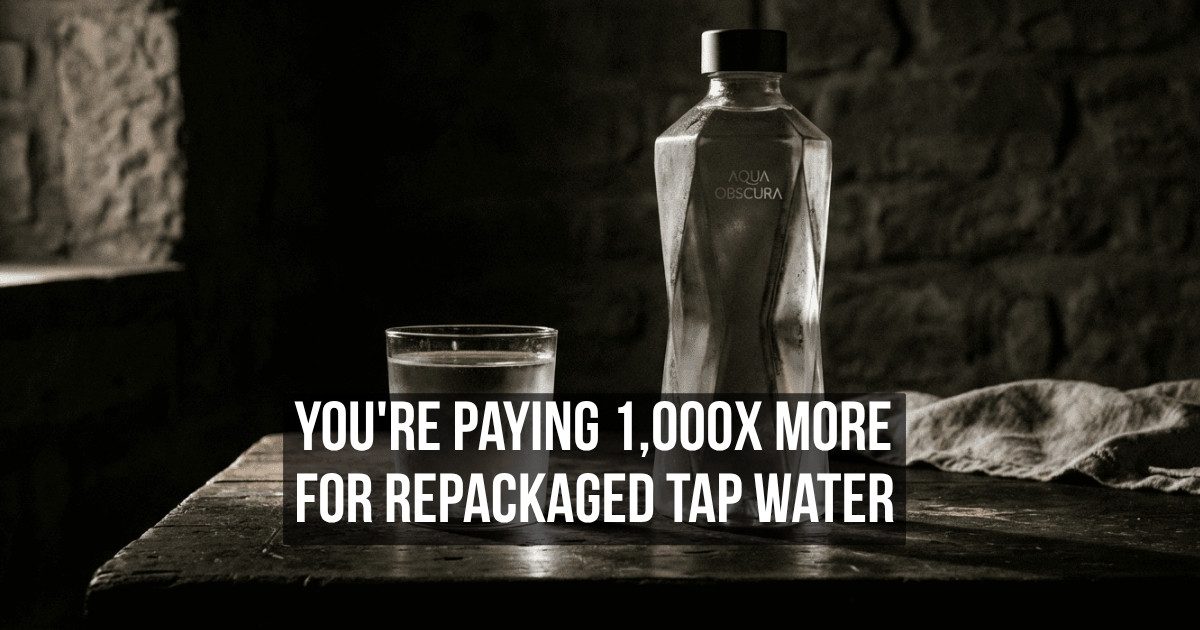
Consider the numbers. A litre of tap water in London costs approximately 0.1 pence. A litre of Evian at a corner shop costs roughly one pound. That is a markup of approximately one thousand times. In airports and train stations, where captive audiences have limited alternatives, a 500-millilitre bottle routinely sells for three to four pounds — making bottled water, per litre, more expensive than petrol in most European countries.
The economics are staggering precisely because the raw material is nearly free. Production costs for bottled water are dominated by packaging, transportation, and marketing — not the water itself. The plastic bottle costs more to manufacture than the liquid inside it. Consumers are not paying for water. They are paying for the bottle, the label, and the brand story printed on it. This premium extraction on a commodity available nearly free is structurally identical to how the organic food premium operates — perception of superiority manufactured independently of actual quality difference.
The Environmental Reckoning
Every year, approximately one million plastic bottles are purchased worldwide every minute. Fewer than 30 percent are recycled. The rest enter landfills, oceans, and waterways, where they take an estimated 450 years to decompose. The carbon footprint of transporting water — a substance that weighs one kilogram per litre — across oceans and continents is enormous. Fiji Water ships its product from the South Pacific to markets in North America and Europe, a journey of thousands of kilometres to deliver something available from the nearest tap.
The environmental cost is not a side effect. It is the business model. Bottled water requires disposable packaging to generate repeat purchases. Refillable containers would collapse the revenue structure overnight. The industry needs you to buy, drink, and discard — then buy again tomorrow. The same mechanism by which recycling became a corporate lie applies here: environmental responsibility is marketed to the consumer while the system that creates waste continues unchanged.
Status in a Plastic Shell
Walk into any co-working space, yoga studio, or business meeting and observe what sits on the table. The brand of water bottle a person carries has become a low-level social signal, a quiet declaration of values and purchasing power. Carrying a Voss bottle communicates something different from carrying a store-brand flat. The water inside is identical. The performance is everything.
This is the industry’s true achievement. Not selling water — that would be too simple. Selling the idea that free water is inferior, that hydration requires a transaction, and that the vessel matters more than the liquid. You are not buying a drink. You are buying a small, portable, disposable piece of identity. And you are doing it several times a week without ever questioning why.
Something went wrong. Please refresh the page and/or try again.
Help us improve your journey
We use cookies to personalize your experience and understand how you use our site. By clicking 'Yes, I'm in!', you help us show you content you'll actually love. If you prefer to keep things simple, you can stick to the essentials. You can change your mind anytime!
Necessary
Always active
The technical storage or access is strictly necessary for the legitimate purpose of enabling the use of a specific service explicitly requested by the subscriber or user, or for the sole purpose of carrying out the transmission of a communication over an electronic communications network.
Preferences
The technical storage or access is necessary for the legitimate purpose of storing preferences that are not requested by the subscriber or user.
Analytics
The technical storage or access that is used exclusively for statistical purposes.The technical storage or access that is used exclusively for anonymous statistical purposes. Without a subpoena, voluntary compliance on the part of your Internet Service Provider, or additional records from a third party, information stored or retrieved for this purpose alone cannot usually be used to identify you.
Advertising
The technical storage or access is required to create user profiles to send advertising, or to track the user on a website or across several websites for similar marketing purposes.




Leave a Reply