Why the Waiting Room Is the Last Unproductive Space Left and That Makes It Quietly Revolutionary
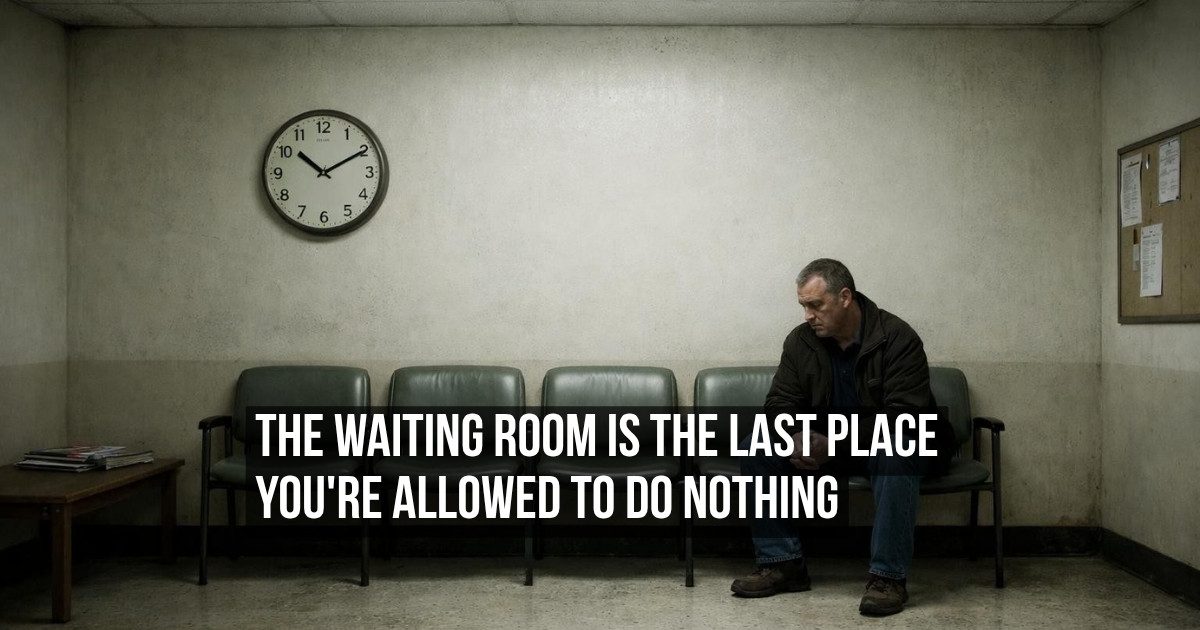
A doctor’s waiting room at 10:15 a.m. on a Tuesday. Twelve plastic chairs, a water cooler, a stack of magazines from last year, a television mounted too high playing a news channel with the volume off. You sit. You wait. There is nothing to do, nothing to optimise, nowhere to be except here, in this chair, for an indeterminate period of time that is out of your control. And in a culture that treats every idle moment as a productivity failure, this small, beige, slightly fluorescent room has become one of the last public spaces where doing absolutely nothing is not only acceptable — it is structurally required.
The Disappearance of Dead Time
Twenty years ago, daily life contained regular pockets of enforced idleness: bus stops, queues at the bank, the gap between ordering food and receiving it. These were moments without demand — brief interludes where the body was stationary, the mind was unoccupied, and the only available activity was observation or thought. Smartphones colonised every one of these pockets. The bus stop became a scrolling session. The queue became an email window. The restaurant wait became a social media check. Dead time — time without purpose, input, or output — was eliminated so thoroughly that most people under 30 have never experienced it as a normal condition of daily life.
The waiting room resists this colonisation. Not entirely — people do check their phones in waiting rooms — but more successfully than almost any other space. Partly this is because the waiting room imposes a unique psychological condition: anticipatory vigilance. You are waiting to be called. Your name could come at any moment. The uncertainty of when you will be summoned creates a low-level attentional readiness that discourages deep engagement with anything else. You scroll, but distractedly. You read, but without commitment. The waiting room holds you in a suspended state that resists both productivity and entertainment.
Enforced Presence
Walk into a GP surgery, a dentist’s office, a visa processing centre, or a hospital outpatient department and observe what people do. Some stare at their phones. Many stare into the middle distance. A few read. Several sit with their hands in their laps, doing nothing at all. The nothing is the point. In a culture where idleness generates anxiety — where the absence of activity prompts the question “shouldn’t I be doing something?” — the waiting room provides institutional permission to not do anything.
You are not lazy for sitting still. You are compliant. The institution told you to wait, and you are waiting. The guilt that normally accompanies inactivity is neutralised by the external authority of the appointment system. For perhaps the only time in your week, stillness is not your fault.
The Accidental Meditation Chamber
Research on mind-wandering has established that unfocused, undirected mental activity serves important cognitive functions. The default mode network — the brain circuit that activates when external demands are absent — is responsible for autobiographical memory consolidation, future planning, social cognition, and creative problem-solving. The default mode network doesn’t activate during scrolling, emailing, or watching content. It activates during genuine idleness: sitting on a park bench, staring out of a window, or waiting in a beige room with nothing to do.
A 2012 study published in Psychological Science found that participants who engaged in periods of undirected mind-wandering showed significantly improved performance on creative problem-solving tasks compared to those whose rest periods were filled with demanding cognitive activities. The waiting room, by accident of its design, creates exactly the conditions that cognitive science identifies as optimal for reflective thought: low stimulation, moderate duration, and no expectation of output.
Why Nobody Designed It This Way
Waiting rooms were not created as contemplative spaces. They were created as holding areas — throughput management solutions for institutions that cannot see all their clients simultaneously. The plastic chairs, the bad lighting, and the year-old magazines are not design choices. They are defaults that nobody invested in improving because the waiting room is considered transitional space: somewhere you pass through, not somewhere you inhabit.
This institutional neglect, paradoxically, is what preserves the room’s value. A waiting room optimised for engagement — with screens showing personalised content, interactive kiosks offering health assessments, and Wi-Fi encouraging productive work — would eliminate the very quality that makes it distinctive. Several healthcare providers have experimented with digitally enhanced waiting areas, and patient feedback consistently splits: some appreciate the distraction, but a notable minority report preferring the quiet, the boredom, and the excuse to simply sit.
The Defence of Boredom
Boredom has become culturally intolerable. Content platforms, notification systems, and infinite-scroll interfaces were built on the premise that boredom is a problem to be solved rather than a state to be experienced. The waiting room pushes back against this premise, not through philosophy but through infrastructure. You cannot leave. You cannot know when you’ll be called. You cannot do anything about either of these constraints. Boredom is not optional here. It is the terms of service.
And within that boredom, something quietly useful happens. Thoughts surface that constant stimulation would have suppressed. A problem you’d been ignoring comes into focus. An idea you hadn’t given space to develops for the first time. A memory you haven’t revisited in years arrives uninvited. None of this is dramatic or transformative. All of it depends on the precise condition the waiting room provides: enforced, purposeless, guilt-free inactivity in a world that has otherwise made such a thing nearly impossible to achieve.
The waiting room is not pleasant. It is not designed. It is not aspirational. But it may be the last remaining public space where the default human state — sitting, thinking, doing nothing — is still the expected behaviour. In a culture that monetises every second and optimises every pause, the beige room with the plastic chairs is, by pure accident, revolutionary.
Something went wrong. Please refresh the page and/or try again.
Help us improve your journey
We use cookies to personalize your experience and understand how you use our site. By clicking 'Yes, I'm in!', you help us show you content you'll actually love. If you prefer to keep things simple, you can stick to the essentials. You can change your mind anytime!
Necessary
Always active
The technical storage or access is strictly necessary for the legitimate purpose of enabling the use of a specific service explicitly requested by the subscriber or user, or for the sole purpose of carrying out the transmission of a communication over an electronic communications network.
Preferences
The technical storage or access is necessary for the legitimate purpose of storing preferences that are not requested by the subscriber or user.
Analytics
The technical storage or access that is used exclusively for statistical purposes.The technical storage or access that is used exclusively for anonymous statistical purposes. Without a subpoena, voluntary compliance on the part of your Internet Service Provider, or additional records from a third party, information stored or retrieved for this purpose alone cannot usually be used to identify you.
Advertising
The technical storage or access is required to create user profiles to send advertising, or to track the user on a website or across several websites for similar marketing purposes.




Leave a Reply