Why Plastic Grocery Bags Survived Decades of Bans While Paper Bags Quietly Disappeared From Every Store
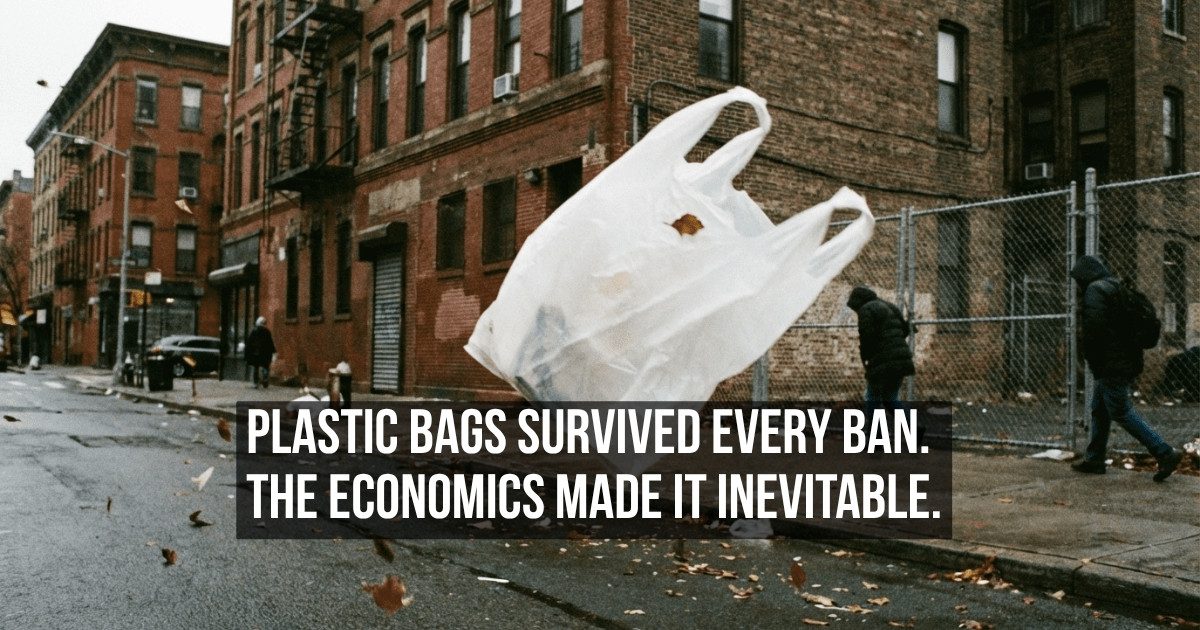
In the 1970s, nearly every grocery store in the developed world offered the same choice at checkout: paper or plastic. By the 2000s, the paper option had quietly vanished from most retailers. Plastic bags became the universal default — and then became the universal villain. Governments from Rwanda to California legislated bans, levied taxes, and launched public campaigns to eliminate them. Yet as of today, the plastic grocery bag persists in more countries than it has been banned from. Paper bags, which face no comparable political hostility, are the ones that actually disappeared. The story of how this happened is less about environmentalism than it is about economics, infrastructure, and lobbying.
How Plastic Displaced Paper
The polyethylene grocery bag was introduced commercially in 1982 by a division of the Swedish company Celloplast. Within a decade, it had captured roughly 80 percent of the US grocery bag market. The reasons were purely economic. A standard plastic bag weighs approximately 6 grams and costs the retailer between 1 and 2 cents. A comparable paper bag weighs roughly 55 grams and costs between 5 and 10 cents. Plastic bags ship flat, occupy a fraction of the warehouse space, and require no special storage conditions. Paper bags are bulky, moisture-sensitive, and heavy to transport.
For a supermarket chain operating thousands of locations and distributing millions of bags weekly, the cost difference is not marginal. It is the kind of line item that determines quarterly margins. Plastic bags won not because consumers preferred them — many didn’t — but because retailers needed them. Paper bags were quietly phased out of most checkout stations not by regulation or consumer choice, but by purchasing departments seeking to cut packaging costs.
The Environmental Paradox
Public intuition says paper is greener than plastic. The lifecycle analysis tells a more complicated story. Manufacturing a standard paper grocery bag requires approximately four times more energy than manufacturing a polyethylene bag. Paper production consumes significantly more water, generates higher levels of air pollution, and produces more solid waste per unit. A 2011 study commissioned by the Northern Ireland Assembly found that a paper bag must be reused at least three times to match the environmental footprint of a single-use plastic bag — and most paper bags are used once and discarded.
Plastic bags, however, dominate the litter landscape. They persist in the environment for centuries, fragment into microplastics, and entangle marine wildlife. Paper bags decompose within months. The environmental debate, in other words, depends entirely on which metric you prioritise: production impact or disposal impact. Both materials have genuine environmental costs, but the visibility of plastic litter — bags in trees, bags in oceans, bags on beaches — made plastic the target while paper quietly benefited from being biodegradable and therefore invisible after disposal.
The Ban Movement and Its Limits
Rwanda became the first country to ban plastic bags in 2008, followed by Bangladesh, Kenya, and eventually parts of the EU, Australia, and multiple US states and cities. The bans succeeded in reducing visible litter and shifting consumer habits toward reusable bags. What they did not always achieve was net environmental improvement. When Ireland introduced a plastic bag levy in 2002, plastic bag consumption dropped by over 90 percent. Sales of thicker, exempt bin liner bags increased by 77 percent. Consumers transferred their demand from one disposable plastic product to another.
In jurisdictions where bans encouraged a shift to reusable polypropylene or cotton bags, the environmental calculus became even more complex. A cotton tote bag must be reused approximately 131 times to offset the higher resource intensity of its production compared to a single-use plastic bag, according to a 2018 lifecycle assessment by the Danish Ministry of Environment. Survey data suggests most consumers own multiple tote bags and use each one far fewer than 131 times.
The Lobbying Infrastructure
The plastic bag industry did not accept its vilification passively. The American Progressive Bag Alliance, funded primarily by polyethylene manufacturers, spent millions lobbying against state and municipal bag bans across the United States. In several states, the industry successfully promoted preemption laws that prevented cities from implementing their own bans — a strategy that overrode local democratic decisions with state-level legislation influenced by manufacturer interests.
Paper bag manufacturers, by contrast, invested comparatively little in public advocacy. The paper industry had no urgent need to campaign: paper bags were not under political attack, and their market share was already declining for economic reasons unrelated to regulation. The asymmetry created a curious dynamic — plastic bags attracted enormous political energy, while the material that was actually disappearing from checkout counters generated almost no public discussion at all.
The Bag You Carry Now
Walk into a supermarket today in London, Sydney, or San Francisco, and the checkout experience looks different from twenty years ago. In many cities, no free bag is offered at all. Consumers bring their own or purchase a thick reusable bag from the store. Paper bags are available in some retailers, typically at a higher price than the remaining plastic option. The choice has not returned to “paper or plastic.” It has evolved into “bring your own or pay.”
The plastic bag survives because it fills a genuine functional niche that no alternative fills as cheaply or as conveniently: lightweight, waterproof, strong relative to its weight, and compact enough to produce, ship, and store in enormous volume at negligible cost. Banning it removes a visible environmental problem but introduces a set of less visible substitutions that are not necessarily better. Paper bags would solve the litter problem but reintroduce the production problem. Cotton bags solve both but only if used far more often than most owners use them.
The grocery bag debate was never really about bags. It was about the difficulty of solving a systems problem by changing a single component. Plastic bags became the symbol of disposable culture — but symbols, once targeted, have a way of shifting the problem rather than solving it. The bag changed. The behaviour didn’t.
Something went wrong. Please refresh the page and/or try again.
Help us improve your journey
We use cookies to personalize your experience and understand how you use our site. By clicking 'Yes, I'm in!', you help us show you content you'll actually love. If you prefer to keep things simple, you can stick to the essentials. You can change your mind anytime!
Necessary
Always active
The technical storage or access is strictly necessary for the legitimate purpose of enabling the use of a specific service explicitly requested by the subscriber or user, or for the sole purpose of carrying out the transmission of a communication over an electronic communications network.
Preferences
The technical storage or access is necessary for the legitimate purpose of storing preferences that are not requested by the subscriber or user.
Analytics
The technical storage or access that is used exclusively for statistical purposes.The technical storage or access that is used exclusively for anonymous statistical purposes. Without a subpoena, voluntary compliance on the part of your Internet Service Provider, or additional records from a third party, information stored or retrieved for this purpose alone cannot usually be used to identify you.
Advertising
The technical storage or access is required to create user profiles to send advertising, or to track the user on a website or across several websites for similar marketing purposes.




Leave a Reply