What Noise Cancelling Headphones Worn Everywhere Reveal About How Unbearable Modern Urban Life Has Become
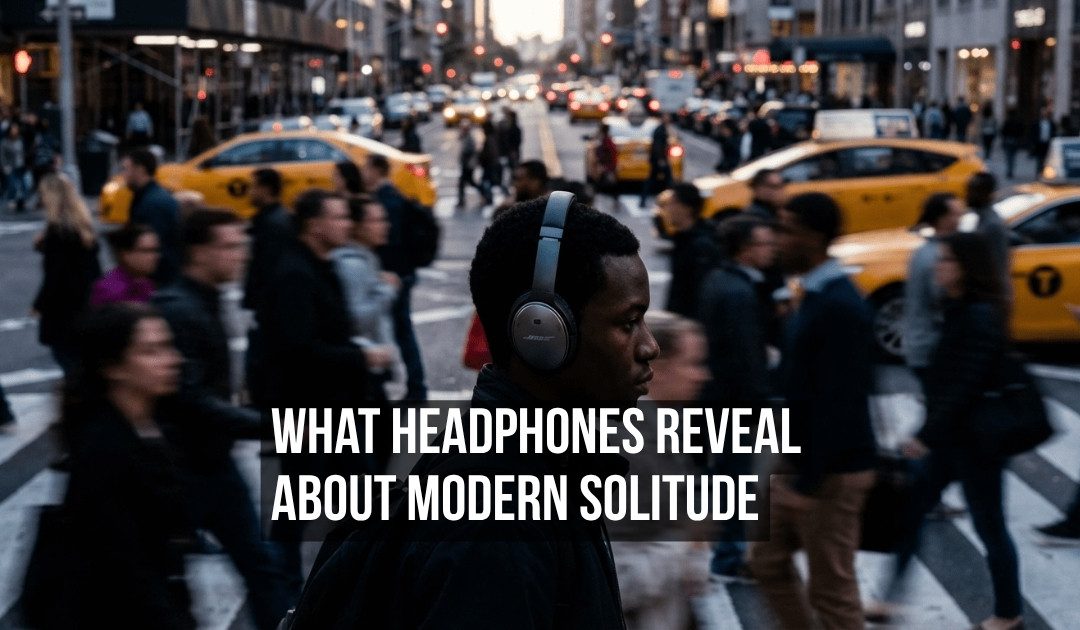
The person walking down the street with noise-cancelling headphones is communicating something. Not to the people around them — quite the reverse. The headphone is a technology of deliberate boundary, and what it guards reveals a great deal about what urban life has become. The same erosion of peripheral social connection that makes headphones feel necessary is documented in the loneliness epidemic — a crisis driven less by the absence of close relationships than by the collapse of casual, ambient social contact.
The Acoustic Problem They Solve
Urban noise is not a minor aesthetic inconvenience. The World Health Organization’s Environmental Noise Guidelines classify chronic exposure to traffic noise, construction, and dense indoor environments as a significant public health problem, associated with cardiovascular disease risk from stress response activation, cognitive impairment from disrupted concentration, and sleep disorders from overnight exposure. Cities are physiologically taxing environments whose costs their residents rarely register consciously because the exposure is continuous and inescapable.
Noise-cancelling headphones, by creating a personal acoustic zone, offer a practical intervention against a problem most urban residents cannot structurally escape. Open-plan offices, crowded public transport, café culture, and urban density all generate ambient noise levels that make sustained focus cognitively costly. The headphone user is not being antisocial. They are managing a genuine environmental stressor with the best available consumer tool.
The adoption curve makes this visible. Sony launched the first commercially successful consumer noise-cancelling headphones in the early 2000s, primarily marketed to frequent flyers. By the 2020s they are mainstream urban objects, worn in offices, gyms, and public parks. The premium noise-cancelling market grew by over 25 percent annually through the 2010s and accelerated further during the pandemic. The demand is a signal about what the environment had become.
The Social Signal They Send
Sociologist Erving Goffman described the management of public space in terms of civil inattention — the mutual social contract allowing strangers to share space without uncomfortable intimacy. The headphone extends this contract into the acoustic domain. It signals: present but not available. It manages social expectation in a way that a visible book or newspaper once did, but with greater efficiency and less ambiguity.
The cost of this management is worth examining. Unstructured encounters with strangers — brief exchanges on trains, overheard conversations in cafés, the ambient texture of public life — generate a form of social input that differs from curated social experience. Research by Nicholas Epley at the University of Chicago found that people consistently underestimate how positive chance conversations with strangers will be. The headphone, whatever it offers, systematically prevents those encounters from occurring. The result is a quieter version of what researchers find when studying why nobody is listening anymore — the retreat from ambient social contact has costs that are invisible precisely because they never happen.
The self-curated acoustic environment is purchased at the cost of the unpredictable social encounter. Whether this is a good trade depends on what the urban environment was offering in those encounters to begin with — and whether the noise level had already made meaningful encounter difficult regardless.
Urban planning implications are beginning to emerge from this pattern. Cities that invest in acoustic infrastructure — noise barriers, traffic calming, building regulation for sound insulation, designated quiet zones — reduce the baseline noise burden that makes personal audio devices necessary. The individual reaching for headphones is solving a problem that urban design created and has not addressed at scale. A quieter city would produce fewer headphone users; the mass demand for personal acoustic management is, in part, a demand that the built environment has consistently failed to meet collectively. The same dynamic — individual solutions filling a structural gap that institutional design refuses to address — appears in why remote work and the office produce identical loneliness.
The irony is that the headphone, as a technology of enforced solitude, may contribute to the urban noise problem it was designed to solve. People insulated from ambient sound are less sensitive to its effects on others, less likely to complain about noise violations, and less invested in the acoustic commons of shared public space. The individual solution, scaled across millions of users, reduces the political pressure to address the collective problem at its source.
The headphone is one of the most revealing objects in the contemporary urban kit. It is a tool for solitude in a world that provides very little of it, and a signal that the baseline conditions of city life have made such tools not a luxury but a daily necessity for maintaining functional cognitive states.
Something went wrong. Please refresh the page and/or try again.
Help us improve your journey
We use cookies to personalize your experience and understand how you use our site. By clicking 'Yes, I'm in!', you help us show you content you'll actually love. If you prefer to keep things simple, you can stick to the essentials. You can change your mind anytime!
Necessary
Always active
The technical storage or access is strictly necessary for the legitimate purpose of enabling the use of a specific service explicitly requested by the subscriber or user, or for the sole purpose of carrying out the transmission of a communication over an electronic communications network.
Preferences
The technical storage or access is necessary for the legitimate purpose of storing preferences that are not requested by the subscriber or user.
Analytics
The technical storage or access that is used exclusively for statistical purposes.The technical storage or access that is used exclusively for anonymous statistical purposes. Without a subpoena, voluntary compliance on the part of your Internet Service Provider, or additional records from a third party, information stored or retrieved for this purpose alone cannot usually be used to identify you.
Advertising
The technical storage or access is required to create user profiles to send advertising, or to track the user on a website or across several websites for similar marketing purposes.




Leave a Reply