Why Brunch Is the Most Effective Social Ritual That Nobody Would Have Invented Deliberately
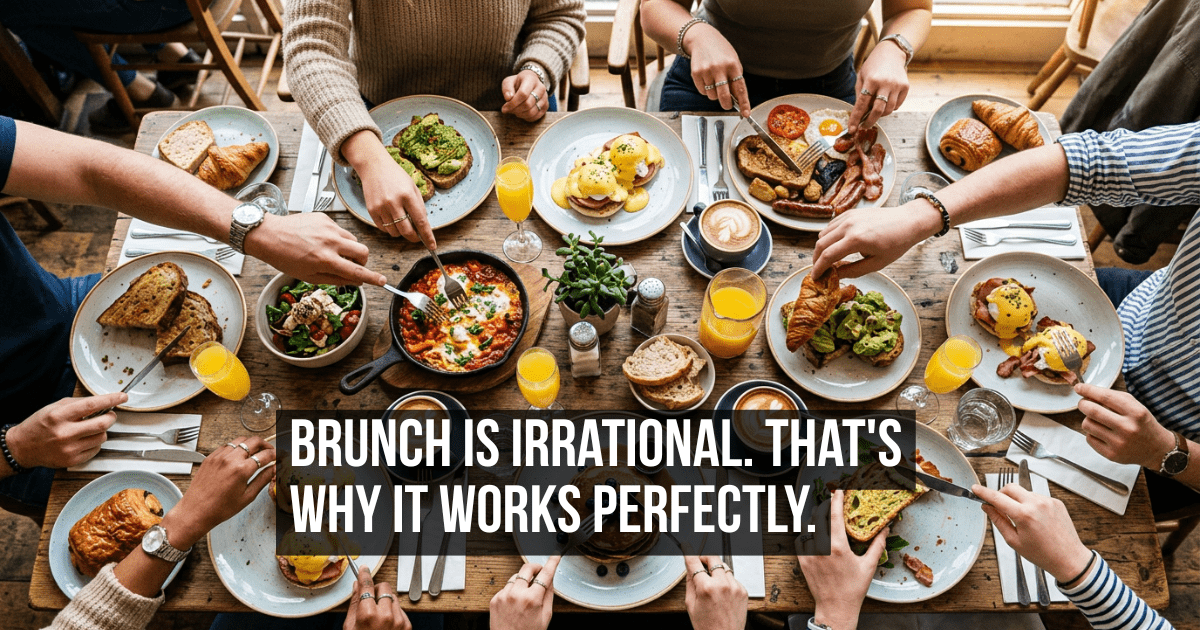
Brunch makes no rational sense as a meal. It arrives too late to function as breakfast, too early to function as lunch, occupies the most productive portion of the one day most people have genuinely free, and in restaurant form costs considerably more than both meals would separately. It solves no nutritional problem that a bowl of cereal at eight and a sandwich at one could not address more efficiently.
And yet it works. More than works — brunch has become, in roughly four decades, one of the most socially durable rituals of urban life across multiple continents. In cities from London to Sydney to Seoul, the Sunday table around which friends gather for two to three hours of unhurried conversation performs a social function that no other meal format reliably produces.
A Brief History of the Accidental Meal
The word “brunch” was coined in 1895 by the British writer Guy Beringer, who proposed in Hunter’s Weekly a Sunday meal that began late enough to eliminate the need for an early breakfast while arriving early enough to allow the afternoon to remain free. The concept migrated to the United States, became associated with urban professional culture through the mid-twentieth century, and reached genuine mass adoption in the 1980s and 1990s alongside the expansion of casual dining. By the 2010s, brunch had become a cultural category with its own visual language, its own social codes, its own economics, and its own critics.
What Beringer proposed as a practical scheduling solution became something its originator almost certainly did not anticipate: a ritual with social functions far exceeding its nutritional ones.
Why the Timing Actually Works
The structural advantage of brunch over dinner is temporal openness. Dinner carries an implicit endpoint: the evening. Guests know, as they sit down, that the night has a shape. Evening fatigue and morning obligations combine to produce a mild background pressure even at the most relaxed dinner table.
Brunch in the late morning creates a different frame. The day is ahead of everyone. Nothing has been depleted. Nobody has yet accumulated the small irritations and decisions that constitute a full day’s cognitive load. The conversation that happens between 11 AM and 1 PM between people who slept well and arrived unhurried tends to be different in quality from the conversation between the same people at 9 PM on a Saturday. Lighter, often more honest, less performed.
The Permission That Moves Something
The social acceptance of drinking at brunch — a mimosa, a Bloody Mary, occasionally a Bellini depending on who is ordering first — during hours when alcohol would otherwise be unusual creates a specific social looseness that evening drinking cannot quite replicate. The disinhibition is mild precisely because nobody is drinking seriously. The effect is more symbolic than pharmacological: drinking during daylight hours signals a willingness to treat a Tuesday’s logic as suspended, to accept that this morning is categorically different from a working one.
That signal, however small, changes the tone of what follows. Conversations that would take three dinners to arrive at sometimes happen during a single brunch, because the permission granted by the format extends beyond the drink.
The Inefficiency Is Load-Bearing
The strongest argument against brunch is that it consumes two to three hours of a day most people can ill afford. The strongest counter-argument is that the two to three hours are the point. Close relationships require unstructured time — not time allocated to a specific activity, but time held open without agenda, in which conversation finds its own direction. Brunch is one of the few formats in urban social life that explicitly protects this kind of time. Dinner has a course structure. Drinks have a countdown. A walk has a route. Brunch has nothing after it except the afternoon, which is everyone’s to use as they choose.
Nobody designed brunch as social technology. It was spontaneously adopted because it solved a real problem that people felt but could not easily name: the need for a long, low-stakes social gathering that doesn’t require the effort of a dinner party, the formality of a lunch, or the exhaustion of a late night. The fact that it makes no sense as a meal category is exactly what gives it its function. Remove the inefficiency, and you remove what the inefficiency was doing.



Leave a Reply