Why Cinema Popcorn Costs Ten Times Market Price and Nobody in the Industry Questions It
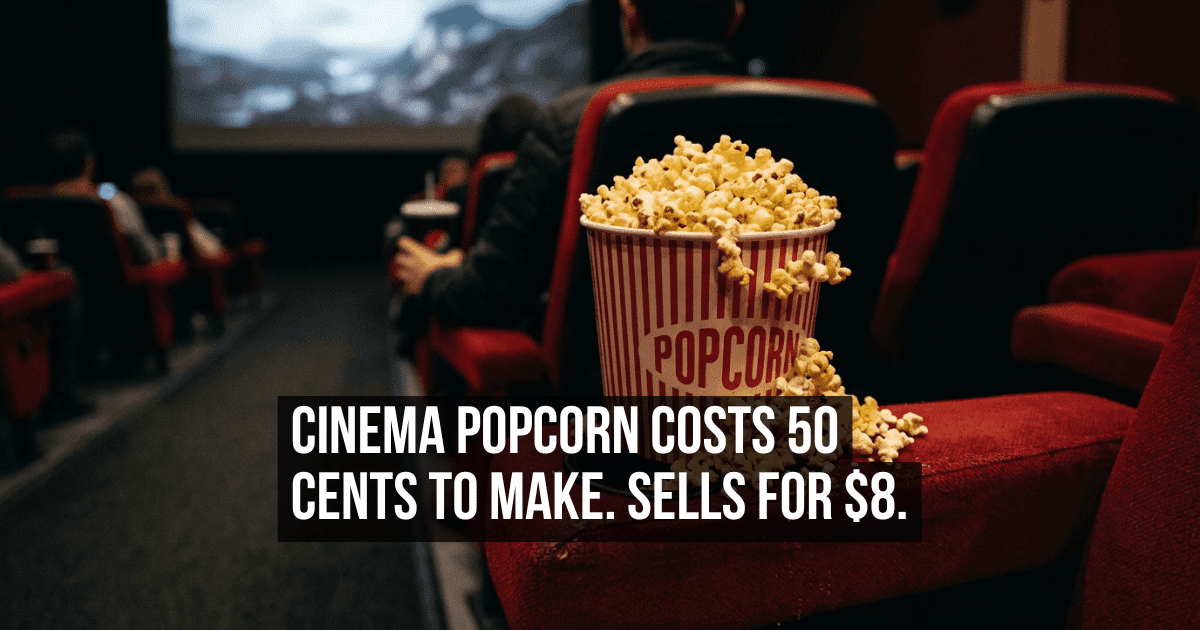
A medium bag of popcorn at a multiplex cinema costs, on average, between four and eight dollars in most Western markets. The same popcorn costs approximately 50 cents to produce. The markup sits between 700 and 1,600 percent, depending on the chain and the market. Nobody in the cinema industry denies this. The economics are discussed openly in trade publications, acknowledged by executives in earnings calls, and occasionally reported in mainstream media. The practice continues. Audiences accept it. And the question of whether any of it is reasonable is raised briefly every few years before being filed away under that’s just how it works.
How it works, precisely, is worth understanding.
The Split Ticket Model
Cinema chains do not primarily profit from ticket sales. Major studios typically take 50 to 70 percent of ticket revenue during a film’s opening weeks — the most commercially important period — dropping to roughly 45 percent in subsequent weeks. For a $15 ticket, the theater may retain as little as $4.50 in the first week of a major release.
Concessions operate on an entirely different margin. The cost of goods for popcorn, sodas, and candy is low; the overhead of staffing a concession counter is minimal; and there is no revenue-sharing arrangement with any studio. A single $6 bag of popcorn generates more net profit for the theater chain than the ticket that admitted the person buying it. The National Association of Theatre Owners in the US has stated explicitly that concessions are the financial foundation of the theatrical exhibition business. The film is, in a structural sense, the mechanism for getting people inside to buy food.
The Captive Audience Mechanism
Standard economics predicts that extreme markups create competitive pressure: competitors enter the market at lower prices and erode the margin. This prediction fails at the cinema because the standard competitive mechanism requires consumer mobility, and cinema concessions eliminate it. You are inside, the film starts in eight minutes, and carrying your own food into most commercial cinemas violates the admission terms. The vendor holds a monopoly not over popcorn in general, but over popcorn at this location, at this moment, for this audience. That monopoly is worth considerably more per kernel than the agricultural commodity price would suggest.
Legal challenges to the practice have had limited success in most markets. US courts have generally upheld theaters’ right to prohibit outside food as a condition of entry. France mandates that cinemas allow outside food and drink; the Netherlands has similar rules. In these markets, concession pricing has moderated without the theatrical business collapsing, which suggests the markup is a profit maximization choice rather than a survival necessity.
The Cross-Subsidy That Keeps Tickets Affordable
One defense of the concession markup is that it enables lower ticket prices. If popcorn margin were eliminated, admission prices would need to rise to maintain viability, and higher ticket prices would reduce attendance. The argument has some validity: the current structure distributes the cost of cinema attendance unevenly, with heavy concession buyers subsidizing light ones. Whether this is preferable to a higher ticket price and no markup on food is a legitimate question, and the answer is not obvious.
What is clear is that the choice to use concessions as the primary profit mechanism rather than tickets reflects decisions made by the industry about where to apply pricing power, not a natural economic law. The industry chose captive-market pricing at the counter over transparent pricing at the box office.
Why Outrage Changes Nothing
The popcorn markup generates reliable annual outrage, widely shared articles, and periodic investigations by consumer advocates. It has changed almost nothing about the practice over several decades. The reason is structural: the outrage occurs after the decision to attend, at the moment of purchase, inside the venue. The moment of maximum consumer leverage — the ticket purchase, the decision whether to attend — has already passed. By the time the price of popcorn becomes visible, the consumer has already committed. The outrage is real. The leverage is gone.
This is a reasonably precise description of how captive market pricing works in general: the price that feels outrageous is always revealed at the moment when the cost of walking away has already been paid.
Something went wrong. Please refresh the page and/or try again.
Help us improve your journey
We use cookies to personalize your experience and understand how you use our site. By clicking 'Yes, I'm in!', you help us show you content you'll actually love. If you prefer to keep things simple, you can stick to the essentials. You can change your mind anytime!
Necessary
Always active
The technical storage or access is strictly necessary for the legitimate purpose of enabling the use of a specific service explicitly requested by the subscriber or user, or for the sole purpose of carrying out the transmission of a communication over an electronic communications network.
Preferences
The technical storage or access is necessary for the legitimate purpose of storing preferences that are not requested by the subscriber or user.
Analytics
The technical storage or access that is used exclusively for statistical purposes.The technical storage or access that is used exclusively for anonymous statistical purposes. Without a subpoena, voluntary compliance on the part of your Internet Service Provider, or additional records from a third party, information stored or retrieved for this purpose alone cannot usually be used to identify you.
Advertising
The technical storage or access is required to create user profiles to send advertising, or to track the user on a website or across several websites for similar marketing purposes.




Leave a Reply