How Airport Duty-Free Shops Use Architecture and Lighting to Make You Spend Money You Never Planned To
You have already passed security, surrendered your water bottle, and removed your shoes for a stranger. Your flight doesn’t board for ninety minutes. You are physiologically stressed, spatially disoriented, and mildly bored. You are, in other words, the perfect customer — and every square metre of the space between the security checkpoint and your departure gate has been engineered to exploit exactly this state.
The Forced March Through Retail
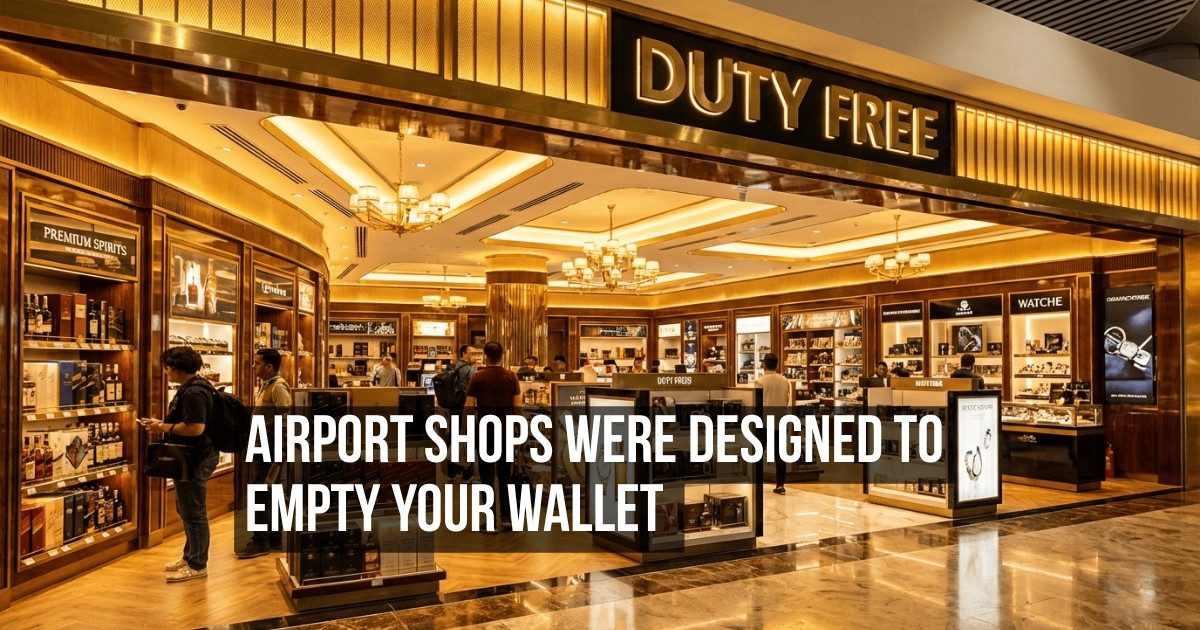
Airport designers call it “commercial walk-through” — the layout principle that routes every departing passenger directly through the duty-free shopping zone before reaching the gate area. There is no alternative path. No shortcut. The corridor from security to departure funnels through perfume counters, liquor displays, and confectionery walls with the architectural inevitability of a cattle chute. London Heathrow’s Terminal 5, designed by Rogers Stirk Harbour + Partners, routes 100 percent of its departing passengers through the retail floor. The design was not accidental. It was the commercial brief.
Airport retail revenue now represents between 30 and 60 percent of non-aeronautical income for major airports worldwide. Heathrow generated approximately 680 million pounds from retail in a single pre-pandemic year. Changi Airport in Singapore — repeatedly voted the world’s best airport — dedicates roughly one-third of its terminal space to shopping, including a four-storey retail complex with its own waterfall. The waterfall is not decorative whimsy. It’s a dwell-time maximiser designed to slow passenger movement through the commercial zone.
Lighting as Persuasion
Step into any airport duty-free zone and notice the light. It is warm, diffused, and noticeably different from the harsh fluorescents of the security area you just endured. The transition is deliberate. Research by retail lighting specialists has demonstrated that warm-toned lighting between 2700K and 3000K induces a measurable relaxation response, lowers perceived time pressure, and increases browsing duration by up to 20 percent.
Perfume and cosmetics counters use directional spotlighting to create focal points that draw the eye toward premium products. Liquor displays employ backlit shelving that makes bottles glow like amber artefacts. Confectionery stands use bright, saturated colour temperatures that activate appetite and impulse-buying circuits. None of these lighting decisions are aesthetic preferences. They are revenue-optimised environmental manipulations calibrated through years of consumer behaviour testing.
The Psychology of the Captive Traveller
Airport shoppers behave differently from high-street shoppers, and the industry knows precisely how. Three psychological conditions converge in the post-security zone: time surplus, stress relief, and the “treat” mindset.
Time surplus: passengers typically arrive 60 to 120 minutes before boarding, creating dead time that shopping fills. Stress relief: having cleared the anxiety of security screening, passengers experience a dopamine rebound — a small neurological reward for surviving the ordeal — that primes them for pleasure-seeking behaviour. And the treat mindset: the liminal status of being “between places” triggers a psychological permission structure. Normal spending rules feel suspended. You are on holiday, or about to be. Regular budgetary constraints loosen.
Duty-free pricing amplifies this effect. The perception of savings — whether or not actual savings exist — creates a justification framework. In reality, multiple consumer investigations have found that duty-free prices on many product categories, particularly electronics and fashion accessories, are comparable to or higher than high-street prices. The tax exemption that gives duty-free its name applies primarily to alcohol and tobacco, yet the “duty-free” label blankets the entire store, extending the perception of discount to products that carry none.
Scent, Sound, and Spatial Manipulation
Walk past any major perfume counter in an airport terminal and you will encounter a scent cloud that extends well beyond the retail boundary. This is not careless spraying by sales staff. Airport perfume retailers use ambient scenting systems — diffusers embedded in ventilation infrastructure — to push fragrance into the walkway. The practice is based on research showing that ambient scent increases unplanned purchases by as much as 14 percent in retail environments.
Background music follows similar logic. Airport retailers tend to play slower-tempo music in the 60-to-80 beats-per-minute range, which studies have correlated with reduced walking speed and increased time spent examining products. Fast-tempo music, by contrast, accelerates movement and reduces browsing — which is why you’ll hear it near the gates when boarding is imminent but almost never in the shopping zone.
Spatial design compounds these effects. Aisles in airport retail zones are deliberately wider than in high-street stores, reducing the sense of crowding that triggers avoidance behaviour. Product islands — freestanding display units positioned in the middle of walkways — force subtle path deviations that increase exposure time to adjacent merchandise. You didn’t decide to look at that whisky display. The floor plan decided for you.
The Transaction You Didn’t Plan
A 2018 report by the travel retail analytics firm m1nd-set found that approximately 70 percent of duty-free purchases are unplanned. Seven out of ten transactions involve products the buyer had no intention of purchasing before entering the space. The airport retail zone is not a shop in any conventional sense. It is a conversion machine — an environment where architecture, lighting, scent, music, and spatial psychology combine to transform a person who was simply trying to reach Gate 34 into a consumer carrying a bag of Toblerone and a bottle of gin they never knew they wanted.
The next time you emerge from security screening and find yourself wandering through racks of designer sunglasses, remember: nothing about this moment is spontaneous. The route was planned. The light was calibrated. The scent was engineered. And the ninety minutes you thought were yours were always part of someone else’s revenue projection.
Something went wrong. Please refresh the page and/or try again.
Help us improve your journey
We use cookies to personalize your experience and understand how you use our site. By clicking 'Yes, I'm in!', you help us show you content you'll actually love. If you prefer to keep things simple, you can stick to the essentials. You can change your mind anytime!
Necessary
Always active
The technical storage or access is strictly necessary for the legitimate purpose of enabling the use of a specific service explicitly requested by the subscriber or user, or for the sole purpose of carrying out the transmission of a communication over an electronic communications network.
Preferences
The technical storage or access is necessary for the legitimate purpose of storing preferences that are not requested by the subscriber or user.
Analytics
The technical storage or access that is used exclusively for statistical purposes.The technical storage or access that is used exclusively for anonymous statistical purposes. Without a subpoena, voluntary compliance on the part of your Internet Service Provider, or additional records from a third party, information stored or retrieved for this purpose alone cannot usually be used to identify you.
Advertising
The technical storage or access is required to create user profiles to send advertising, or to track the user on a website or across several websites for similar marketing purposes.




Leave a Reply