Why You Open the Fridge Again Even Though Nothing Has Changed Inside It
The Door You Open for No Reason
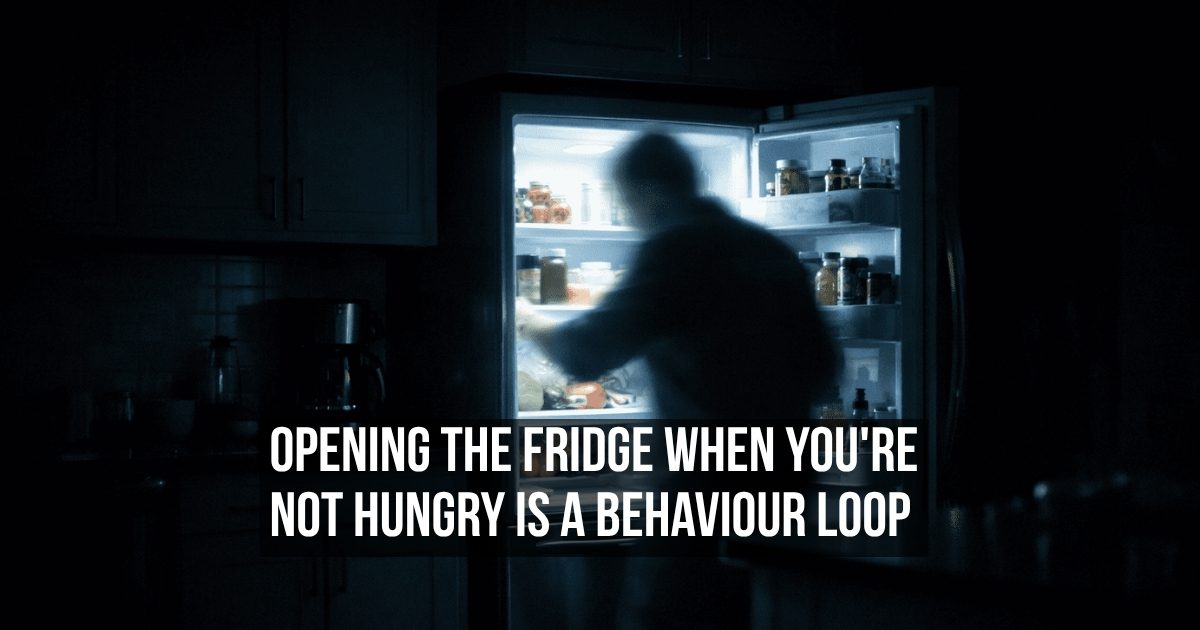
You ate twenty minutes ago. You are not hungry. You know you are not hungry. You walk to the kitchen anyway, open the fridge, stare at the contents for approximately six seconds, close the door, and return to whatever you were doing. Nothing was taken. Nothing was considered. The entire interaction had no purpose, no outcome, and no nutritional consequence whatsoever.
Fifteen minutes later, you do it again.
The Ritual That Is Not About Food
The fridge visit is not about hunger. If it were, the first inspection would have resolved it. You opened the door, surveyed the options, found nothing compelling, and closed it. Hunger did not change in the intervening minutes. The yogurt did not become more interesting. The leftover pasta did not improve. And yet you returned, because the trip was never about the contents.
It is about interruption. Specifically, the self-administered interruption your brain generates when it is bored, restless, or stuck on a task and needs a low-stakes physical action to reset. The fridge is the most convenient reset button in any home — located centrally, requiring minimal effort, offering sensory stimulation (cold air, visual scan, the hum of the compressor) without demanding commitment. You do not need to decide anything. You just need to open a door.
The Comfort Circuit
Behavioral researcher Wendy Wood at the University of Southern California has studied habitual behaviors for decades. Her research shows that roughly 43 percent of daily actions are performed habitually — triggered not by conscious decision but by contextual cues. The fridge visit is a textbook case. The cue is not hunger. It is a specific internal state: low-grade restlessness, mild boredom, the transitional moment between finishing one task and starting another.
Your brain has paired that state with the fridge so many times that the connection is now automatic. Restless? Walk to kitchen. Bored? Open fridge. Between activities? Stand in cold light and stare at condiments. The behavior is its own reward — not because the fridge delivers anything, but because the physical act of walking, opening, scanning, and returning provides a micro-break that the brain processes as a completed action. Something was done. Nothing changed. But the loop closed, and that is enough.
The Domestic Patrol
There is also a deeper layer — one that sounds absurd but is well-documented in behavioral ecology. Animals patrol their territory. They revisit food sources at regular intervals to confirm availability. The behavior is not driven by immediate need but by the maintenance of spatial knowledge: what is where, how much remains, has anything changed since the last check.
Your fridge visit follows the same logic. You are not eating. You are inventorying. The brief visual scan updates your mental model of available resources — a function that was genuinely useful when food storage was uncertain and supply was unpredictable. In a modern kitchen with a fully stocked refrigerator, the behavior is outdated but the circuitry is not. Your brain still wants to confirm that the food is there, even when the last time it checked was twelve minutes ago and the food has not developed the ability to leave.
The Door Will Not Stop Opening
You cannot stop doing this by telling yourself to stop. The behavior runs below the level where willpower operates. It is a comfort ritual wrapped in a territorial check, triggered by a state you barely register, and completed before your conscious mind has time to ask why you are standing in front of an open refrigerator for the third time in an hour.
Nothing has changed inside the fridge. But something briefly changed inside you — a small circuit completed, a restless signal quieted, a brain momentarily satisfied by the illusion that opening a door counts as doing something. It does not. But it will keep working anyway.
Something went wrong. Please refresh the page and/or try again.
Help us improve your journey
We use cookies to personalize your experience and understand how you use our site. By clicking 'Yes, I'm in!', you help us show you content you'll actually love. If you prefer to keep things simple, you can stick to the essentials. You can change your mind anytime!
Necessary
Always active
The technical storage or access is strictly necessary for the legitimate purpose of enabling the use of a specific service explicitly requested by the subscriber or user, or for the sole purpose of carrying out the transmission of a communication over an electronic communications network.
Preferences
The technical storage or access is necessary for the legitimate purpose of storing preferences that are not requested by the subscriber or user.
Analytics
The technical storage or access that is used exclusively for statistical purposes.The technical storage or access that is used exclusively for anonymous statistical purposes. Without a subpoena, voluntary compliance on the part of your Internet Service Provider, or additional records from a third party, information stored or retrieved for this purpose alone cannot usually be used to identify you.
Advertising
The technical storage or access is required to create user profiles to send advertising, or to track the user on a website or across several websites for similar marketing purposes.




Leave a Reply