Why Your Worst Ideas Always Come Right Before Your Best Ones Do
The Terrible Idea That Came First
You are trying to solve a problem. The first idea that arrives is bad. You know it is bad the moment it forms. The second idea is worse. The third is embarrassing enough that you would deny having thought it if anyone asked. And then, somewhere around attempt four or five, something lands. Something sharp, unexpected, actually good. The kind of idea that makes you sit up and reach for a pen.
You credit the good idea to inspiration. But it only arrived because the bad ones cleared the path.
The Queue Your Brain Runs
Creative cognition does not work like a search engine. You do not type a query and receive the best result first. Your brain runs a queue — and the obvious, familiar, conventional ideas are always at the front of the line. They arrive first not because they are best, but because they require the least cognitive effort to retrieve.
Psychologist Dean Keith Simonton at UC Davis spent decades studying creative output and found a consistent pattern he called the equal-odds rule: the ratio of successful ideas to total ideas remains roughly constant across a creator’s career. More output does not just mean more good ideas. It means proportionally more bad ones too. The path to a breakthrough runs directly through a pile of failures. There is no shortcut that skips the queue.
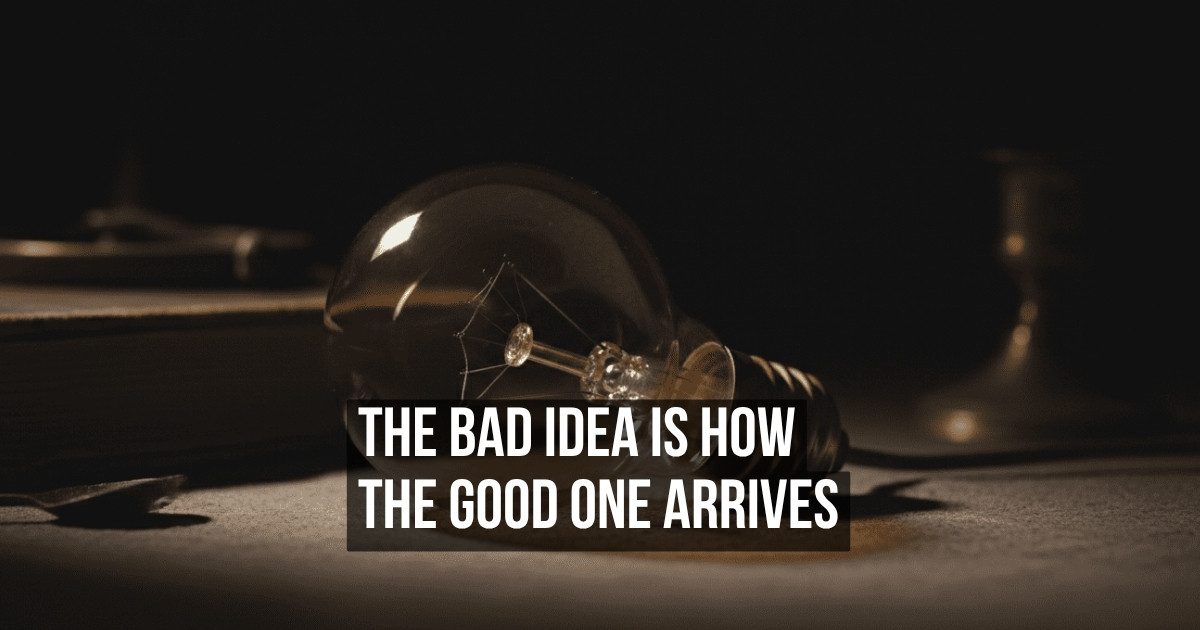
Your worst ideas are not obstacles to your best ones. They are prerequisites.
Why the Obvious Must Exit First
The first ideas you generate for any problem are almost always retrievals — solutions you have seen before, approaches that worked elsewhere, patterns your brain has filed under “standard response.” They feel productive because they arrive quickly. They are usually mediocre because they are common. If you had the idea easily, so would anyone else facing the same problem.
Genuinely original ideas live deeper in the associative network. They require your brain to make connections between domains that do not normally communicate — linking a restaurant experience to a software interface, or a childhood memory to a business strategy. These connections take time to surface because they require the conventional pathways to be exhausted first. Your brain will not reach for the unusual until the usual has been fully depleted.
Brainstorming research confirms this. A 2012 study by Ritter and Dijksterhuis published in Psychological Science showed that the most original ideas in a brainstorming session reliably appeared in the second half, not the first. Participants who stopped early — who took their first workable idea and ran with it — consistently produced less creative outcomes than those who pushed past the obvious.
The Discomfort Tax
The problem is that generating bad ideas feels terrible. Every failed attempt registers as evidence that you are not creative, not smart, not capable of solving this particular problem. The temptation to stop after the first reasonable idea is overwhelming — not because it is the best idea, but because continuing means tolerating the discomfort of producing more material you know is inadequate.
Most people quit the creative process at exactly the moment it is about to become productive. They mistake the discomfort of the middle for a signal that they are failing, when in reality the discomfort is the signal that the queue is being cleared.
The Bad Idea as Compass
Next time you are stuck, try producing five ideas you know are wrong. Deliberately. Without judgment. Write them down with the explicit understanding that none of them will be used. What you will find is that idea six or seven — the one that arrives after the pressure to be brilliant has been removed — is often sharper than anything you would have produced trying to get it right on the first attempt.
Your best ideas are not hiding from you. They are waiting behind the worst ones. And the only way through is through.
Something went wrong. Please refresh the page and/or try again.
Help us improve your journey
We use cookies to personalize your experience and understand how you use our site. By clicking 'Yes, I'm in!', you help us show you content you'll actually love. If you prefer to keep things simple, you can stick to the essentials. You can change your mind anytime!
Necessary
Always active
The technical storage or access is strictly necessary for the legitimate purpose of enabling the use of a specific service explicitly requested by the subscriber or user, or for the sole purpose of carrying out the transmission of a communication over an electronic communications network.
Preferences
The technical storage or access is necessary for the legitimate purpose of storing preferences that are not requested by the subscriber or user.
Analytics
The technical storage or access that is used exclusively for statistical purposes.The technical storage or access that is used exclusively for anonymous statistical purposes. Without a subpoena, voluntary compliance on the part of your Internet Service Provider, or additional records from a third party, information stored or retrieved for this purpose alone cannot usually be used to identify you.
Advertising
The technical storage or access is required to create user profiles to send advertising, or to track the user on a website or across several websites for similar marketing purposes.




Leave a Reply