You Have a Message Marked Unread That You Have Already Read
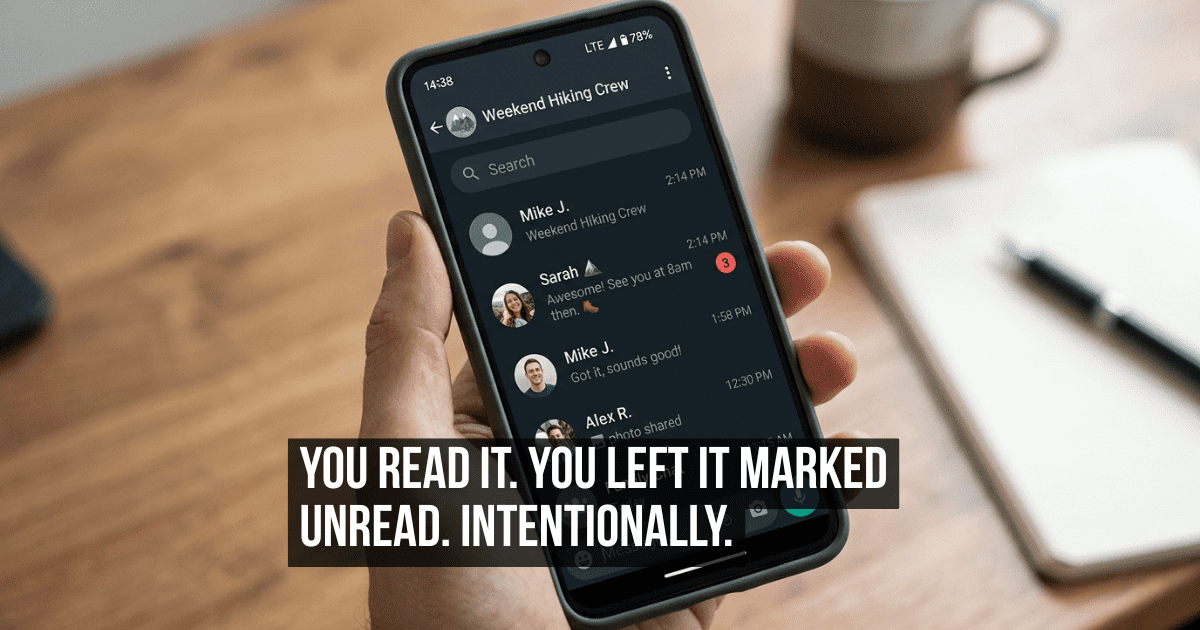
The notification arrived. You opened the app, found the message, read it fully, absorbed it, maybe reread it once, and then closed the app, leaving the message marked unread. It sits there now, bolded, with its dot, looking exactly like a message you haven’t seen. You have seen it. You made a decision to make it look like you haven’t.
This is one of the stranger small deceptions of contemporary digital life, and it’s almost universal.
The Unread as a Tool
Leaving a message marked unread after reading it is a workaround, and like most workarounds, it exists because the systems available don’t quite map onto the behavior required. What you need, functionally, is a way to flag something as read but not yet dealt with, a middle state between the notification’s urgency and the definitive closure of a reply. The unread marker is not that, but it’s the closest approximation available.
The bolded message in the inbox is a to-do item in the only format that the interface makes impossible to ignore. An actual task list entry can be bypassed, buried, forgotten. A message left visually unread interrupts every time you open the app, which is exactly the function you need it to perform when you have something that genuinely requires a response you’re not yet ready to give.
What the Delay Is Actually Managing
People leave messages unread after reading them for a specific set of reasons worth distinguishing. The message that requires a considered reply, something emotional, complex, or that demands research before answering, gets left unread as a reminder to return when better equipped. The message from someone you find difficult, where the response requires more emotional resource than the moment provides. The message that arrived at the exact wrong time, where reading-to-respond immediately would produce a worse response than reading-then-waiting.
Research on digital communication and response timing finds that reply quality varies significantly with the responder’s cognitive and emotional state at the time of writing. The deliberate unread is, in this context, a quality-control decision: you’ve read it, you know what it contains, you’ve decided that the best response isn’t available right now.
The Messages That Stay Unread the Longest
The deliberately unread message has a characteristic lifespan. Messages left unread for efficiency reasons, the ones flagged as reminders, tend to get answered within the day. Messages left unread because they’re emotionally difficult, or because they came from someone you’re in an unresolved dynamic with, or because you’re genuinely unsure what to say, tend to stay in that limbo state for days or weeks.
The longer it stays unread, the harder it becomes to reply, because now the delay itself is part of what needs to be addressed. The gap between reading and responding has grown wide enough that any reply will have to account for it, which adds a layer of complexity to what may have been a relatively simple message at the point of arrival. The deliberately unread message can become a trap of its own making.
The Slight Social Deception
Most messaging apps carry an ambient expectation of response time that the deliberately unread message is quietly circumventing. The person who sent it may not know you’ve read it. That’s partly the point.
This is a mild form of temporal dishonesty, using the interface’s appearance to buy time without declaring that you’re doing so. It doesn’t cause harm in most cases. But it does involve presenting a visible state that doesn’t match your actual state, which is, by definition, a small deception.
Most people who do it regularly don’t think of it in those terms. They think of it as managing their inbox. Both descriptions are accurate. The one you use probably depends on whose message you left unread.
Something went wrong. Please refresh the page and/or try again.
Help us improve your journey
We use cookies to personalize your experience and understand how you use our site. By clicking 'Yes, I'm in!', you help us show you content you'll actually love. If you prefer to keep things simple, you can stick to the essentials. You can change your mind anytime!
Necessary
Always active
The technical storage or access is strictly necessary for the legitimate purpose of enabling the use of a specific service explicitly requested by the subscriber or user, or for the sole purpose of carrying out the transmission of a communication over an electronic communications network.
Preferences
The technical storage or access is necessary for the legitimate purpose of storing preferences that are not requested by the subscriber or user.
Analytics
The technical storage or access that is used exclusively for statistical purposes.The technical storage or access that is used exclusively for anonymous statistical purposes. Without a subpoena, voluntary compliance on the part of your Internet Service Provider, or additional records from a third party, information stored or retrieved for this purpose alone cannot usually be used to identify you.
Advertising
The technical storage or access is required to create user profiles to send advertising, or to track the user on a website or across several websites for similar marketing purposes.




Leave a Reply