The Last-Minute Mirror Check Before Leaving the House Is Not About Vanity
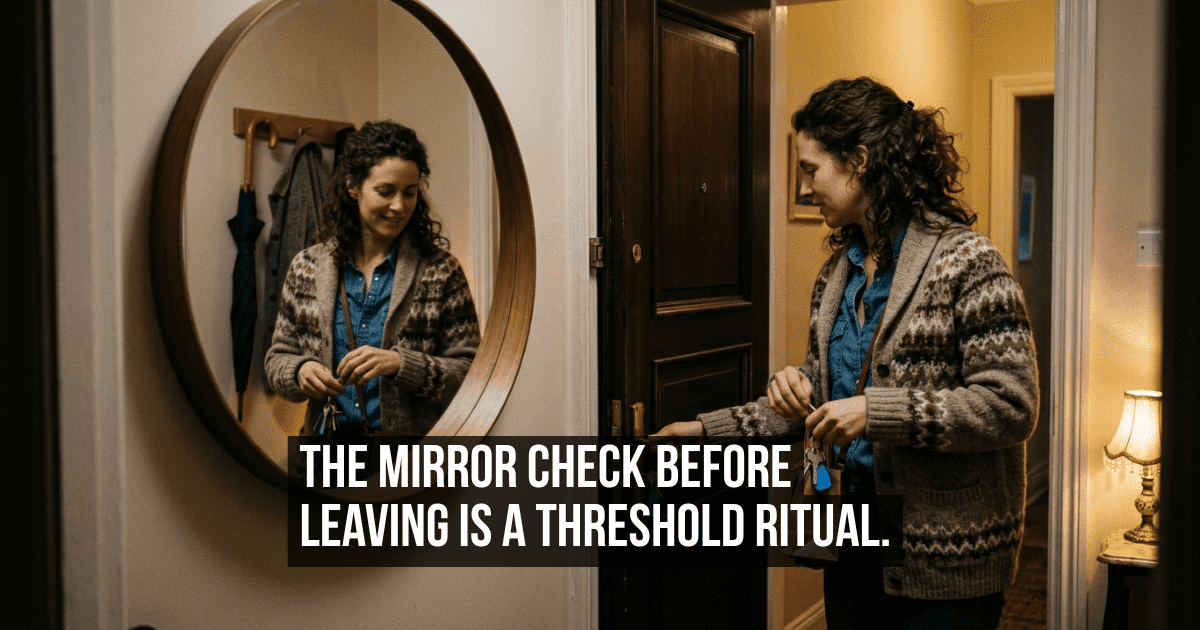
The coat is on. The bag is over the shoulder. The keys are in hand. And then, in the last four seconds before the door, you turn to the mirror, or the glass of a window, or the dark screen of a turned-off television, for a look that is over before it’s fully begun. A check. A brief inventory. Then you leave.
If asked, you’d probably call it vanity, or habit, or just something you do. It’s something more specific than any of those.
The Transition Checkpoint
The last-minute mirror check is a pre-departure ritual that most people perform and few examine. On its surface it looks like concern for appearance, a final quality control pass before presenting yourself to the world. But the timing is off for that explanation. A check motivated purely by appearance would happen earlier, with enough time to change something. The four-second check at the door, coat already on, is too late to matter for appearance and happens anyway.
What it’s actually doing is closer to what anthropologists call a liminality ritual, a behavior that marks the passage from one social space to another. The threshold between private and public is one of the most psychologically significant boundaries in daily life. Inside is where you are without an audience. Outside is where you’re performing, in the broadest sense: adjusting your behavior, monitoring your presentation, meeting other people’s expectations of who you are.
The mirror, in this context, isn’t showing you your appearance. It’s confirming that the version of you that exists privately, in the home, in the morning, before the day has organized itself around you, has been adequately assembled for external use.
What the Check Is Actually Assessing
Social psychologists who study self-presentation find that the anxiety associated with transitions between private and public space tends to peak in the moments immediately before the crossing. The check provides a micro-resolution of that anxiety, a brief, concrete act of reassurance that works even when nothing about the image has changed since the last time you looked.
Research on self-monitoring, the degree to which individuals actively manage their public presentation, finds that high self-monitors perform more frequent appearance checks in transitional moments. But even low self-monitors, who generally pay less attention to how they come across, perform some version of the door-check. The behavior isn’t about vanity. It’s about readiness.
What Happens When the Mirror Isn’t There
The discomfort of leaving without a mirror check is modest but real. Many people report a persistent low-level unease during the early minutes of a trip when the exit was rushed and the check skipped. Not because anything is actually wrong, but because the sequence was incomplete.
The mirror check is the final step in a departure ritual that most people have developed over years without consciously constructing it. Keys, phone, bag, mirror, door. Remove one element and the departure doesn’t feel finished, even if everything was packed correctly and nothing was forgotten. The body knows the sequence and registers its absence. It’s the same mechanism that makes you feel like you’ve forgotten something when you’ve changed your morning routine, even when you haven’t actually forgotten anything at all.
The Version of You the Mirror Approves
The check is almost always positive. You look, you register something acceptable, you leave. The cases where it catches something, a collar, a smear, a visible problem, are rare enough that the check isn’t really about catching things. It’s about completing a sequence.
Ready, packed, keys, mirror, door. Remove any element and the departure feels unfinished. The mirror isn’t the last step before leaving. It’s the step that makes leaving feel complete.
Vanity would require that you like what you see. The check works fine either way.
Something went wrong. Please refresh the page and/or try again.
Help us improve your journey
We use cookies to personalize your experience and understand how you use our site. By clicking 'Yes, I'm in!', you help us show you content you'll actually love. If you prefer to keep things simple, you can stick to the essentials. You can change your mind anytime!
Necessary
Always active
The technical storage or access is strictly necessary for the legitimate purpose of enabling the use of a specific service explicitly requested by the subscriber or user, or for the sole purpose of carrying out the transmission of a communication over an electronic communications network.
Preferences
The technical storage or access is necessary for the legitimate purpose of storing preferences that are not requested by the subscriber or user.
Analytics
The technical storage or access that is used exclusively for statistical purposes.The technical storage or access that is used exclusively for anonymous statistical purposes. Without a subpoena, voluntary compliance on the part of your Internet Service Provider, or additional records from a third party, information stored or retrieved for this purpose alone cannot usually be used to identify you.
Advertising
The technical storage or access is required to create user profiles to send advertising, or to track the user on a website or across several websites for similar marketing purposes.




Leave a Reply