You held the elevator door and instantly regretted it
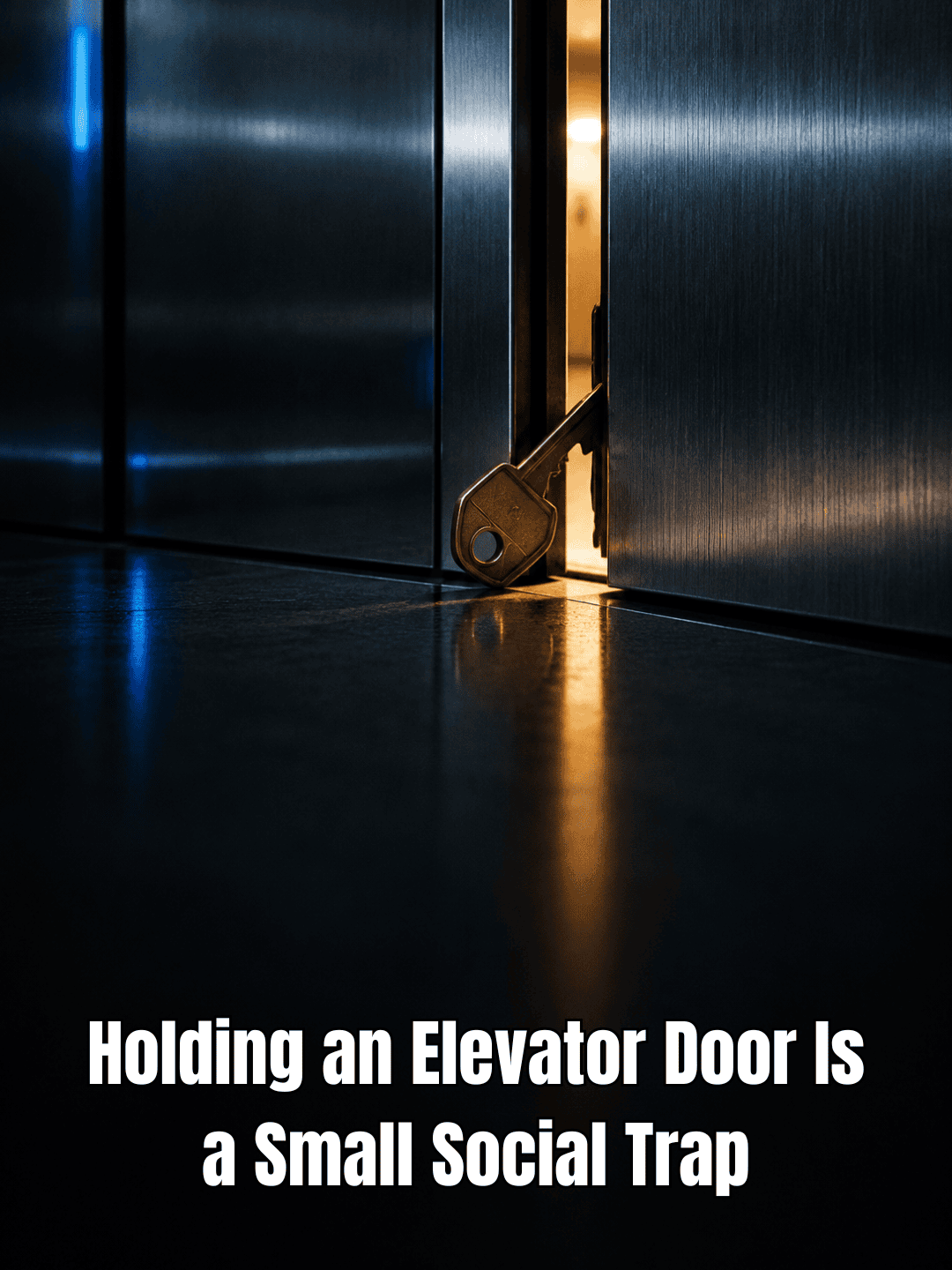
You see someone approaching down the corridor, so you hold the door. It is a kind thing to do, and it takes one second. Then you realize the person is about fourteen steps away and has started to jog, in a small, apologetic trot, waving thanks in advance.
You stand there, hand on the sensor, smiling with the specific warmth of someone who now has to hold a smile for six seconds. You wish you had never pressed it.
The regret is not about the time. It is about what you have just signed up for: a debt of gratitude, and an audience.
Some people have the opposite problem. They arrive at a deliberately normal pace, as if to say that nobody asked you to wait. You are not thanked, you are not hurried, and the walk feels about forty seconds long.
Meanwhile the lift is humming, the doors keep trying to close against your hand, and the bit of your brain that does arithmetic has begun to calculate how much of your day you have just given away.
The favor with hidden costs
Holding a door costs almost nothing, so why does it feel expensive? Because you have made an offer without knowing its terms. The other person might be two steps away or twenty. You will not know until it is too late to withdraw.
Now there is an obligation on their side. The sociologist Alvin Gouldner described the norm of reciprocity in 1960: when someone does us a favor, we feel pressure to repay it. A tiny favor creates a tiny debt, and the jog is the first installment, a visible payment of hurry.
The jog is also a performance. It says: I know you did not have to, and I respect your time. You, in turn, perform the reply, “No problem, take your time,” which is a lie and is understood to be a lie.
Both of you know the script. The thanks is rehearsed, the wave is rehearsed, and the whole exchange takes less time than it takes to read about it. What makes it uncomfortable is that neither of you gets to opt out of the performance once it has started.
The debt is real even when it is tiny. People who have been helped by a stranger often look for a small way to return the favor within minutes, whether by pressing the button for the right floor or by saying something warm. A courtesy begins a short conversation about who owes what.
Six seconds of social weather
Then comes the ride. You are in a small box with a stranger who owes you a nod. There is the choice of floor, the glance at the number panel, the careful study of shoes. Ten seconds feel like a conversation neither of you wants.
Elevators are among the last places where two people are forced into physical closeness with no way out. People respond in a predictable way: eyes up, phones out, bodies still. The nod at the door was a sociable gesture, and the elevator is a machine for undoing it.
Look at where everyone stands. They face the doors, shoulders slightly turned, watching the numbers climb as if it were a sport. Every body in the box is saying the same silent thing: this is not personal, and it will be over soon.
The same moment has a different version when you are the one running. You see the doors closing, you speed up, and a hand appears in the gap. For a second you feel nothing but gratitude, and then you step inside and become the person who has to make small talk with the hero of the hour.
It is a small lesson in how etiquette works. A gesture that seems generous when made quickly can lock you into a longer, more awkward exchange, and no rulebook says when the courtesy ends.
The rules nobody wrote
Most people operate with an informal rule: hold the door if the person is close, and let it close if they are not. The judgment is made in a fraction of a second, based on their pace, their expression and how much of a hurry you are in yourself.
Misjudge it and you pay in seconds of awkwardness. Judge it well and nobody notices, which is why good etiquette goes unrecognized and bad etiquette is remembered.
There is a graceful way out of the doubtful cases. Wave the person on with a smile and let the door close, as if to say: no rush, I’ll see you inside. Nobody takes offense, and nobody has to run.
Another small mercy is to tell them how long you will wait. “I’ve got it, take your time” released into the corridor makes the jog optional, and it turns an obligation into a gift.
There is a kinder reading of the regret. It is a sign that you take other people’s time seriously, including your own. A person who never feels awkward about holding a door has probably never held one for the wrong person.
The kindest gesture and the most awkward one are often the same second.
Something went wrong. Please refresh the page and/or try again.
Help us improve your journey
We use cookies to personalize your experience and understand how you use our site. By clicking 'Yes, I'm in!', you help us show you content you'll actually love. If you prefer to keep things simple, you can stick to the essentials. You can change your mind anytime!
Necessary
Always active
The technical storage or access is strictly necessary for the legitimate purpose of enabling the use of a specific service explicitly requested by the subscriber or user, or for the sole purpose of carrying out the transmission of a communication over an electronic communications network.
Preferences
The technical storage or access is necessary for the legitimate purpose of storing preferences that are not requested by the subscriber or user.
Analytics
The technical storage or access that is used exclusively for statistical purposes.The technical storage or access that is used exclusively for anonymous statistical purposes. Without a subpoena, voluntary compliance on the part of your Internet Service Provider, or additional records from a third party, information stored or retrieved for this purpose alone cannot usually be used to identify you.
Advertising
The technical storage or access is required to create user profiles to send advertising, or to track the user on a website or across several websites for similar marketing purposes.




Leave a Reply