Your Nostalgia Isn’t About the Past — It’s About What Your Present Refuses to Provide
The Song From 2003
A song plays — one you have not heard in years. Instantly, you are not in your kitchen anymore. You are in a specific car, on a specific road, during a summer that felt longer than any summer since. The smell of the seats. The heat through the window. A version of yourself that worried about different things and found joy in places you have since stopped looking.
The feeling is warm, vivid, and strangely painful. You call it nostalgia. But the pain is not about the past. It is about right now.
A Diagnosis Disguised as a Feeling
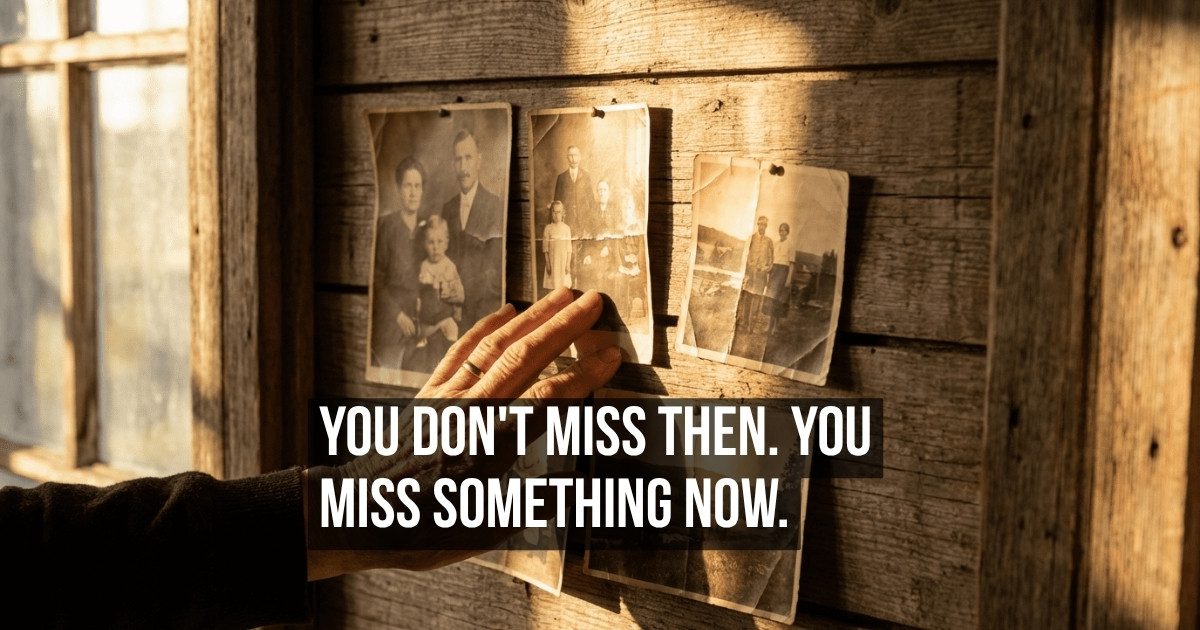
Nostalgia presents itself as a love letter to the past. It feels like you are missing something that was. But look closer at when it arrives. It does not show up randomly. It shows up when something in the present is insufficient — when your current life is missing a quality that the remembered version possessed.
You do not get nostalgic for 2003 because 2003 was objectively good. You were probably broke, uncertain, and making decisions you would later regret. You get nostalgic for 2003 because 2003 contained something your present does not: unstructured time, or the feeling of possibility, or friendships that operated without scheduling, or a body that did not yet require maintenance.
Nostalgia is not a review of the past. It is a critique of the present delivered in the gentlest possible format.
The Edit Your Memory Performs
Your brain does not remember the past as it was. It remembers a curated version — stripped of tedium, drained of anxiety, saturated with significance. The boring Tuesday afternoons disappear. The arguments dissolve. What remains is a highlight reel scored by the music you happened to be listening to at the time.
Psychologist Krystine Batcho at Le Moyne College has studied nostalgia for over two decades. Her research shows that nostalgic memories are consistently more emotionally intense, more social, and more identity-relevant than typical autobiographical memories. Your brain does not just store the past selectively. It enhances it — adding emotional contrast that makes the present look flat by comparison.
You are not remembering a better time. You are comparing an edited film to unedited footage and concluding that real life has gotten worse.
What You Actually Miss
Run the inventory on any strong nostalgic episode and the specifics reveal a pattern. You miss the apartment, not because it was nice — it was objectively terrible — but because you had people in it at midnight on a Wednesday for no reason. You miss the commute to a job you hated because the commute included a phone call with someone you no longer speak to daily. You miss the city you left, not the city itself, but the specific freedom of being unknown in it.
Every nostalgic impulse, decoded, is a request. More spontaneity. More connection without logistics. More identity that is not defined by obligation. These are not features of the past. They are deficits of the present that your brain is flagging in the only language it has: memory.
The Signal You Keep Romanticizing
The danger of nostalgia is not that it makes you sad. It is that it lets you outsource your dissatisfaction to a timeline you cannot change. As long as the problem is “things were better then,” you are exempt from asking what is missing now. The past becomes a storage unit for everything your current life refuses to provide, and visiting it feels easier than renovating the present.
Your nostalgia is not sentimental. It is specific, diagnostic, and worth taking literally. Not as a map back to where you were, but as an uncomfortably honest inventory of what your life has stopped including.
Something went wrong. Please refresh the page and/or try again.
Help us improve your journey
We use cookies to personalize your experience and understand how you use our site. By clicking 'Yes, I'm in!', you help us show you content you'll actually love. If you prefer to keep things simple, you can stick to the essentials. You can change your mind anytime!
Necessary
Always active
The technical storage or access is strictly necessary for the legitimate purpose of enabling the use of a specific service explicitly requested by the subscriber or user, or for the sole purpose of carrying out the transmission of a communication over an electronic communications network.
Preferences
The technical storage or access is necessary for the legitimate purpose of storing preferences that are not requested by the subscriber or user.
Analytics
The technical storage or access that is used exclusively for statistical purposes.The technical storage or access that is used exclusively for anonymous statistical purposes. Without a subpoena, voluntary compliance on the part of your Internet Service Provider, or additional records from a third party, information stored or retrieved for this purpose alone cannot usually be used to identify you.
Advertising
The technical storage or access is required to create user profiles to send advertising, or to track the user on a website or across several websites for similar marketing purposes.




Leave a Reply