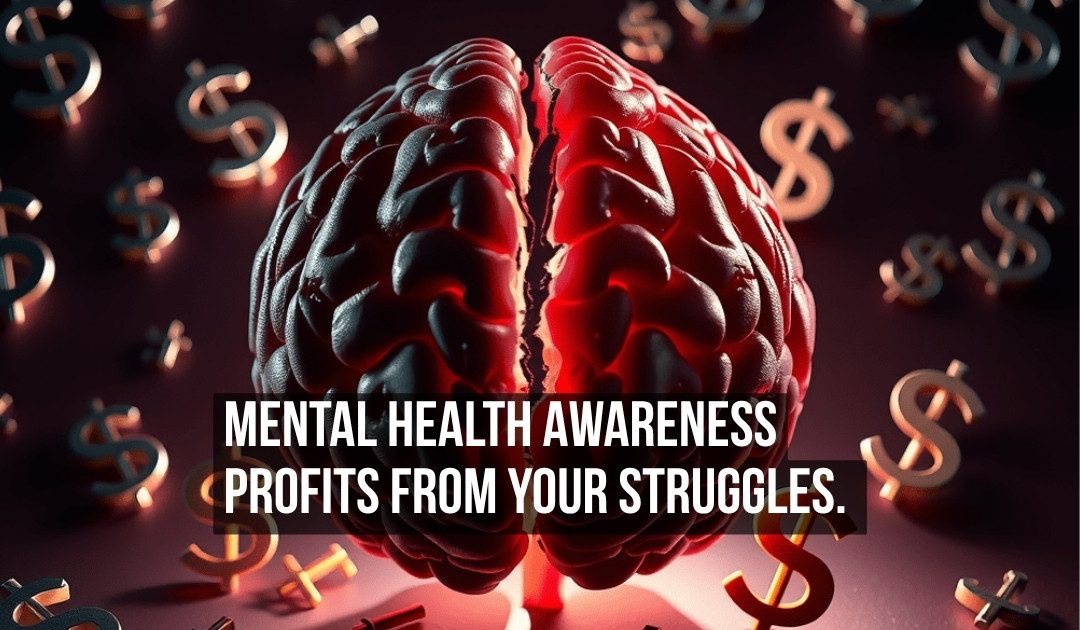
Mental Health Awareness Built a Two Hundred Billion Dollar Industry That Profits From Keeping You in Treatment
Normalizing mental health created a market that requires you to stay sick.
Mental health awareness has achieved remarkable cultural normalization. Therapy is no longer stigmatized. Discussing mental health openly is encouraged. Diagnosis and treatment are more accessible. These are genuine achievements. But they’ve also created a therapeutic-industrial complex that profits from proliferating diagnoses, pathologizing normal experience, and keeping people engaged with treatment indefinitely.
The mental health industry has grown to over $200 billion annually. This growth correlates with awareness campaigns, but it also creates incentive structures where more diagnosis means more revenue. The system doesn’t profit from people getting better—it profits from people staying in treatment, ideally indefinitely.
The Diagnostic Expansion
One marker of this dynamic is diagnostic expansion. Behaviors that were once considered personality variations or normal responses to stress now get pathologized as disorders requiring treatment. The threshold for diagnosis keeps lowering, capturing more people into treatment systems.
This serves multiple functions. It reduces stigma by making mental health conditions more common—if everyone’s diagnosable, diagnosis carries less shame. But it also expands the treatment market by reclassifying normal human variation as requiring professional intervention.
The question rarely asked is whether this expansion helps people or simply creates lifetime customers for mental health services. If brief sadness becomes depression requiring treatment, if social anxiety becomes a disorder instead of personality trait, if normal stress becomes pathological condition—the result is population perpetually engaged with mental health system.
The Therapy Industrial Complex
The normalization of therapy has also created expectation of continuous treatment. Therapy is framed not as intervention for specific problems but as ongoing maintenance, something healthy people do indefinitely to stay healthy. This transforms short-term treatment into permanent subscription.
This model benefits providers through stable, long-term revenue. But it’s unclear if it benefits clients. Some people need ongoing therapeutic support. But many could benefit from time-limited treatment focused on specific issues, then discontinuation once those issues are addressed.
The current model discourages discontinuation. Stopping therapy is framed as regression or avoidance, not as successful completion. The assumption is that everyone benefits from perpetual therapeutic relationship, which conveniently aligns with provider financial interests. The tech sector has accelerated this logic further: AI therapists don’t just risk the same dynamic—they systematize it at scale.
The Self-Diagnosis Culture
Online mental health awareness has also enabled self-diagnosis culture where people identify with disorders based on relatable symptom descriptions. Social media amplifies this through content that makes disorders seem common, even universal: “signs you have ADHD,” “trauma responses you don’t recognize,” “symptoms of depression people miss.”
This content serves awareness function but also encourages identifying normal experiences as pathological. You see list of anxiety symptoms and recognize yourself, concluding you have anxiety disorder—when you might just be experiencing normal human stress. TikTok mental health content operates by the same logic: high engagement, low accountability, and a format optimized for self-identification over accuracy.
The self-diagnosis often leads to self-treatment through mental health content, apps, courses, coaches. An entire ecosystem has emerged selling mental health solutions to people who’ve self-identified as needing them, often without professional diagnosis or assessment of whether intervention is actually necessary.
The Medicalization
Mental health awareness has also normalized pharmaceutical intervention as first-line treatment. Medication can be life-saving for severe conditions. But the threshold for pharmacological treatment has lowered alongside diagnostic expansion.
This creates situation where normal sadness gets medicated as depression, normal anxiety gets medicated as disorder, normal attention variation gets medicated as ADHD. The pills address symptoms but don’t resolve underlying issues, creating dependency that benefits pharmaceutical companies through long-term prescriptions.
The messaging around medication has shifted from “treatment for severe conditions” to “support for anyone struggling.” This expansion serves market growth but medicalizes experiences that might be better addressed through lifestyle changes, social support, or simply accepting that some discomfort is normal.
The Awareness Paradox
Perhaps most troubling is how awareness itself may worsen outcomes for some people. Constant exposure to mental health content can increase symptom awareness, which increases symptom reporting, which increases treatment-seeking. But it’s unclear if people are actually more sick or just more aware of normal experiences reframed as symptoms.
Studies show that mental health awareness campaigns correlate with increased diagnosis and treatment-seeking but don’t consistently show improved mental health outcomes at population level. This suggests awareness may be creating treatment demand without corresponding health improvement.
The paradox is that awareness was supposed to reduce suffering by encouraging treatment. But if awareness primarily increases identification with disorders rather than actual recovery, it may be perpetuating suffering under guise of addressing it. Meanwhile, the loneliness epidemic continues to deepen—suggesting the system is treating symptoms while the underlying social conditions that produce them go unaddressed.
The Recovery Disincentive
What’s missing in mental health awareness is emphasis on recovery and treatment completion. The narrative is “get help and stay in treatment” rather than “get help, resolve specific issues, discontinue when appropriate.”
This lack of recovery emphasis serves the industry. People who recover and discontinue treatment are lost customers. People who remain in indefinite treatment provide ongoing revenue. The incentive structure favors keeping people engaged with mental health systems, not helping them graduate from those systems.
Mental health awareness achieved important cultural shifts. But it’s also created markets that profit from proliferating diagnosis and perpetual treatment. And we need to question whether the current system serves people’s wellbeing or primarily serves its own growth.
Something went wrong. Please refresh the page and/or try again.
Help us improve your journey
We use cookies to personalize your experience and understand how you use our site. By clicking 'Yes, I'm in!', you help us show you content you'll actually love. If you prefer to keep things simple, you can stick to the essentials. You can change your mind anytime!
Necessary
Always active
The technical storage or access is strictly necessary for the legitimate purpose of enabling the use of a specific service explicitly requested by the subscriber or user, or for the sole purpose of carrying out the transmission of a communication over an electronic communications network.
Preferences
The technical storage or access is necessary for the legitimate purpose of storing preferences that are not requested by the subscriber or user.
Analytics
The technical storage or access that is used exclusively for statistical purposes.The technical storage or access that is used exclusively for anonymous statistical purposes. Without a subpoena, voluntary compliance on the part of your Internet Service Provider, or additional records from a third party, information stored or retrieved for this purpose alone cannot usually be used to identify you.
Advertising
The technical storage or access is required to create user profiles to send advertising, or to track the user on a website or across several websites for similar marketing purposes.




Leave a Reply