The Supermarket Checkout Line You Choose Will Almost Always Feel Like the Wrong One
The Wrong Line, Every Time
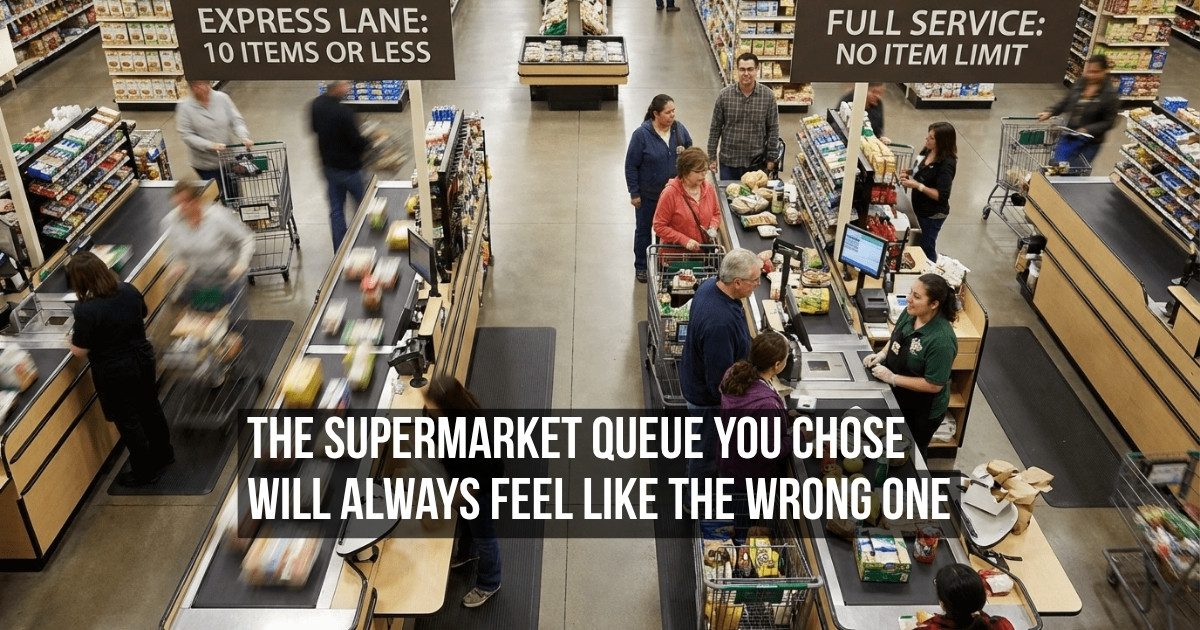
You scan the checkout lanes. You assess the variables: number of people, cart volume, cashier speed, the wild card of the elderly gentleman paying by check. You choose. You commit. And within forty-five seconds, the line next to yours begins moving while yours has stalled behind someone disputing a coupon.
This is not bad luck. It is mathematics wearing the disguise of personal failure.
The Odds Were Never in Your Favor
If there are three checkout lines and you pick one, there are two remaining lines that could potentially move faster than yours. The probability that your line is the fastest is one in three. The probability that at least one other line beats yours is two in three. You are statistically more likely to feel like you chose wrong than to feel like you chose right, every single time, regardless of how carefully you analyzed the situation.
Mathematician Dan Meyer illustrated this principle by showing that in any multi-queue system, the individual’s subjective experience is almost guaranteed to be negative. Add four lines, and the odds drop to one in four that you picked the fastest. At six registers, you have an 83 percent chance of watching someone else move faster. The more options available, the worse you feel about whatever you chose.
What Makes It Sting
Pure probability would be tolerable if your brain processed it neutrally. It does not. The person who was behind you in the other line and is now walking toward the exit while you are still watching a price check on aisle seven triggers a specific cognitive response: counterfactual thinking. Your brain involuntarily constructs the alternate reality where you chose differently, and that fictional version of events feels more real than the statistical explanation.
A 1995 study by Daniel Kahneman and Amos Tversky on loss aversion demonstrated that the pain of losing is psychologically approximately twice as powerful as the pleasure of gaining. Applied to checkout lines: the frustration of being in a slow line is felt roughly twice as intensely as the satisfaction of being in a fast one. You barely notice when you choose well. You remember for hours when you choose poorly.
The result is a perfectly designed system for persistent dissatisfaction. The odds guarantee you will usually be in a slower line. Your brain guarantees you will feel it disproportionately when you are.
The Switching Trap
So you switch. You grab your cart and migrate to the line that was moving. And it stops. Because of course it does — the same probability applies to the new line, and now you have also added the psychic penalty of having actively abandoned your original position. Studies on lane-switching in traffic by Redelmeier and Tibshirani at the University of Toronto found the identical pattern: drivers who changed lanes frequently arrived at their destination no faster but reported significantly higher frustration. Action felt productive. Its result was neutral. Its emotional cost was real.
The checkout line punishes both patience and impatience equally. Stay and you suffer from inaction. Switch and you suffer from regret. The system does not have a winning strategy.
A Miniature Model of Every Decision
The supermarket checkout is a compressed version of how you experience choice in general. You evaluate, you commit, you immediately compare your outcome against visible alternatives, and you feel bad about a result that was, statistically, the most likely one all along. The line was never going to feel right. The architecture of the choice guaranteed it.
You did not pick the wrong line. You picked a line in a system where “wrong” is the default experience and “right” is the rare exception you will immediately forget.
Something went wrong. Please refresh the page and/or try again.
Help us improve your journey
We use cookies to personalize your experience and understand how you use our site. By clicking 'Yes, I'm in!', you help us show you content you'll actually love. If you prefer to keep things simple, you can stick to the essentials. You can change your mind anytime!
Necessary
Always active
The technical storage or access is strictly necessary for the legitimate purpose of enabling the use of a specific service explicitly requested by the subscriber or user, or for the sole purpose of carrying out the transmission of a communication over an electronic communications network.
Preferences
The technical storage or access is necessary for the legitimate purpose of storing preferences that are not requested by the subscriber or user.
Analytics
The technical storage or access that is used exclusively for statistical purposes.The technical storage or access that is used exclusively for anonymous statistical purposes. Without a subpoena, voluntary compliance on the part of your Internet Service Provider, or additional records from a third party, information stored or retrieved for this purpose alone cannot usually be used to identify you.
Advertising
The technical storage or access is required to create user profiles to send advertising, or to track the user on a website or across several websites for similar marketing purposes.




Leave a Reply