The Real Reason Your Phone Battery Dies Faster Every Year Has Nothing to Do With Age
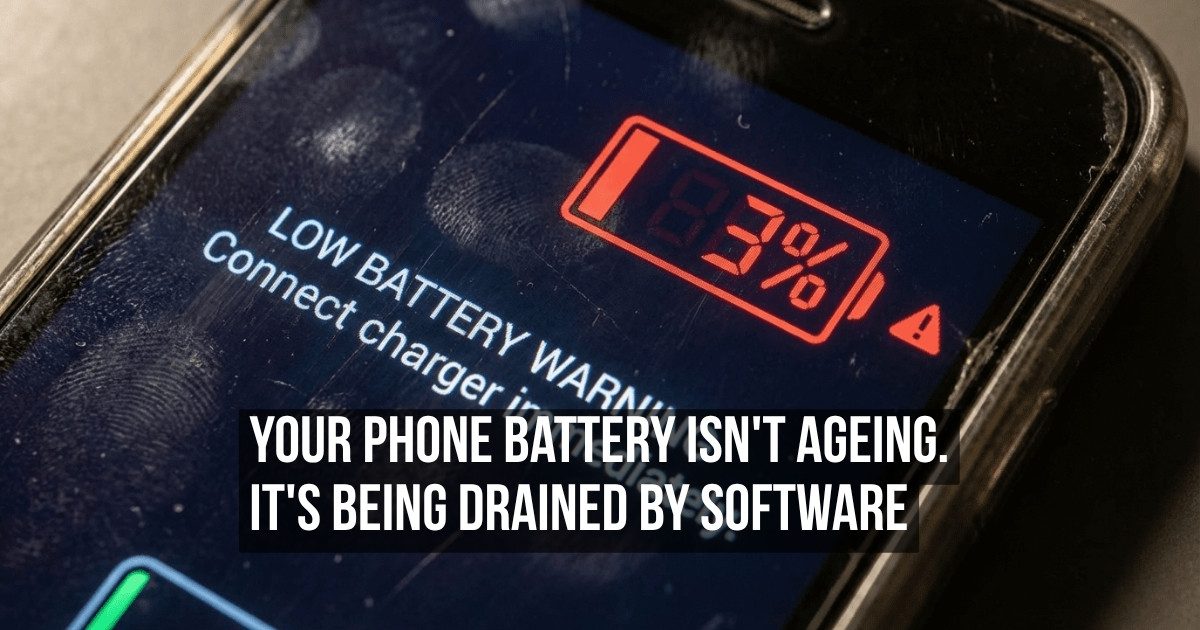
Eighteen months after buying a new smartphone, you notice it. The battery that once lasted a full day now dies by mid-afternoon. You assume the battery has degraded — lithium-ion cells do lose capacity over charge cycles, after all. But the battery is only part of the story, and in many cases, it’s the smaller part. The real drain is coming from software: updates, background processes, and design decisions that systematically increase power consumption long after you’ve stopped thinking of your phone as new.
The Update That Takes More Than It Gives
Every major operating system update arrives with a list of new features and security patches. What the release notes don’t mention is the computational overhead. iOS and Android updates consistently increase the processing demands on the device’s hardware. New animations require more GPU cycles. Expanded notification systems poll servers more frequently. Machine learning features — predictive text, photo categorisation, real-time voice processing — run background tasks that didn’t exist when the phone shipped.
A phone released in 2023 was optimised for the software it shipped with. By 2025, it’s running an operating system designed with 2025 hardware in mind — faster processors, more RAM, larger batteries. The old hardware must work harder to execute the same instructions, consuming more power per task. Apple’s own battery health documentation acknowledges that software updates can affect battery performance, though the company frames this as an inevitable side effect rather than a design choice.
Background Activity You Never Authorised
Check your phone’s battery usage screen right now. Beneath the apps you actively used today, you’ll find a list of applications that consumed power while you weren’t looking. Social media apps refresh feeds, pre-load videos, and ping location services at intervals measured in minutes. Messaging platforms maintain persistent connections to multiple servers. Email clients sync across accounts on schedules you probably never configured and may not know how to change.
A study by researchers at Purdue University found that on average, only 10 to 30 percent of an app’s energy consumption is spent on the core function the user actually wants. The remaining 70 to 90 percent goes to analytics, advertising modules, location tracking, and data transmission to third-party servers. The flashlight app you downloaded doesn’t need much power to illuminate your screen. But the advertising SDK embedded inside it is busy transmitting your device ID, location, and usage patterns to a dozen data brokers while the torch is on.
Designed Thickness, Designed Limits
Modern smartphones are thinner than they need to be. The Samsung Galaxy S24 measures 7.6 millimetres thick. The iPhone 15 Pro comes in at 8.25 millimetres. Both dimensions represent engineering choices that prioritise aesthetics over battery capacity. A phone even two millimetres thicker could accommodate a significantly larger battery — estimates suggest 15 to 25 percent more capacity — without meaningfully changing the user experience. Nobody has ever complained that their phone was too thick. Millions complain daily that it doesn’t last long enough.
The thinness race is driven by marketing differentiation, not user demand. Each product launch features measurements and weight comparisons as headline specifications, training consumers to associate slimness with technological progress. The trade-off — less physical space for the component that determines how long the device remains functional — is never presented as a trade-off. It is presented as an achievement.
The Charging Cycle Illusion
Lithium-ion batteries do degrade. After 500 complete charge cycles, a typical smartphone battery retains approximately 80 percent of its original capacity. That’s a genuine 20 percent loss. But users commonly report battery performance declines of 40 to 50 percent over the same period — far exceeding what chemical degradation alone can explain.
The gap between expected degradation and experienced degradation is filled by software. Each update adds features that consume more power. Each newly installed app brings its own background processes. Push notification volume increases as more services compete for attention. The battery is losing capacity at one rate while the demands on it are increasing at a faster rate. The result feels like rapid battery decline, but much of what users experience as hardware failure is actually software inflation — the steady, invisible expansion of what the device is expected to do.
Replacement as Revenue
Phone manufacturers operate on upgrade cycles of two to three years. A device that performed perfectly at 36 months would weaken the incentive to buy its successor. Battery anxiety — the specific stress of watching a percentage counter drop through the afternoon — is one of the most powerful motivators for replacement. Surveys by Counterpoint Research consistently rank battery life as the primary reason consumers upgrade, ahead of camera quality, screen size, or processing speed.
Making batteries user-replaceable would extend device lifespans significantly. Until the EU’s new regulation requiring removable batteries takes full effect, most flagship phones seal the battery behind glued glass panels that require professional tools and thermal equipment to open. The technical justification — water resistance, structural integrity — is genuine but incomplete. A replaceable battery costs a manufacturer nothing in materials. What it costs them is a customer who keeps the same phone for five years instead of two.
Your battery isn’t simply ageing. It’s being outpaced by software that demands more from it each month, housed in a shell designed to be as thin as possible rather than as durable as possible, and sealed shut to ensure that when the decline becomes unbearable, the solution is a new phone rather than a new battery. The degradation is real. The inevitability of it is not.
Something went wrong. Please refresh the page and/or try again.
Help us improve your journey
We use cookies to personalize your experience and understand how you use our site. By clicking 'Yes, I'm in!', you help us show you content you'll actually love. If you prefer to keep things simple, you can stick to the essentials. You can change your mind anytime!
Necessary
Always active
The technical storage or access is strictly necessary for the legitimate purpose of enabling the use of a specific service explicitly requested by the subscriber or user, or for the sole purpose of carrying out the transmission of a communication over an electronic communications network.
Preferences
The technical storage or access is necessary for the legitimate purpose of storing preferences that are not requested by the subscriber or user.
Analytics
The technical storage or access that is used exclusively for statistical purposes.The technical storage or access that is used exclusively for anonymous statistical purposes. Without a subpoena, voluntary compliance on the part of your Internet Service Provider, or additional records from a third party, information stored or retrieved for this purpose alone cannot usually be used to identify you.
Advertising
The technical storage or access is required to create user profiles to send advertising, or to track the user on a website or across several websites for similar marketing purposes.




Leave a Reply