How a Single Coffee Order Became the Most Precisely Engineered Status Signal in Daily Life
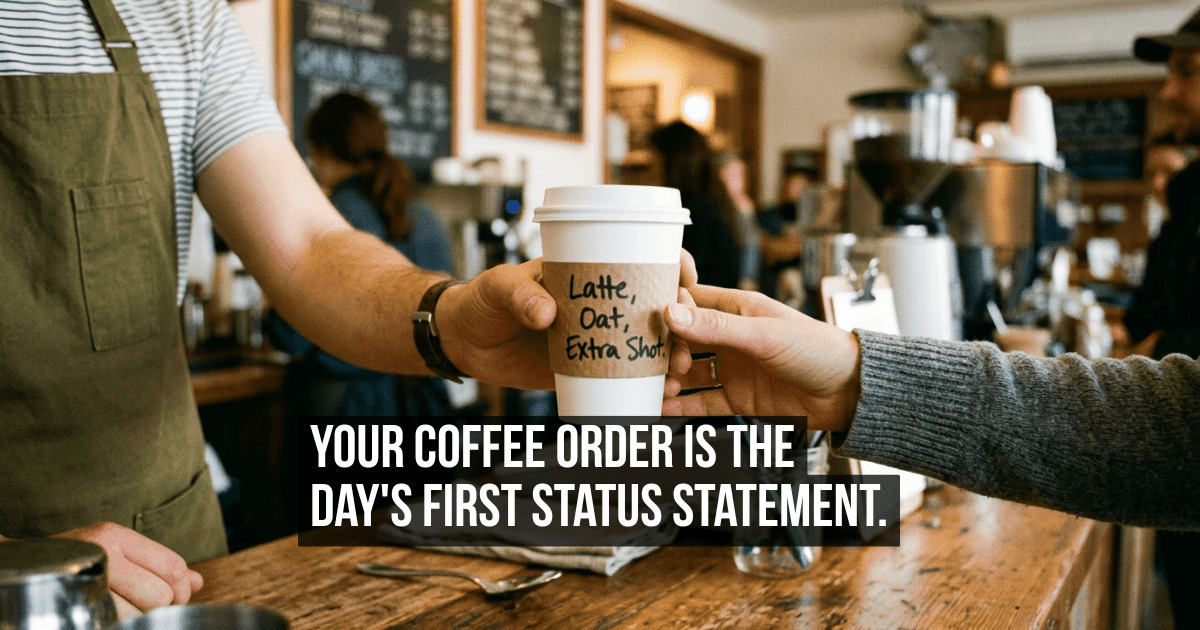
Consider what happens at the coffee counter. The person ahead of you orders a large oat-milk flat white with an extra shot, light foam, 65 degrees. The barista writes initials on a cup. The order is assembled. In approximately two minutes, something has been communicated — not about coffee preferences, exactly, but about who the ordering person understands themselves to be and would like to be understood as.
The coffee order has become, in urban professional culture, one of the most information-dense daily performances available. In a single sentence, it signals familiarity with specialty coffee culture, nutritional priorities, brand awareness, and an attitude toward precision and personal requirements that has specific class and cultural associations. None of this is hidden. None of it is accidental.
The Anatomy of Signal
Decode the elements. The milk choice communicates first: oat milk arrived in mainstream coffee culture in the mid-2010s and was initially associated with environmental consciousness and dietary sophistication. By 2020 it had spread to mass-market chains, diluting the signal. Specialty milks — barista oat versus standard oat, macadamia, specific brand preferences — now distinguish levels of initiation more precisely.
The drink type signals familiarity with specialty coffee vocabulary: a flat white is correctly understood as distinct from a latte by someone who knows both, which is a statement of cultural fluency. Asking for a cappuccino at a third-wave coffee shop signals a different kind of initiation. Asking for a black Americano signals either austerity, taste preference, or a deliberate rejection of the complexity signaling game — which is itself a signal.
Temperature specification — 65 degrees, not too hot — communicates that the person has specific preferences they have identified and articulated, and expects these preferences to be accommodated. The extra shot indicates a relationship with caffeine that is managed and understood. Each addition narrows the population of people who would order identically, increasing the specificity of the self-identification.
How Coffee Became a Class Marker
The sociology of coffee consumption has tracked a consistent pattern over the past four decades. The specialty coffee movement of the 1970s and 1980s — associated with Peet’s in Berkeley and the early Starbucks in Seattle — differentiated a premium, educated consumer class from the mass drip-coffee market. As Starbucks scaled globally through the 1990s and 2000s, the signal it had encoded began to migrate upward: Starbucks became mainstream, which meant it no longer marked distinction.
The third-wave coffee movement — specialty roasters, single-origin beans, pour-over methods, the barista as craftsperson rather than order-taker — re-established the distinction at a higher register. The vocabulary, the aesthetics, and the price points of third-wave coffee function as cultural capital: resources that are acquired through exposure and education, not simply through money, and that signal membership in a cultural formation associated with education, urban residence, and a particular relationship to consumption as expression.
The Role of the Barista
The specialty coffee counter has developed a specific theater of expertise. A skilled barista knows their beans, their ratios, their extraction times, and their milk textures; they can discuss origins and processing methods with genuine knowledge. The knowledgeable customer who orders precisely and receives their order correctly has been, briefly, recognized as a fellow initiate. The exchange is not purely commercial. It contains a small performance of mutual recognition within a shared cultural framework.
Chain coffee counters have partially replicated this theater through standardized customization systems — the Starbucks modifier vocabulary, the apps that offer twenty-seven milk options — but the encounter lacks the craft dimension. Customization at a chain signals consumer fluency with a commercial system. Ordering at a specialty counter signals something more like cultural membership.
The Order You Don’t Change
Most people who have developed a specific coffee order maintain it with a consistency that is mildly remarkable. The order becomes part of daily identity — a reliable, low-stakes daily expression of preference and selfhood that resists casual modification. Changing your coffee order requires revising a piece of self-description that you have been delivering, dozens of times per week, to dozens of witnesses. It is not impossible, but it carries a small cost that most people, without fully articulating why, prefer not to pay. The order is not just what you drink. It is a small, recurring statement of who you are.
Something went wrong. Please refresh the page and/or try again.
Help us improve your journey
We use cookies to personalize your experience and understand how you use our site. By clicking 'Yes, I'm in!', you help us show you content you'll actually love. If you prefer to keep things simple, you can stick to the essentials. You can change your mind anytime!
Necessary
Always active
The technical storage or access is strictly necessary for the legitimate purpose of enabling the use of a specific service explicitly requested by the subscriber or user, or for the sole purpose of carrying out the transmission of a communication over an electronic communications network.
Preferences
The technical storage or access is necessary for the legitimate purpose of storing preferences that are not requested by the subscriber or user.
Analytics
The technical storage or access that is used exclusively for statistical purposes.The technical storage or access that is used exclusively for anonymous statistical purposes. Without a subpoena, voluntary compliance on the part of your Internet Service Provider, or additional records from a third party, information stored or retrieved for this purpose alone cannot usually be used to identify you.
Advertising
The technical storage or access is required to create user profiles to send advertising, or to track the user on a website or across several websites for similar marketing purposes.




Leave a Reply