You’ve Already Decided and You’re Only Asking for Opinions to Feel Less Responsible
The Question You Already Answered
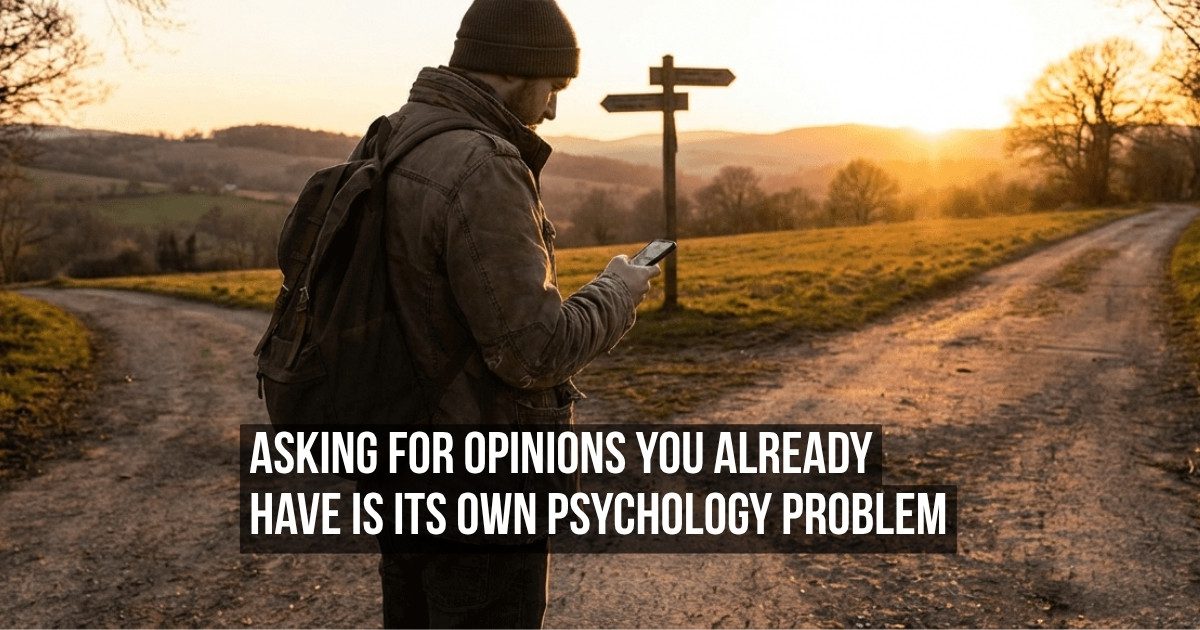
You text three friends. “Should I take the job?” You explain the pros and cons, the salary difference, the commute, the risk. You present it as an open question. Balanced. Undecided. Genuinely seeking input.
But pay attention to what happens when someone says “don’t take it.” Your chest tightens. A small argument forms instantly. You start defending the option you were supposedly unsure about with the urgency of someone whose mind was made up before the conversation started.
Consultation as Costume
Asking for opinions feels like a responsible thing to do. Thoughtful. Mature. The kind of behavior that belongs to someone who considers multiple perspectives before making a major life decision. Except that in most cases, the consultation is not a decision-making tool. It is a distribution mechanism for blame.
If you ask four people and three of them agree with what you already wanted, you now have social coverage. The choice is no longer just yours. It has been validated by your network. And if it goes wrong, the weight is shared — at least psychologically. “Everyone said I should go for it” is a sentence engineered to transform personal accountability into collective endorsement.
The Filter You Don’t Notice
Look at how you select the people you ask. You do not consult randomly. You choose the friend who will probably agree, the sibling who always says “go for it,” the colleague who shares your values. The sample is curated before the first question leaves your mouth.
Behavioral economists call this confirmation bias in social form. A 2009 study by Yaniv and Choshen-Hillel published in Organizational Behavior and Human Decision Processes showed that people consistently weigh advice confirming their initial preference more heavily than contradicting advice — even when the contradicting source is objectively more qualified. You are not gathering data. You are building a case.
The one friend who tells you what you do not want to hear? You dismiss them as “not understanding the full picture.” The full picture, in this context, means the version of reality that supports what you already feel.
Why Deciding Alone Feels Dangerous
Owning a decision completely — saying “I chose this, nobody influenced me, it was entirely mine” — is terrifying. Not because the decision might be wrong, but because there is no buffer if it is. Every good outcome belongs to you, but so does every bad one. No shared responsibility. No “well, they told me to.” Just you, your choice, and whatever follows.
Asking for opinions creates the illusion of collaboration around what is fundamentally a solo act. You were always going to take that job, leave that relationship, book that flight. The polling was theater — well-intentioned, thoroughly convincing, but theater.
The Test You Can Run Right Now
Next time you are about to ask someone for their opinion on a decision, try something first. Flip a coin. Not to decide — but to watch your reaction. The moment the coin lands, you will know immediately whether you feel relieved or disappointed. That reaction is your actual decision. It was there before the coin. It was there before the question.
You never needed anyone’s opinion. You needed their signature on a permission slip you had already written yourself.
Something went wrong. Please refresh the page and/or try again.
Help us improve your journey
We use cookies to personalize your experience and understand how you use our site. By clicking 'Yes, I'm in!', you help us show you content you'll actually love. If you prefer to keep things simple, you can stick to the essentials. You can change your mind anytime!
Necessary
Always active
The technical storage or access is strictly necessary for the legitimate purpose of enabling the use of a specific service explicitly requested by the subscriber or user, or for the sole purpose of carrying out the transmission of a communication over an electronic communications network.
Preferences
The technical storage or access is necessary for the legitimate purpose of storing preferences that are not requested by the subscriber or user.
Analytics
The technical storage or access that is used exclusively for statistical purposes.The technical storage or access that is used exclusively for anonymous statistical purposes. Without a subpoena, voluntary compliance on the part of your Internet Service Provider, or additional records from a third party, information stored or retrieved for this purpose alone cannot usually be used to identify you.
Advertising
The technical storage or access is required to create user profiles to send advertising, or to track the user on a website or across several websites for similar marketing purposes.




Leave a Reply