Why Fragrance on Your Shampoo Label Is a Legal Loophole Hiding Dozens of Undisclosed Chemicals
Flip over any shampoo bottle, body wash, or moisturiser in your bathroom and scan the ingredients list. Somewhere near the bottom, you’ll find a single word: “fragrance.” Sometimes it appears as “parfum.” Either way, it represents the most legally protected piece of ambiguity in the personal care industry — a single term that can conceal anywhere from a handful to several thousand individual chemical compounds, none of which the manufacturer is required to disclose.
The Trade Secret Defence
The fragrance exemption exists because scent formulations are classified as trade secrets. In the United States, the Fair Packaging and Labeling Act of 1967 requires cosmetic manufacturers to list ingredients on product packaging — with one critical exception. Fragrance compositions may be listed as a single entry, protecting the proprietary blend from competitor imitation. The same exemption exists in the EU under Regulation (EC) No 1223/2009, though European rules do require disclosure of 26 specific allergens if they exceed certain concentration thresholds.
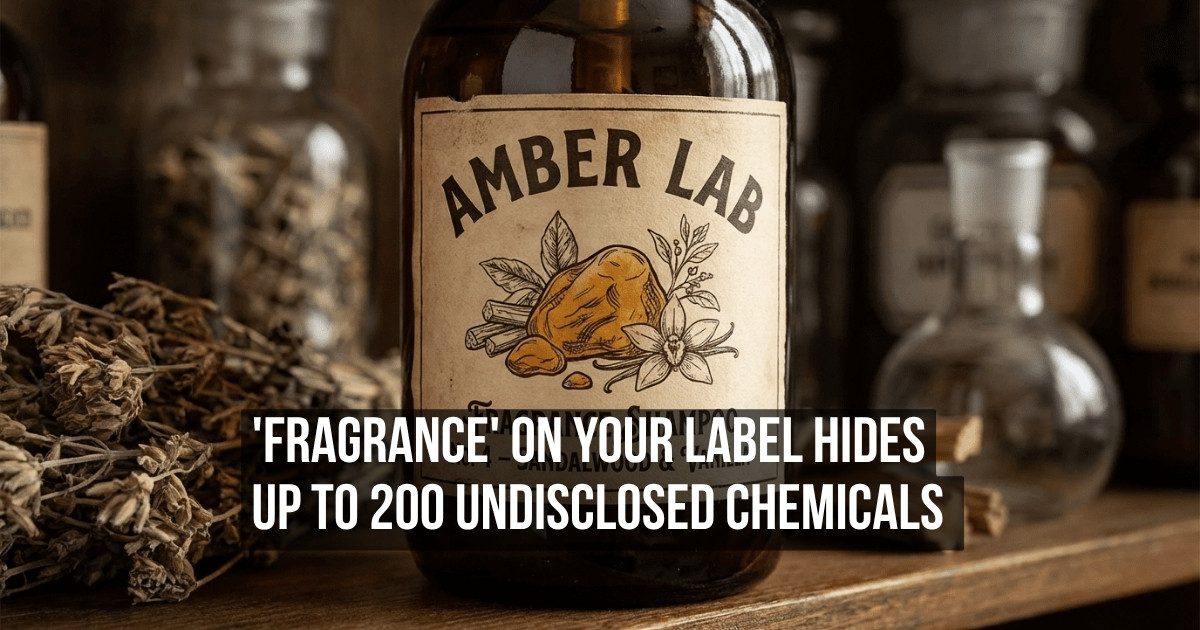
The result is a legal architecture where a shampoo label might list every ingredient down to the preservative at 0.01 percent concentration but then bundle dozens of fragrance chemicals under one word. A 2018 analysis by the Environmental Working Group found that the average fragrance in a consumer product contains approximately 14 undisclosed chemicals. Some luxury perfumes contain more than 200.
What Hides Behind the Word
Fragrance formulations can include synthetic musks, phthalates, aldehydes, and volatile organic compounds. Diethyl phthalate, commonly used as a fragrance solvent, has been identified by researchers as a potential endocrine disruptor — a chemical that can interfere with hormonal signalling. Synthetic musks such as galaxolide and tonalide are persistent environmental pollutants that bioaccumulate in aquatic organisms and have been detected in human breast milk.
None of these compounds would appear on your shampoo label. They are all legally subsumed under the word “fragrance.” A consumer with a specific sensitivity or concern about a particular chemical has no way to determine whether the product contains it without contacting the manufacturer directly — and manufacturers are under no obligation to respond.
The Scale of Daily Exposure
Consider a typical morning routine. Shampoo, conditioner, body wash, deodorant, moisturiser, sunscreen, toothpaste. A 2016 study by the Environmental Working Group found that the average woman uses 12 personal care products daily, containing a combined total of 168 chemical ingredients. For men, the figures are lower but still substantial: six products, 85 ingredients. In both cases, “fragrance” appears on multiple product labels, meaning the actual chemical count is higher than the listed ingredients suggest.
Dermal absorption varies by chemical and body region, but the skin is not the impermeable barrier that casual intuition assumes. Studies published in the Journal of Exposure Science and Environmental Epidemiology have demonstrated measurable blood levels of phthalates, parabens, and synthetic musks in participants whose sole exposure route was through normal use of fragranced personal care products. You are not simply smelling these chemicals. You are absorbing them.
The Industry’s Self-Regulation Argument
The fragrance industry points to self-regulatory bodies as evidence that adequate oversight exists. The International Fragrance Association publishes a standards document — the IFRA Code of Practice — that restricts or prohibits certain ingredients based on safety assessments conducted by the Research Institute for Fragrance Materials. Compliance, however, is voluntary. No government agency audits adherence. No penalties exist for violations. And the safety assessments themselves have been criticised by independent toxicologists for relying on outdated testing protocols and industry-funded research.
In practice, self-regulation means the industry that creates the chemicals also sets the safety standards, conducts the testing, and decides what counts as compliance. The fox, in this arrangement, does not merely guard the henhouse. It built the henhouse, wrote the building code, and conducts the inspections.
Fragrance-Free Is Not Chemical-Free
Consumers seeking to avoid undisclosed fragrance chemicals face a secondary deception. Products labelled “unscented” or “fragrance-free” are not necessarily free of fragrance chemicals. “Unscented” often means the product contains masking agents — chemicals added specifically to neutralise the smell of other ingredients. These masking agents are themselves fragrance compounds and may appear on the label under the same “fragrance” or “parfum” umbrella they were supposed to eliminate.
The distinction between “fragrance-free” and “unscented” is not standardised. Some manufacturers use them interchangeably. Others apply internal definitions that may or may not align with consumer expectations. A product that smells like nothing can still contain a complex cocktail of synthetic compounds designed to achieve that precise nothingness.
The Label That Tells You Nothing
Every other category of consumer product has moved toward greater ingredient transparency over the past two decades. Food labels now list allergens, nutritional content, and country of origin. Cleaning products increasingly disclose active ingredients and environmental impact data. Cosmetics remain the outlier — a category where a single word on the back of a bottle can legally stand in for dozens of chemicals that you apply to your skin every morning and absorb into your body before you’ve finished breakfast.
The word “fragrance” on your shampoo label is not an ingredient. It is a door that has been deliberately closed, behind which an unknown number of compounds sit undisclosed, untested in combination, and unreported to the person whose skin they touch daily. You have a legal right to know what is in your food. You have no equivalent right to know what is in the product you rub into your scalp.
Something went wrong. Please refresh the page and/or try again.
Help us improve your journey
We use cookies to personalize your experience and understand how you use our site. By clicking 'Yes, I'm in!', you help us show you content you'll actually love. If you prefer to keep things simple, you can stick to the essentials. You can change your mind anytime!
Necessary
Always active
The technical storage or access is strictly necessary for the legitimate purpose of enabling the use of a specific service explicitly requested by the subscriber or user, or for the sole purpose of carrying out the transmission of a communication over an electronic communications network.
Preferences
The technical storage or access is necessary for the legitimate purpose of storing preferences that are not requested by the subscriber or user.
Analytics
The technical storage or access that is used exclusively for statistical purposes.The technical storage or access that is used exclusively for anonymous statistical purposes. Without a subpoena, voluntary compliance on the part of your Internet Service Provider, or additional records from a third party, information stored or retrieved for this purpose alone cannot usually be used to identify you.
Advertising
The technical storage or access is required to create user profiles to send advertising, or to track the user on a website or across several websites for similar marketing purposes.




Leave a Reply