What Actually Happens Inside a Dishwasher During the Cycle That Nobody Ever Watches
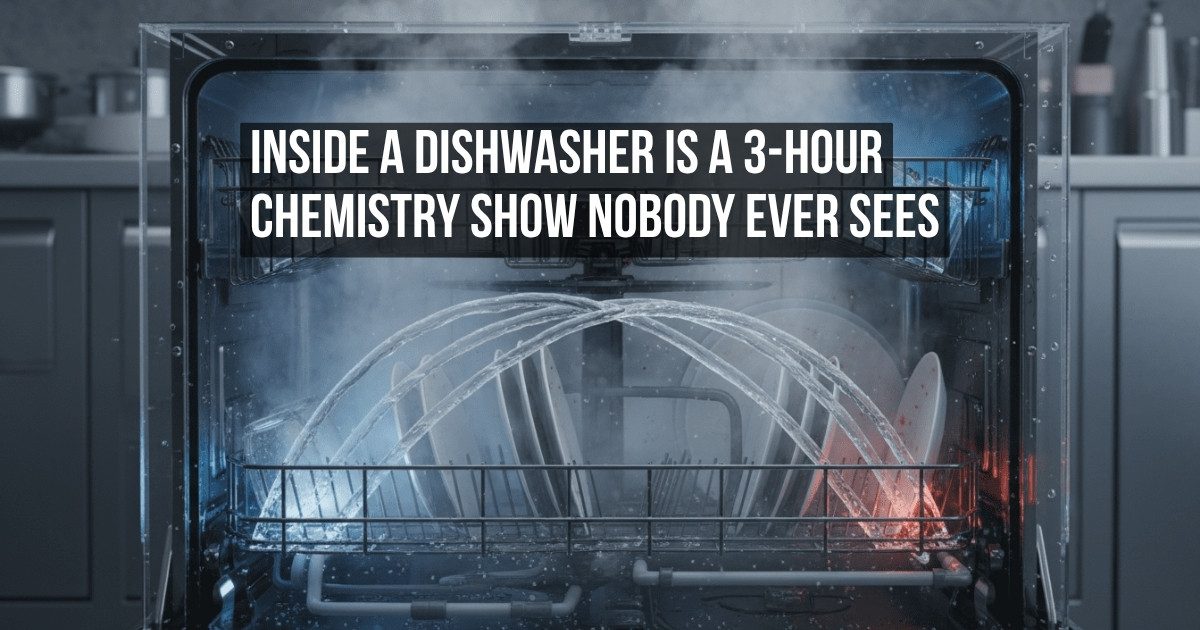
You load the plates, press a button, and walk away. For the next ninety minutes to three hours, a sealed box in your kitchen performs a sequence of operations so precisely engineered that most people never think about it — and virtually nobody has ever watched it happen. The dishwasher is the only major appliance in your home whose entire working process is invisible to you during normal use. What actually goes on inside is considerably more complex, more violent, and more chemically sophisticated than the gentle hum from the other side of the door suggests.
The Pre-Wash: Softening the Battlefield
Most modern cycles begin with a cold or lukewarm rinse lasting five to ten minutes. No detergent is released at this stage. The purpose is purely mechanical: jets of water at moderate pressure dislodge the loosest food particles and flush them toward the filter at the base of the tub. The machine is surveying the damage before committing resources.
This is also when the machine fills with water — and the volume is surprisingly small. A modern dishwasher uses between 6 and 12 litres of water for the entire cycle, compared to the 40 to 60 litres an average person uses when washing the same load by hand. The water enters through a solenoid valve at the back, collects in a sump at the bottom, and is pumped upward through the spray arms. The machine doesn’t fill like a bath. It recirculates a thin layer of water at high velocity, using the same liquid multiple times.
The Main Wash: Chemistry Meets Force
When the main wash phase begins, the detergent dispenser door pops open — released by a timed solenoid mechanism or, in newer models, a wax motor that melts at a specific temperature. The detergent enters water that has been heated to between 50 and 65 degrees Celsius, depending on the cycle selected. At this temperature, the water itself becomes an active cleaning agent, breaking down fats and softening proteins far more effectively than cold water can.
The detergent performs multiple simultaneous functions. Surfactants reduce water surface tension, allowing the liquid to sheet across glass and ceramic rather than beading. Enzymes — proteases for protein-based residues, amylases for starch — break organic matter into water-soluble fragments. Builders soften hard water by sequestering calcium and magnesium ions that would otherwise leave white deposits. Bleaching agents, typically oxygen-based in modern formulations, attack tea stains, tomato residue, and other coloured compounds that surfactants alone cannot remove.
All of this is delivered at pressure. The spray arms — typically one lower, one upper, and sometimes a third at the ceiling of the tub — spin at speeds between 30 and 70 revolutions per minute, propelled by the reactive force of water exiting angled nozzles. The jets hit plates and glasses at velocities that, while insufficient to damage most crockery, are forceful enough to strip baked-on residues that soaking alone wouldn’t budge for hours.
The Filter Nobody Cleans
At the bottom of the tub sits the component most dishwasher owners forget exists: the filter assembly. Every particle of food dislodged during the wash has to go somewhere, and the filter prevents it from recirculating onto clean surfaces. Older machines used self-cleaning grinders — essentially garbage disposals — that pulverised food particles small enough to flush down the drain. Modern machines, designed for quieter operation, replaced grinders with manual mesh filters that require periodic cleaning by the user.
Most users never clean them. A survey by appliance manufacturer Bosch found that a significant proportion of dishwasher owners were unaware their machine had a removable filter. The consequence: a filter clogged with decomposing food residue, which reduces cleaning efficiency, generates odours, and creates a breeding ground for bacteria that the hot wash is supposed to eliminate. The machine designed to sanitise your dishes can, through neglect, become the least hygienic surface in the kitchen.
The Rinse: Where Shine Is Made
After the main wash drains, fresh water enters for the rinse phase — typically two rinse cycles, each using clean water heated to 65 to 75 degrees. The final rinse is the hottest phase of the entire cycle and serves a dual purpose: removing residual detergent and sanitising the load through thermal exposure. Water above 70 degrees for sufficient duration kills the vast majority of common foodborne bacteria.
Rinse aid, dispensed from a separate reservoir during the final rinse, is not a cleaning product. It is a drying agent. By reducing water surface tension even further than the detergent did, rinse aid causes water to sheet off surfaces in thin films rather than forming droplets. Droplets, left to evaporate, leave mineral spots. Sheeting water carries minerals away with it. The difference between a glass that emerges spotless and one covered in white dots is not the quality of the wash. It’s the presence of five millilitres of rinse aid in the final minutes.
The Drying Phase: Heat, Time, and Condensation
Most dishwashers in Europe use condensation drying. The stainless-steel walls of the tub cool faster than the dishes inside, creating a temperature differential that draws moisture off the hot surfaces and condenses it against the cooler walls, where it drains away. No fan. No heating element. Just physics. This is why opening a dishwasher immediately after the cycle ends releases a blast of steam and leaves everything wet — the condensation process needs time and a temperature gradient to work.
Plastic items dry poorly in condensation systems because plastic does not retain heat as efficiently as ceramic or glass. The temperature differential is too small to drive moisture off the surface. Your Tupperware isn’t defective. The drying method simply wasn’t designed for it.
An Engineering Marvel Nobody Appreciates
Behind the door you close and forget, a machine coordinates hydraulic pressure, thermal management, chemical reactions, mechanical rotation, and gravity-based filtration in a choreographed sequence that lasts up to three hours and uses less water than a five-minute shower. The dishwasher is arguably the most sophisticated appliance in the average home — more chemically complex than a washing machine, more thermally demanding than an oven, and more hydraulically intricate than a central heating system. And the only attention most of us give it is the irritation of emptying it the next morning.
Something went wrong. Please refresh the page and/or try again.
Help us improve your journey
We use cookies to personalize your experience and understand how you use our site. By clicking 'Yes, I'm in!', you help us show you content you'll actually love. If you prefer to keep things simple, you can stick to the essentials. You can change your mind anytime!
Necessary
Always active
The technical storage or access is strictly necessary for the legitimate purpose of enabling the use of a specific service explicitly requested by the subscriber or user, or for the sole purpose of carrying out the transmission of a communication over an electronic communications network.
Preferences
The technical storage or access is necessary for the legitimate purpose of storing preferences that are not requested by the subscriber or user.
Analytics
The technical storage or access that is used exclusively for statistical purposes.The technical storage or access that is used exclusively for anonymous statistical purposes. Without a subpoena, voluntary compliance on the part of your Internet Service Provider, or additional records from a third party, information stored or retrieved for this purpose alone cannot usually be used to identify you.
Advertising
The technical storage or access is required to create user profiles to send advertising, or to track the user on a website or across several websites for similar marketing purposes.




Leave a Reply